Florida Southern College, Lakeland
Updated · 945 residents
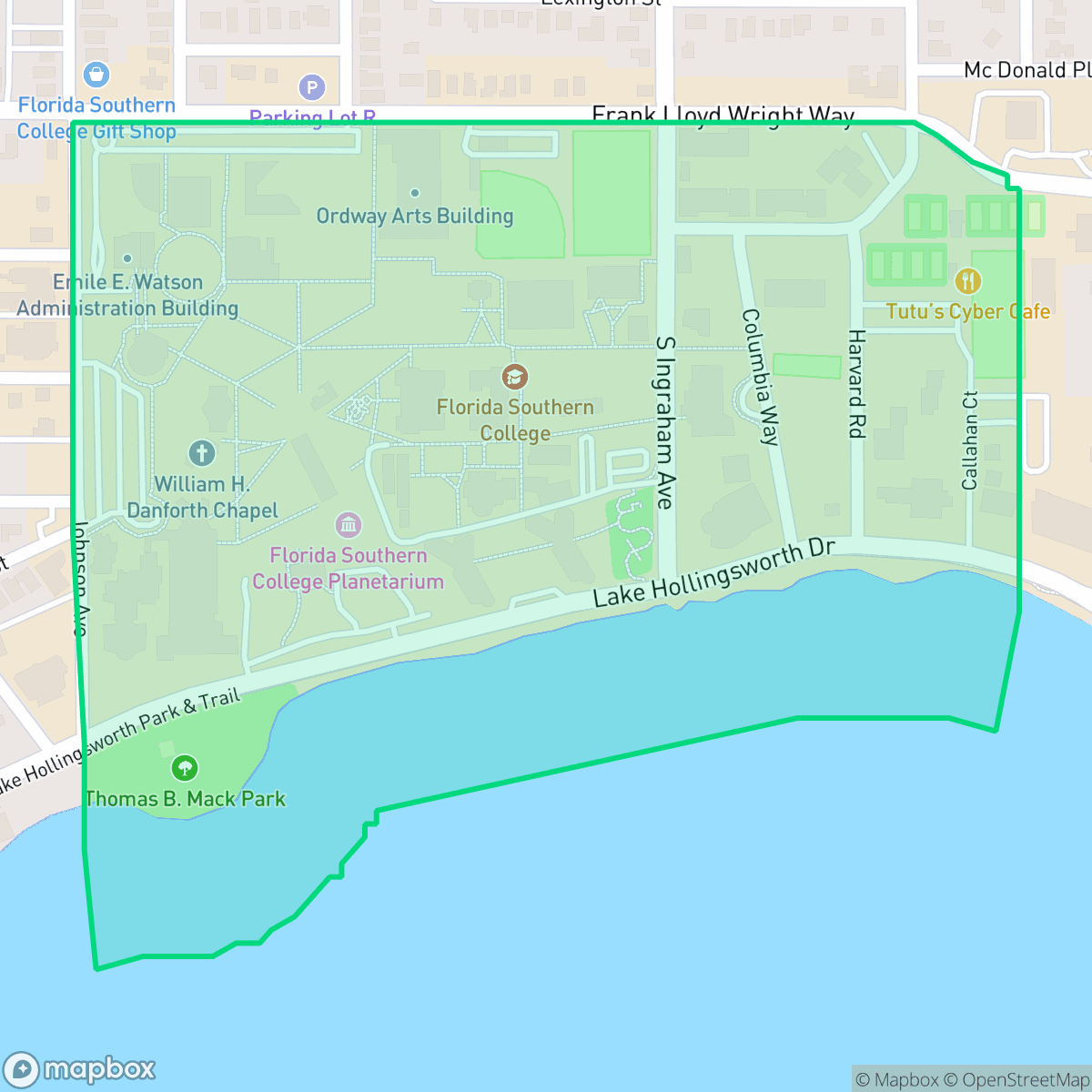
The Florida Southern College neighborhood is defined by its unique collection of Frank Lloyd Wright architecture and a scenic location near Lake Hollingsworth. Residents enjoy a highly walkable environment with exceptionally clean air and a vibrant atmosphere that balances academic energy with quiet, tree-lined residential streets.
Key Highlights
About Florida Southern College
The Florida Southern College neighborhood in Lakeland, Florida, is defined by the college's historic campus, which occupies land originally purchased as a defunct citrus grove in 1921. The neighborhood's character is anchored by the college's status as a National Historic Landmark, featuring the world's largest single-site collection of Frank Lloyd Wright architecture. Commissioned in 1938 by President Ludd M. Spivey to create a 'temple of education,' the campus includes 13 structures designed by Wright, such as the Annie Pfeiffer Chapel and the Water Dome. These buildings, known as the 'Child of the Sun' collection, represent a significant architectural period of organic design that integrates the structures into the Florida landscape. The surrounding area has evolved into a residential and academic enclave, maintaining a distinct identity tied to the college's mid-century architectural legacy and its lakeside setting near Lake Hollingsworth.
The Florida Southern College neighborhood serves as a distinct academic and residential enclave where the presence of a National Historic Landmark fosters a unique aesthetic. The area is characterized by a well-maintained landscape and a high density of large, private homes, which contributes to a visually pleasing environment. Because of its grid-based layout and proximity to the lake, the neighborhood offers high walkability that encourages residents to explore local coffee shops and parks on foot. According to iHuus data, this setting provides a significantly more vibrant atmosphere than other parts of the city while maintaining a peaceful residential character. For prospective residents, the area offers a balance of suburban comfort and institutional stability, supported by high levels of health insurance coverage among the local population. While the neighborhood is generally quiet, residents may notice moderate traffic noise from nearby busy streets. The community is well-suited for those who value architectural significance, outdoor accessibility, and a stable, conservative-leaning environment. Families should note that while the Polk County School District provides access to high-performing magnet and charter programs, placement often depends on navigating a competitive school choice process rather than simple geographic zoning.
Neighborhood Scores Across 15 Qualities
Residential spacing provides a moderate level of separation between homes, offering more distance from neighbors than the Lakeland average. Mature trees and standard suburban setbacks create a balanced environment with some buffers between structures.
A structured grid system and a central lakeside loop provide consistent sidewalks and pedestrian priority zones. This level of accessibility is significantly higher than the average for Lakeland.
Upscale amenities, private pools, and manicured campus facilities contribute to an aesthetic that is significantly more visually pleasing than the Lakeland average. According to iHuus data, the area features a high density of large homes and well-kept grounds.
Abundant green spaces, tree-lined streets, and accessible lakefront paths provide ample walking areas for pets. According to iHuus data, these features make the area significantly more dog-friendly than much of Lakeland.
Transitioning between commercial blocks and single-family residential grids, this area features a significant tree canopy and institutional landscapes. The landscape density remains consistent with the broader Lakeland average.
A steady mix of university activity and local dining options creates a much more vibrant atmosphere than the city average. Residents can find frequent activity near local coffee shops, parks, and entertainment venues within this walkable suburban area.
Steady sounds from nearby busy streets are noticeable, though the area remains significantly quieter than the Lakeland average according to iHuus data.
Air quality remains consistently high with minimal pollutants, significantly exceeding the Lakeland average according to iHuus data.
Primarily residential and institutional in character, this area lacks heavy industry and stays significantly clearer of industrial zones than the Lakeland average. Residents may encounter occasional light commercial activity such as gas stations or printing services, but large-scale manufacturing is absent.
Health insurance enrollment among residents is exceptionally high, significantly surpassing the Lakeland city average according to iHuus data.
Conservative-leaning residents form the majority in this area, representing a more conservative political tilt than the average Lakeland neighborhood according to iHuus data.
A balanced mix of young adults, families, and older residents defines the area. This demographic spread is slightly more varied than the typical age distribution found throughout Lakeland.
Residual flood risks exist within this area due to its location in a 500-year floodplain, though safety levels remain notably higher than the Lakeland average according to iHuus data.
Address-Level Insights for Florida Southern College


iHuus Neighborhood Intelligence Insights
Get address-level neighborhood insights for Florida Southern College
- Street-level scores — see how individual blocks compare, not just neighborhood averages
- Micro-zone boundaries — identify quiet pockets, flood boundaries, and walkable clusters before you visit
- 15 dimensions in full — walkability, noise, air quality, school quality, insurance coverage, population age profile, urban/rural index, and more
- Boundary risk alerts — know if your address sits near a block boundary where scores drop, the kind of detail no listing will ever mention
- School insights — individual school ratings and insights, not just district-level data
- Compare before you commit — side-by-side data across neighborhoods, down to block precision
No credit card required
Compare with Any Neighborhood
| Dimension | Florida Southern College | Beacon Hill |
|---|---|---|
| 🚶 Walkabilityavg 5.03 | ||
| 🔊 Acoustic Comfortavg 3.5 | ||
| 🤫 Privacy Indexavg 5.3 | ||
| 🎨 Visual Appealavg 5.07 | ||
| 🐕 Dog Friendlinessavg 5.42 | ||
| 🗺️ Urban-Rural Indexavg 6.53 | ||
| ✨ Neighborhood Vibeavg 2.18 | ||
| 🏥 Health Insurance Coverageavg 5.4 | ||
| 🌿 Air Qualityavg 7.09 | ||
| 🏭 Industrial Proximityavg 5.58 | ||
| 🌊 Flood Safetyavg 5.2 | ||
| 🗳️ Ideological Leanavg 2.17 | ||
| 👥 Population Age Profileavg 4.38 | ||
| 🔥 Fire Safety | ||
| 🏫 School Quality |
Florida Southern College Rankings
School Districts Serving Florida Southern College
School Insights for Florida Southern College
Below average outcomes; significant attendance and academic challenges.
School Insights
See what's really behind every school rating near Florida Southern College
- Individual school ratings — each school's own score with outcome context, not just a district average
- Enrollment & class size data — student-to-teacher ratio and how it compares to the state average
- Full demographics breakdown — ethnicity and gender composition for every school in the enrollment zone
- Every school in the district — all schools within the enrollment boundary ranked by rating, not just the closest one
- Grade levels & benchmarks — elementary through high school, with below/above state-average flags
No credit card required