Downtown, Lakeland
Updated · 1,250 residents
Downtown Lakeland serves as a vibrant cultural hub defined by its historic architecture and exceptional walkability. Residents enjoy a diverse social atmosphere with extensive access to lakefront paths and clean air, making it a unique destination for those seeking an active, pedestrian-friendly lifestyle.
Key Highlights
About Downtown
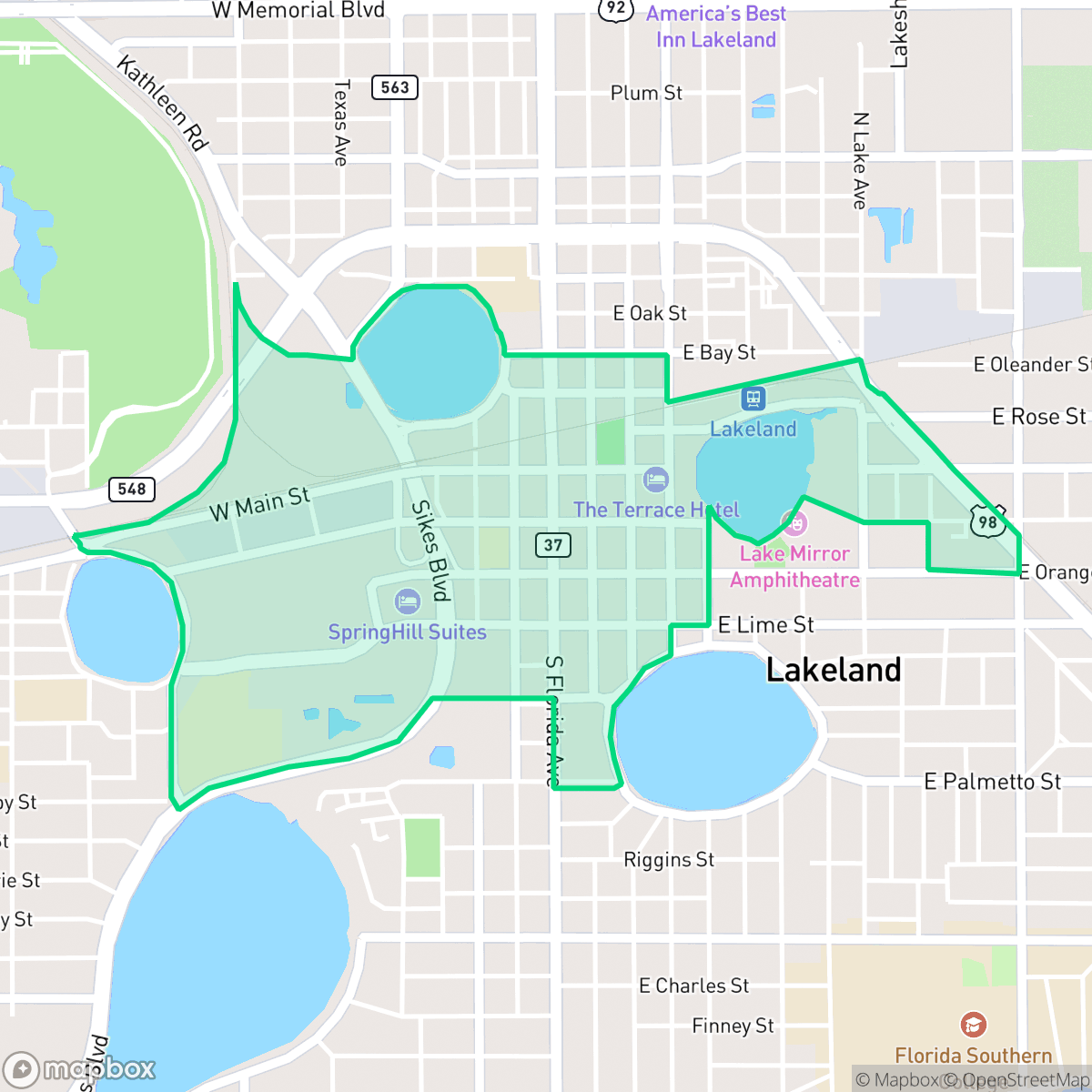
Downtown Lakeland, anchored by the Munn Park Historic District, originated from 80 acres purchased by founder Abraham Munn in 1882. The neighborhood’s character is defined by its 1920s-era architecture, a legacy of the Florida land boom, including the Mediterranean-inspired Polk Theatre and the neoclassical Frances Langford Promenade at Lake Mirror. Designed by Charles Wellford Leavitt as part of the City Beautiful movement, the promenade serves as a landmark civic space. While early growth was driven by the railroad and citrus industry, the downtown area underwent significant revitalization in the late 20th century to preserve its historic commercial core. Today, the district remains a walkable hub of masonry buildings, public squares, and historic sites that reflect over a century of development, serving as the cultural and commercial heart of the city.
The neighborhood functions as the energetic center of the city, characterized by a lively mix of dining, theaters, and local landmarks that draw residents and visitors alike. According to iHuus data, the area maintains a balanced demographic profile, attracting a blend of young professionals, families, and seniors. Despite its urban density, the district retains a semi-rural feel through the integration of open land, scattered greenery, and expansive water bodies. The political landscape is notably diverse, reflecting a wide range of perspectives that contribute to a balanced community environment.
Living in this area involves balancing the benefits of high walkability and excellent air quality against moderate street noise and occasional operational sounds from nearby commercial corridors. While the visual landscape is composed of modest, tidy residential and civic buildings, prospective residents should be aware of a moderate flood risk and the need to navigate the broader district's competitive school choice lottery to access top-tier educational programs. The neighborhood is particularly well-suited for those who prioritize a walkable, pet-friendly lifestyle and proximity to the city's primary cultural venues.
Neighborhood Scores Across 15 Qualities
Residential spacing varies between dense multi-family units and detached homes with moderate buffers. According to iHuus data, this level of separation is higher than the Lakeland city average.
Pedestrian access is excellent due to a dense grid of sidewalks and dedicated lakefront paths. This area offers much greater walkability than the typical Lakeland neighborhood, with safe crossings and continuous loops for walking.
Standard residential lots, apartment complexes, and civic buildings create a functional landscape that appears more visually varied than the Lakeland average. According to iHuus data, the area features tidy yards and modest housing without significant luxury estates or large private lot sizes.
Extensive lakefront trails and connected green spaces around Mirror Lake and Lake Morton provide much safer, more accessible walking routes for pets than the typical Lakeland neighborhood. These areas offer abundant grassy paths and perimeter loops that are largely separated from heavy traffic.
Frequent open land and scattered greenery provide a slightly more semi-rural atmosphere than the typical Lakeland urban environment. This area features a mix of low-rise commercial blocks and residential pockets interspersed with large water bodies and woodland.
Active street life and a dense concentration of dining, theaters, and local landmarks create a much more energetic atmosphere than the city average. This area features frequent pedestrian activity driven by nearby colleges, cultural venues, and a diverse mix of eateries.
Steady traffic sounds from nearby thoroughfares are present, though the level of acoustic activity remains slightly higher than the Lakeland average.
Air quality remains consistently high with minimal pollutants, significantly surpassing the average levels found throughout Lakeland according to iHuus data.
Light industrial and commercial activities, such as breweries and printing services, exist alongside residential areas, creating a landscape slightly more industrial than the Lakeland average. Residents should be aware of occasional utility odors and low-level operational noise from nearby transit corridors and rail lines.
Health insurance accessibility is slightly lower than the Lakeland average, according to iHuus data. This indicates a moderate level of coverage among the local population.
Political perspectives are distributed relatively evenly across the area, representing a much more balanced ideological split than the heavily conservative leaning seen in the rest of Lakeland.
Residents experience a more balanced age distribution than much of the city, featuring an even spread of young professionals, families, and seniors according to iHuus data.
Some residual flood risk exists due to being located within a 500-year floodplain, though safety levels are notably higher than the Lakeland average according to iHuus data.
Address-Level Insights for Downtown


iHuus Neighborhood Intelligence Insights
Get address-level neighborhood insights for Downtown
- Street-level scores — see how individual blocks compare, not just neighborhood averages
- Micro-zone boundaries — identify quiet pockets, flood boundaries, and walkable clusters before you visit
- 15 dimensions in full — walkability, noise, air quality, school quality, insurance coverage, population age profile, urban/rural index, and more
- Boundary risk alerts — know if your address sits near a block boundary where scores drop, the kind of detail no listing will ever mention
- School insights — individual school ratings and insights, not just district-level data
- Compare before you commit — side-by-side data across neighborhoods, down to block precision
No credit card required
Compare with Any Neighborhood
| Dimension | Downtown | Beacon Hill |
|---|---|---|
| 🚶 Walkabilityavg 5.03 | ||
| 🔊 Acoustic Comfortavg 3.5 | ||
| 🤫 Privacy Indexavg 5.3 | ||
| 🎨 Visual Appealavg 5.07 | ||
| 🐕 Dog Friendlinessavg 5.42 | ||
| 🗺️ Urban-Rural Indexavg 6.53 | ||
| ✨ Neighborhood Vibeavg 2.18 | ||
| 🏥 Health Insurance Coverageavg 5.4 | ||
| 🌿 Air Qualityavg 7.09 | ||
| 🏭 Industrial Proximityavg 5.58 | ||
| 🌊 Flood Safetyavg 5.2 | ||
| 🗳️ Ideological Leanavg 2.17 | ||
| 👥 Population Age Profileavg 4.38 | ||
| 🔥 Fire Safety | ||
| 🏫 School Quality |
Downtown Rankings
School Districts Serving Downtown
School Insights for Downtown
Below average outcomes; significant attendance and academic challenges.
School Insights
See what's really behind every school rating near Downtown
- Individual school ratings — each school's own score with outcome context, not just a district average
- Enrollment & class size data — student-to-teacher ratio and how it compares to the state average
- Full demographics breakdown — ethnicity and gender composition for every school in the enrollment zone
- Every school in the district — all schools within the enrollment boundary ranked by rating, not just the closest one
- Grade levels & benchmarks — elementary through high school, with below/above state-average flags
No credit card required