Crystal Lake, Lakeland
Updated · 5,459 residents
Crystal Lake is a semi-rural enclave defined by its central lake and established mid-century aesthetic. Residents enjoy better-than-average walkability and access to local services, though the area experiences frequent noise from nearby transit corridors.
Key Highlights
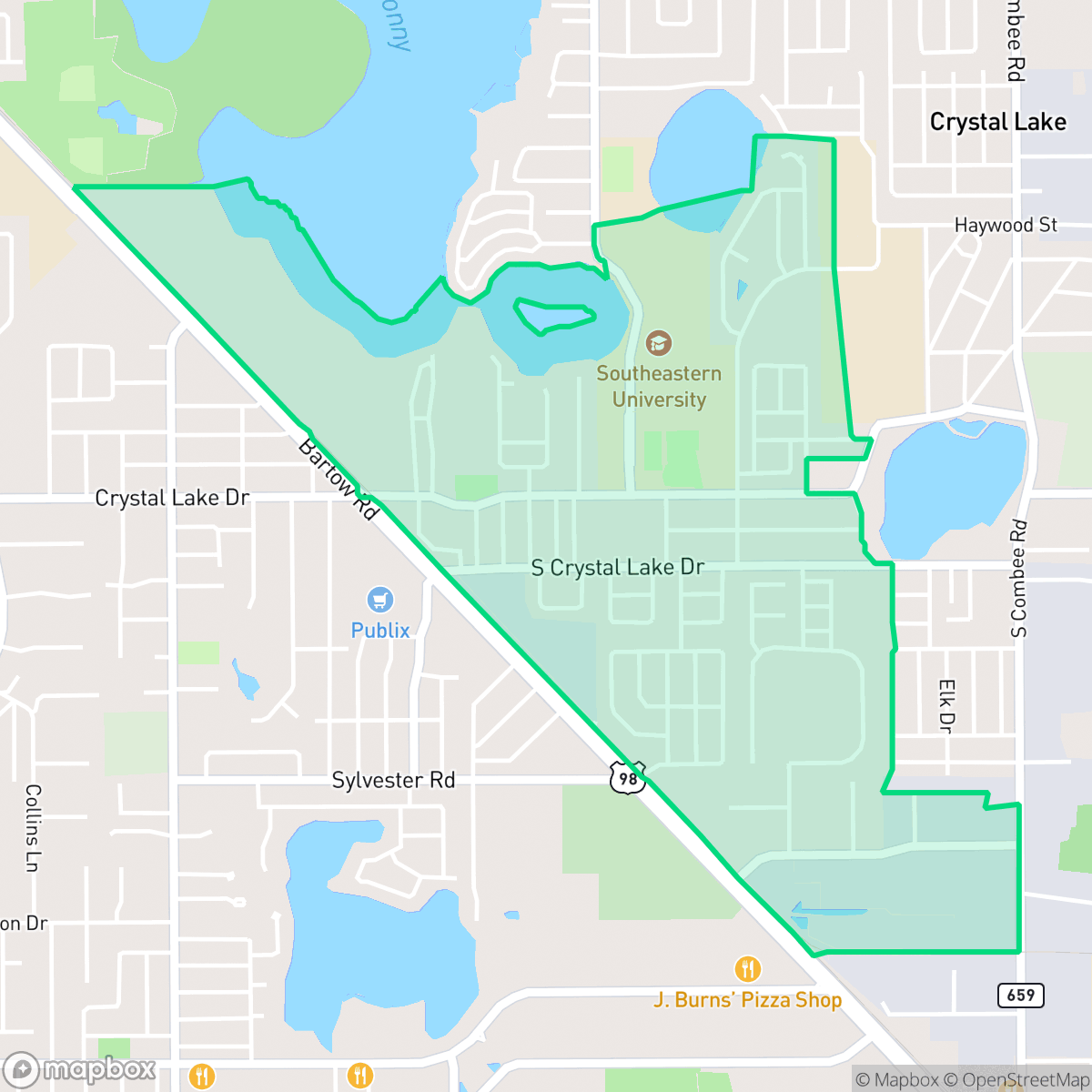
About Crystal Lake
The Crystal Lake neighborhood in Lakeland, Florida, traces its origins to the region's early agricultural history, characterized by citrus groves and small-scale farming. Named for the 27-acre natural freshwater lake at its center, the area transitioned into a residential community during the mid-20th century. Today, it is recognized for its mid-century ranch-style homes and suburban character. The lake remains the neighborhood’s primary landmark, with Crystal Lake Park providing public access for fishing and recreation. Situated in southeastern Lakeland near Southeastern University, the neighborhood maintains a quiet, water-centric identity that balances its 'Old Florida' roots with its evolution into an established, family-oriented residential enclave.
The neighborhood features a distinct visual appeal characterized by well-maintained landscapes and private pools that elevate the standard tract housing. Its semi-rural character is reinforced by open wooded areas and green verges, providing a more spacious environment than the dense urban core of Lakeland. The area maintains a steady rhythm of activity, with local dining and essential services benefiting from its proximity to nearby academic hubs.
Potential residents should weigh these benefits against the high noise levels generated by regional traffic and transit routes. While the sidewalk network supports pedestrian movement, connectivity is periodically interrupted by heavy logistics traffic on the neighborhood edges. Families will find themselves within the Polk County School District, where access to high-performing magnet and charter schools often requires participation in a competitive choice lottery. The area also carries a moderate risk of flooding and maintains a predominantly conservative political environment.
Neighborhood Scores Across 15 Qualities
Residential spacing varies across the area, offering more separation between neighbors than the typical Lakeland density. While some sections feature closely positioned homes and multi-family units, other pockets provide greater buffers through larger residential lots.
Pedestrian accessibility is above the Lakeland average due to a consistent sidewalk network in many residential zones. However, safety and connectivity are occasionally interrupted by high-traffic arterials and industrial truck routes.
Residential streetscapes feature more manicured lawns and private pools than the typical Lakeland area. While many sections consist of standard tract housing, certain pockets offer a more affluent aesthetic with well-maintained landscapes.
Abundant green verges, lakeside parks, and proximity to large athletic fields provide more accessible walking space for pets than the Lakeland average. While dedicated off-leash areas are limited, the presence of connected grass buffers and forested lakefronts supports regular exercise.
Open land and wooded areas are frequently interspersed with residential pockets, creating a setting slightly more rural than the typical Lakeland landscape. This mix of greenery and scattered homes provides a more open environment compared to the denser urban core of the city.
A steady rhythm of local cafes, restaurants, and essential services provides much more activity than the typical Lakeland neighborhood. While some pockets are quiet and residential, other areas offer a lively mix of dining and retail near nearby campus hubs.
Frequent disturbances from nearby heavy traffic and transit routes are common here. According to iHuus data, acoustic comfort in this area is consistent with the average levels found across Lakeland.
Air quality in Crystal Lake is consistently high with minimal pollutants. According to iHuus data, the air remains significantly cleaner than the Lakeland average.
Industrial activity is significantly lower than the Lakeland average, with most areas consisting of residential streets and green spaces. While some edges of the neighborhood feature warehouses and logistics hubs that may increase truck traffic, heavy industry is largely absent from the area.
Health insurance enrollment levels in Crystal Lake are higher than the average found across Lakeland. According to iHuus data, a significant portion of the population maintains coverage, though gaps in access remain present.
Political leanings in this area are primarily conservative, leaning more so than the average for Lakeland according to iHuus data.
Residents live alongside a balanced mix of young adults, families, and seniors. This demographic spread is largely consistent with the broader Lakeland area according to iHuus data.
Flood risk in this area is slightly higher than the Lakeland average, though a detailed FEMA study for this specific zone is currently unavailable.
Address-Level Insights for Crystal Lake


iHuus Neighborhood Intelligence Insights
Get address-level neighborhood insights for Crystal Lake
- Street-level scores — see how individual blocks compare, not just neighborhood averages
- Micro-zone boundaries — identify quiet pockets, flood boundaries, and walkable clusters before you visit
- 15 dimensions in full — walkability, noise, air quality, school quality, insurance coverage, population age profile, urban/rural index, and more
- Boundary risk alerts — know if your address sits near a block boundary where scores drop, the kind of detail no listing will ever mention
- School insights — individual school ratings and insights, not just district-level data
- Compare before you commit — side-by-side data across neighborhoods, down to block precision
No credit card required
Compare with Any Neighborhood
| Dimension | Crystal Lake | Beacon Hill |
|---|---|---|
| 🚶 Walkabilityavg 5.03 | ||
| 🔊 Acoustic Comfortavg 3.5 | ||
| 🤫 Privacy Indexavg 5.3 | ||
| 🎨 Visual Appealavg 5.07 | ||
| 🐕 Dog Friendlinessavg 5.42 | ||
| 🗺️ Urban-Rural Indexavg 6.53 | ||
| ✨ Neighborhood Vibeavg 2.18 | ||
| 🏥 Health Insurance Coverageavg 5.4 | ||
| 🌿 Air Qualityavg 7.09 | ||
| 🏭 Industrial Proximityavg 5.58 | ||
| 🌊 Flood Safetyavg 5.2 | ||
| 🗳️ Ideological Leanavg 2.17 | ||
| 👥 Population Age Profileavg 4.38 | ||
| 🔥 Fire Safety | ||
| 🏫 School Quality |
Crystal Lake Rankings
School Districts Serving Crystal Lake
School Insights for Crystal Lake
Below average outcomes; significant attendance and academic challenges.
School Insights
See what's really behind every school rating near Crystal Lake
- Individual school ratings — each school's own score with outcome context, not just a district average
- Enrollment & class size data — student-to-teacher ratio and how it compares to the state average
- Full demographics breakdown — ethnicity and gender composition for every school in the enrollment zone
- Every school in the district — all schools within the enrollment boundary ranked by rating, not just the closest one
- Grade levels & benchmarks — elementary through high school, with below/above state-average flags
No credit card required