Cleveland Heights, Lakeland
Updated · 1,912 residents
Cleveland Heights is an upscale suburban community defined by its historic municipal golf course and spacious residential lots. Residents enjoy clean air and proximity to diverse local dining and retail, though the area experiences notable noise from nearby transit corridors.
Key Highlights
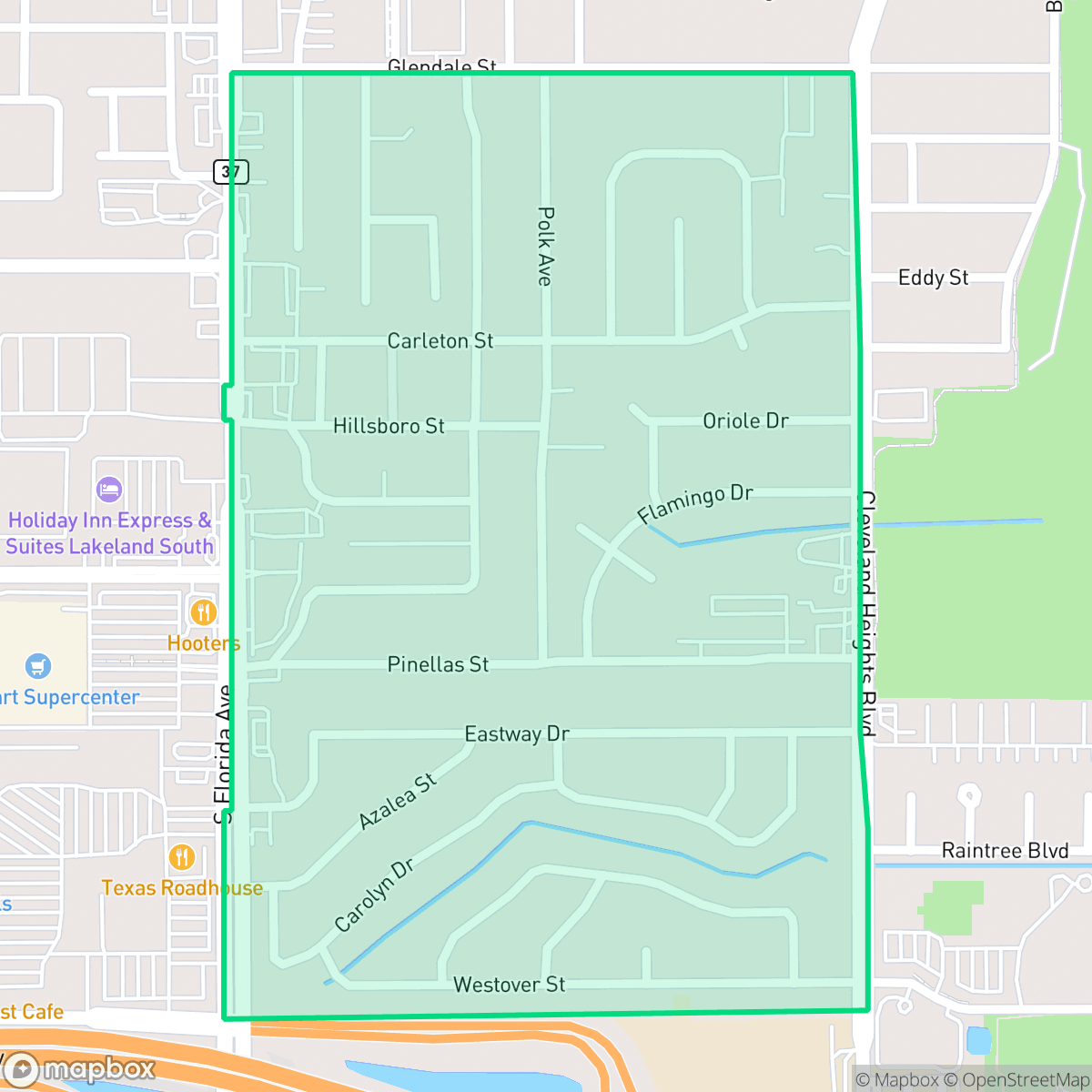
About Cleveland Heights
Cleveland Heights in Lakeland, Florida, originated in 1924 when real estate developer H.A. Stahl purchased 560 acres south of Lake Hollingsworth to create an exclusive residential and recreational community named after his hometown of Cleveland, Ohio. The neighborhood's defining landmark, the Cleveland Heights Golf Course, opened in 1925 and was designed by noted architects Howard Toomey and William Flynn. Initially a private development, the project faced financial challenges during the Great Depression, leading the City of Lakeland to acquire the property in 1932. Today, the municipal golf course remains a historic centerpiece of the area, having expanded to 27 holes and serving as a long-standing hub for local recreation and golf culture.
The neighborhood maintains a distinct semi-rural character, characterized by open land, woodland, and a visual landscape of large homes with private pools. It functions as an active suburban hub where residents have convenient access to fitness centers, essential services, and a variety of restaurants. The community attracts a diverse demographic, ranging from young adults to families and seniors, all of whom benefit from the polished aesthetic and the generous spacing between properties provided by the surrounding green space. While the area offers a quiet atmosphere on residential streets, it is important to note that persistent noise from transit routes and flight paths can be a factor for those sensitive to acoustic disturbances. Pedestrians will find calm conditions for walking on local streets, but the lack of widespread sidewalks along major arterials creates some limitations for those who prefer to travel without a vehicle. Families in the area are served by the Polk County School District, which offers a range of options including traditional neighborhood schools and competitive magnet programs. Prospective residents should consider that while the neighborhood provides a high quality of life and excellent air quality, navigating the local school choice lottery is often necessary to access the district's top-tier educational pathways.
Neighborhood Scores Across 15 Qualities
Housing density fluctuates between compact apartments and detached homes with moderate buffers. According to iHuus data, the level of separation between neighbors is slightly higher than the Lakeland average due to nearby green spaces like the golf course.
Residential streets offer calm walking conditions, though major arterials and a lack of widespread sidewalks create barriers for pedestrians. According to iHuus data, the area provides better walkability than much of Lakeland.
Large homes and frequent upscale amenities contribute to a visual landscape that is notably more polished than the Lakeland average. According to iHuus data, residents will find spacious driveways and private pools interspersed with standard suburban housing.
Access to large parks and nearby golf course green spaces makes this area more dog friendly than the Lakeland average. While residential sidewalks are present, they occasionally lack wide verges or direct connections away from busier roads.
Frequent open land and scattered homes amidst fields or woodland characterize this area. According to iHuus data, the landscape is more rural than most parts of Lakeland.
Local dining and retail strips provide significantly more activity than the Lakeland average. Residents can access various fitness centers, diverse restaurants, and essential services within concentrated pockets of the neighborhood.
Persistent acoustic disturbances from nearby transit corridors and flight paths make this area noisier than the Lakeland average, according to iHuus data.
Air quality remains consistently high with minimal pollutants, significantly surpassing the Lakeland average according to iHuus data.
Industrial activity is significantly lower than the Lakeland average, consisting mostly of residential streets and light commercial areas. While some sections near central corridors experience heavier traffic from storage facilities and retail loading docks, there is no heavy industrial presence in the neighborhood.
Health insurance coverage among residents in this area is moderate and stays roughly in line with the average seen across Lakeland.
Conservative views represent the majority of the community, though a modest opposing presence exists. This political leaning is slightly more pronounced than in the rest of Lakeland.
Residents live alongside a balanced mix of young adults, families, and seniors. This demographic variety in Cleveland Heights is slightly more diverse than the Lakeland average, according to iHuus data.
Residual flood risks exist due to being within a fifty-year floodplain; however, safety levels are notably higher than the Lakeland average according to iHuus data.
Address-Level Insights for Cleveland Heights


iHuus Neighborhood Intelligence Insights
Get address-level neighborhood insights for Cleveland Heights
- Street-level scores — see how individual blocks compare, not just neighborhood averages
- Micro-zone boundaries — identify quiet pockets, flood boundaries, and walkable clusters before you visit
- 15 dimensions in full — walkability, noise, air quality, school quality, insurance coverage, population age profile, urban/rural index, and more
- Boundary risk alerts — know if your address sits near a block boundary where scores drop, the kind of detail no listing will ever mention
- School insights — individual school ratings and insights, not just district-level data
- Compare before you commit — side-by-side data across neighborhoods, down to block precision
No credit card required
Compare with Any Neighborhood
| Dimension | Cleveland Heights | Beacon Hill |
|---|---|---|
| 🚶 Walkabilityavg 5.03 | ||
| 🔊 Acoustic Comfortavg 3.5 | ||
| 🤫 Privacy Indexavg 5.3 | ||
| 🎨 Visual Appealavg 5.07 | ||
| 🐕 Dog Friendlinessavg 5.42 | ||
| 🗺️ Urban-Rural Indexavg 6.53 | ||
| ✨ Neighborhood Vibeavg 2.18 | ||
| 🏥 Health Insurance Coverageavg 5.4 | ||
| 🌿 Air Qualityavg 7.09 | ||
| 🏭 Industrial Proximityavg 5.58 | ||
| 🌊 Flood Safetyavg 5.2 | ||
| 🗳️ Ideological Leanavg 2.17 | ||
| 👥 Population Age Profileavg 4.38 | ||
| 🔥 Fire Safety | ||
| 🏫 School Quality |
Cleveland Heights Rankings
School Districts Serving Cleveland Heights
School Insights for Cleveland Heights
Below average outcomes; significant attendance and academic challenges.
School Insights
See what's really behind every school rating near Cleveland Heights
- Individual school ratings — each school's own score with outcome context, not just a district average
- Enrollment & class size data — student-to-teacher ratio and how it compares to the state average
- Full demographics breakdown — ethnicity and gender composition for every school in the enrollment zone
- Every school in the district — all schools within the enrollment boundary ranked by rating, not just the closest one
- Grade levels & benchmarks — elementary through high school, with below/above state-average flags
No credit card required