Beacon Hill, Lakeland
Updated · 472 residents
Beacon Hill is a historic enclave defined by its diverse architectural styles and grid-based street network. It offers a highly walkable environment with exceptionally clean air and a quiet, upscale suburban atmosphere that appeals to a wide range of residents.
Key Highlights
About Beacon Hill
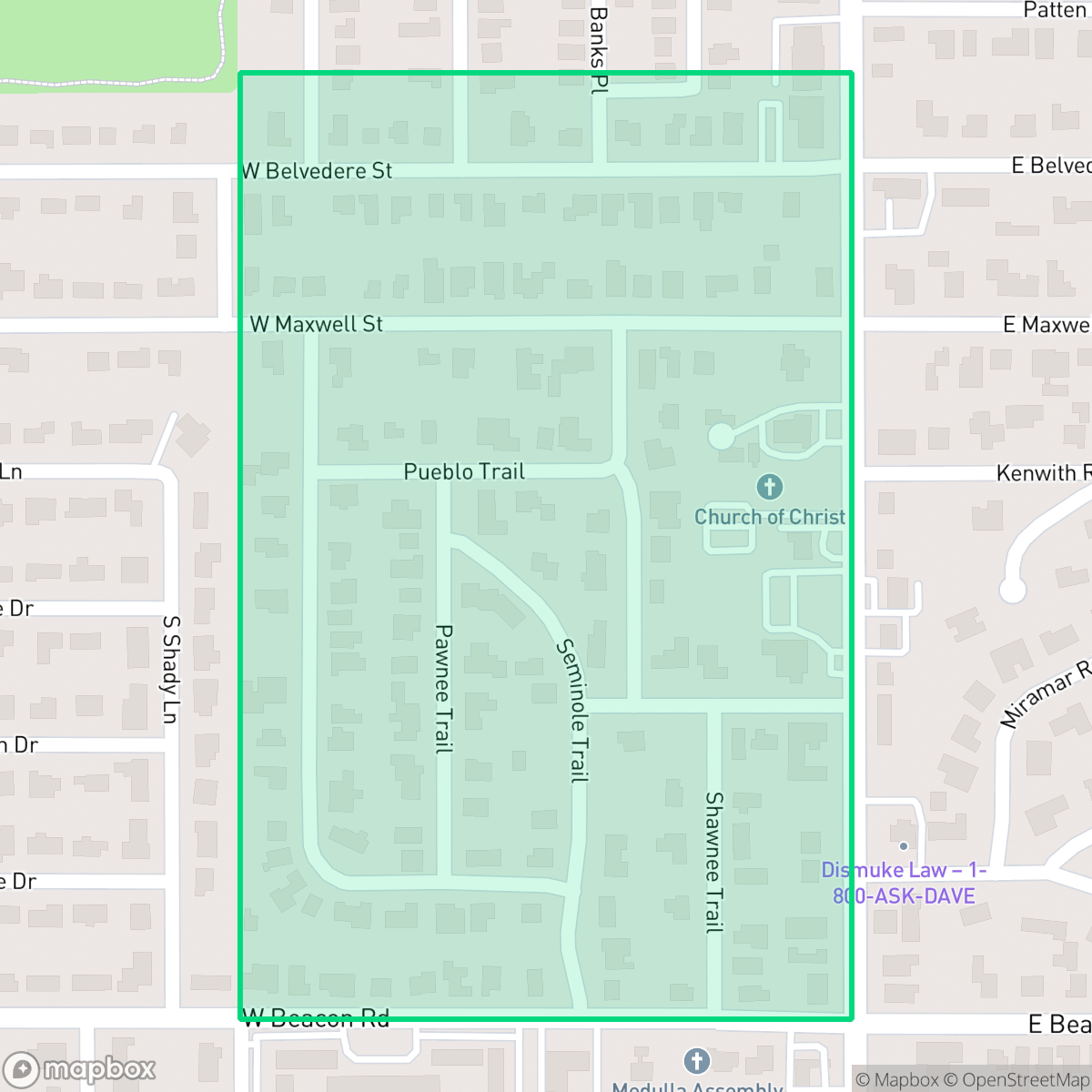
The Beacon Hill neighborhood in Lakeland, Florida, was platted in 1924 during the Florida Land Boom by developers Malcolm G. Waring, Alpheus M. Davis, and George Coogle. Likely named after Boston’s historic district, the area is characterized by streets named for Native American tribes, including Cherokee, Comanche, Hiawatha, Pawnee, Pueblo, Seminole, and Shawnee Trails. Historically attracting upper-middle-class residents, including mayors and state legislators, the neighborhood features a diverse architectural stock from the 1920s, primarily consisting of bungalow-style homes, Colonial Revival, and Tudor designs. In 1993, the neighborhood, along with the adjacent Alta Vista development, was listed on the National Register of Historic Places as the Beacon Hill-Alta Vista Residential District, preserving its unique character and historical significance as a prominent residential enclave from the city's early expansion period.
The area maintains a semi-rural aesthetic, characterized by open land and wooded patches interspersed with established residential pockets. Residents benefit from a higher level of local activity compared to the city average, with various cafes and wellness services contributing to a vibrant suburban hub. The neighborhood layout is particularly conducive to pedestrian travel, featuring a grid-based street network that makes navigating the area on foot straightforward and safe.
Prospective residents should consider the balance of privacy and community, as the area offers moderate spacing between homes and consistent architectural appeal. While the environment is generally tranquil, there is occasional noise from nearby thoroughfares. According to iHuus data, the community leans conservative, and the neighborhood maintains a balanced age demographic that includes families, seniors, and young adults. Families seeking education will navigate the Polk County School District, which provides access to elite magnet programs alongside traditional zoned schools.
Neighborhood Scores Across 15 Qualities
Homes feature typical suburban spacing with shared fence lines and some tree buffering. According to iHuus data, this level of separation provides more privacy than the average Lakeland neighborhood.
Sidewalks are readily available along main thoroughfares and a grid-based street network makes navigating the area on foot much easier than the typical Lakeland experience. While some residential side streets lack pavement, low traffic volumes maintain a safe environment for pedestrians.
Spacious lots and well-maintained single-family homes with consistent architecture define the area. According to iHuus data, the visual landscape features more frequent upscale amenities and larger residential footprints than the typical Lakeland neighborhood.
Continuous grass verges along sidewalks and nearby access to a public park with open green fields provide ample space for walking dogs. According to iHuus data, these features make the area slightly more accommodating for pet owners than the Lakeland average.
Open land and wooded areas are interspersed with suburban residential pockets, matching the typical character found across Lakeland. This balance of scattered homes and denser development provides a landscape that is neither fully urban nor entirely rural.
Diverse dining options and wellness services provide a level of activity that is notably higher than the Lakeland average. Residents can access various cafes and local eateries within a landscape that balances suburban residential life with energetic pockets of commerce.
Steady sounds from nearby busy streets are present, though levels remain significantly more tranquil than the city average according to iHuus data.
Air quality remains exceptionally clear and poses minimal health concerns for residents. This level of cleanliness is significantly higher than the average found throughout Lakeland, according to iHuus data.
Largely residential in character, this area features more light commercial activity than the typical Lakeland neighborhood. While heavy industry is absent, residents should note the proximity of a nearby Superfund site and occasional traffic from local service businesses like gas stations and breweries.
Health insurance enrollment among residents is notably higher than the Lakeland average, according to iHuus data.
Conservative values represent the majority of the community, reflecting a more conservative political leaning than the Lakeland average according to iHuus data.
Residents live alongside a balanced mix of young adults, families, and seniors. This demographic spread is more varied than the typical age distribution found across Lakeland.
Residual flood risks exist within the area, though safety levels remain notably higher than the Lakeland average according to iHuus data.
Address-Level Insights for Beacon Hill


iHuus Neighborhood Intelligence Insights
Get address-level neighborhood insights for Beacon Hill
- Street-level scores — see how individual blocks compare, not just neighborhood averages
- Micro-zone boundaries — identify quiet pockets, flood boundaries, and walkable clusters before you visit
- 15 dimensions in full — walkability, noise, air quality, school quality, insurance coverage, population age profile, urban/rural index, and more
- Boundary risk alerts — know if your address sits near a block boundary where scores drop, the kind of detail no listing will ever mention
- School insights — individual school ratings and insights, not just district-level data
- Compare before you commit — side-by-side data across neighborhoods, down to block precision
No credit card required
Compare with Any Neighborhood
| Dimension | Beacon Hill | Camphor |
|---|---|---|
| 🚶 Walkabilityavg 5.03 | ||
| 🔊 Acoustic Comfortavg 3.5 | ||
| 🤫 Privacy Indexavg 5.3 | ||
| 🎨 Visual Appealavg 5.07 | ||
| 🐕 Dog Friendlinessavg 5.42 | ||
| 🗺️ Urban-Rural Indexavg 6.53 | ||
| ✨ Neighborhood Vibeavg 2.18 | ||
| 🏥 Health Insurance Coverageavg 5.4 | ||
| 🌿 Air Qualityavg 7.09 | ||
| 🏭 Industrial Proximityavg 5.58 | ||
| 🌊 Flood Safetyavg 5.2 | ||
| 🗳️ Ideological Leanavg 2.17 | ||
| 👥 Population Age Profileavg 4.38 | ||
| 🔥 Fire Safety | ||
| 🏫 School Quality |
Beacon Hill Rankings
School Districts Serving Beacon Hill
School Insights for Beacon Hill
Below average outcomes; significant attendance and academic challenges.
School Insights
See what's really behind every school rating near Beacon Hill
- Individual school ratings — each school's own score with outcome context, not just a district average
- Enrollment & class size data — student-to-teacher ratio and how it compares to the state average
- Full demographics breakdown — ethnicity and gender composition for every school in the enrollment zone
- Every school in the district — all schools within the enrollment boundary ranked by rating, not just the closest one
- Grade levels & benchmarks — elementary through high school, with below/above state-average flags
No credit card required