Washington Park, Hollywood
Updated · 2,373 residents
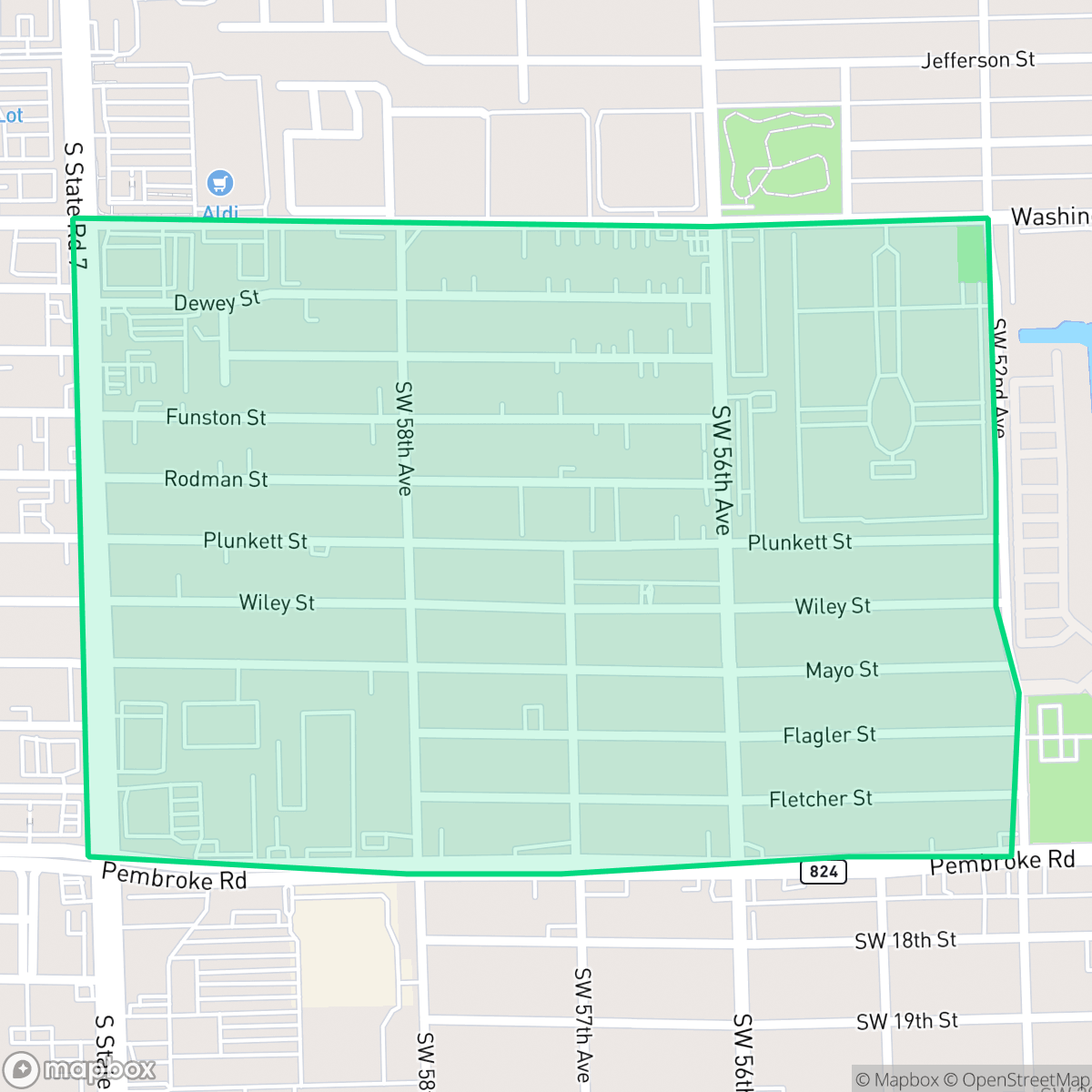
Washington Park is a suburban neighborhood located four miles west of downtown Hollywood, characterized by a functional mix of residential streets and light industrial zones. The area offers a walkable grid for residents, though it experiences consistent noise from nearby transit corridors and flight paths.
Key Highlights
About Washington Park
Washington Park originated as a predominantly Black residential community before being annexed into the City of Hollywood in 1963. Following its annexation, the neighborhood underwent significant rezoning that shifted its land use, leading to a reduction in residential housing and the expansion of industrial and commercial sectors. In response to these changes, the community organized to improve local quality of life, leading to the 1967 formation of the Washington Park Civic Association. This organization played a pivotal role in local revitalization efforts, focusing on community service and public safety. Today, the neighborhood, located approximately four miles west of Downtown Hollywood, retains a distinct identity characterized by its history of grassroots advocacy and its ongoing evolution as a mixed-use area within the city's southern gateway.
The neighborhood maintains a steady suburban rhythm with a diverse age demographic, ranging from young adults to older residents. Its landscape is defined by standard tract housing and multi-family units, which are interspersed with commercial warehouses and logistics hubs. This layout creates a practical, if modest, suburban environment that is supported by a strong foundation of grassroots civic engagement. The community is politically liberal and benefits from a layout that facilitates pedestrian movement across its grid of sidewalks and local crossings.
Prospective residents should consider that public green space is somewhat limited, as much of the area's vegetation is located within private yards. The neighborhood faces moderate flood risks and is subject to auditory disturbances from its proximity to major transportation routes. Educational services are provided by the Broward County School District, which is currently managing significant operational changes and budget adjustments while maintaining a state-designated A-grade. This area is well-suited for those who value a central, walkable suburban location and are comfortable with a landscape that balances residential living with light industrial activity.
Neighborhood Scores Across 15 Qualities
Residential spacing varies between closely packed single-family homes and multi-unit complexes, resulting in a level of privacy that is roughly consistent with the Hollywood average. According to iHuus data, residents may experience limited setbacks between neighboring structures in certain high-density pockets.
Pedestrian movement is facilitated by a dense grid of sidewalks and safe crossings, which is slightly more accessible than the Hollywood average. While major arterials and canals can act as barriers, many residential streets and apartment complexes provide reliable pathways for walking.
Standard tract housing and multi-family units define the area, providing a functional landscape that sits slightly below the Hollywood average for visual variety. Resident views consist mainly of uniform rooftops and small yards, occasionally interspersed with community pools or nearby commercial structures.
Pet owners may find fewer public walking areas than the Hollywood average, as much of the neighborhood's greenery is contained within private yards. While a large central park and some gated community spaces exist, street-level verges for walking are often narrow.
Open spaces and scattered greenery are more prevalent here than in the rest of Hollywood. According to iHuus data, the landscape consists primarily of a suburban grid featuring single-family homes interspersed with industrial warehouses and larger commercial zones.
Daily activity levels are slightly above the city average due to a functional mix of residential streets, transit hubs, and local dining options. According to iHuus data, certain pockets offer surprisingly lively atmosphere near shopping centers, while other areas remain more subdued and focused on civic institutions.
Frequent auditory disturbances from nearby transit corridors and flight paths characterize this area. According to iHuus data, acoustic comfort in Washington Park is notably lower than the Hollywood average.
Air quality in Washington Park varies between acceptable and unhealthy levels, though conditions are slightly better than the Hollywood average. According to iHuus data, sensitive groups may experience occasional concerns during certain periods.
Light commercial warehouses and logistics hubs are present near major highways, resulting in a level of truck traffic comparable to the rest of Hollywood. Residents should note that while most areas remain residential, certain southern sections contain significant loading bays and proximity to industrial yards.
Health insurance accessibility in this area is lower than the Hollywood average, according to iHuus data. Residents may find fewer local options for coverage compared to other parts of the city.
Voting patterns and census indicators show a significantly more liberal political leaning than the Hollywood average, according to iHuus data.
Residents live alongside a balanced mix of young adults, families, and older individuals. According to iHuus data, this demographic spread is slightly more varied than the typical age distribution found across Hollywood.
Flood risk in this area is higher than the Hollywood average, though a detailed study from FEMA has not yet been finalized for this specific neighborhood. Residents should remain aware of local drainage patterns as noted by iHuus data.
Address-Level Insights for Washington Park


iHuus Neighborhood Intelligence Insights
Get address-level neighborhood insights for Washington Park
- Street-level scores — see how individual blocks compare, not just neighborhood averages
- Micro-zone boundaries — identify quiet pockets, flood boundaries, and walkable clusters before you visit
- 15 dimensions in full — walkability, noise, air quality, school quality, insurance coverage, population age profile, urban/rural index, and more
- Boundary risk alerts — know if your address sits near a block boundary where scores drop, the kind of detail no listing will ever mention
- School insights — individual school ratings and insights, not just district-level data
- Compare before you commit — side-by-side data across neighborhoods, down to block precision
No credit card required
Compare with Any Neighborhood
| Dimension | Washington Park | 441 Corridor |
|---|---|---|
| 🚶 Walkabilityavg 6.53 | ||
| 🔊 Acoustic Comfortavg 3.63 | ||
| 🤫 Privacy Indexavg 4.86 | ||
| 🎨 Visual Appealavg 6.02 | ||
| 🐕 Dog Friendlinessavg 5.22 | ||
| 🗺️ Urban-Rural Indexavg 5.78 | ||
| ✨ Neighborhood Vibeavg 3.98 | ||
| 🏥 Health Insurance Coverageavg 5.49 | ||
| 🌿 Air Qualityavg 5.56 | ||
| 🏭 Industrial Proximityavg 6.24 | ||
| 🌊 Flood Safetyavg 3.26 | ||
| 🗳️ Ideological Leanavg 4.88 | ||
| 👥 Population Age Profileavg 4.77 | ||
| 🔥 Fire Safety | ||
| 🏫 School Quality |
Washington Park Rankings
School Districts Serving Washington Park
School Insights for Washington Park
Below average outcomes; significant attendance and academic challenges.
School Insights
See what's really behind every school rating near Washington Park
- Individual school ratings — each school's own score with outcome context, not just a district average
- Enrollment & class size data — student-to-teacher ratio and how it compares to the state average
- Full demographics breakdown — ethnicity and gender composition for every school in the enrollment zone
- Every school in the district — all schools within the enrollment boundary ranked by rating, not just the closest one
- Grade levels & benchmarks — elementary through high school, with below/above state-average flags
No credit card required