TY Park, Hollywood
Updated · 340 residents
Centered on the expansive green space of its namesake park, this neighborhood offers a pedestrian-friendly environment with well-maintained landscapes and upscale residential appeal. While the area provides excellent walking paths for residents and their pets, those living here should expect noticeable noise from nearby transit corridors.
Key Highlights
About TY Park
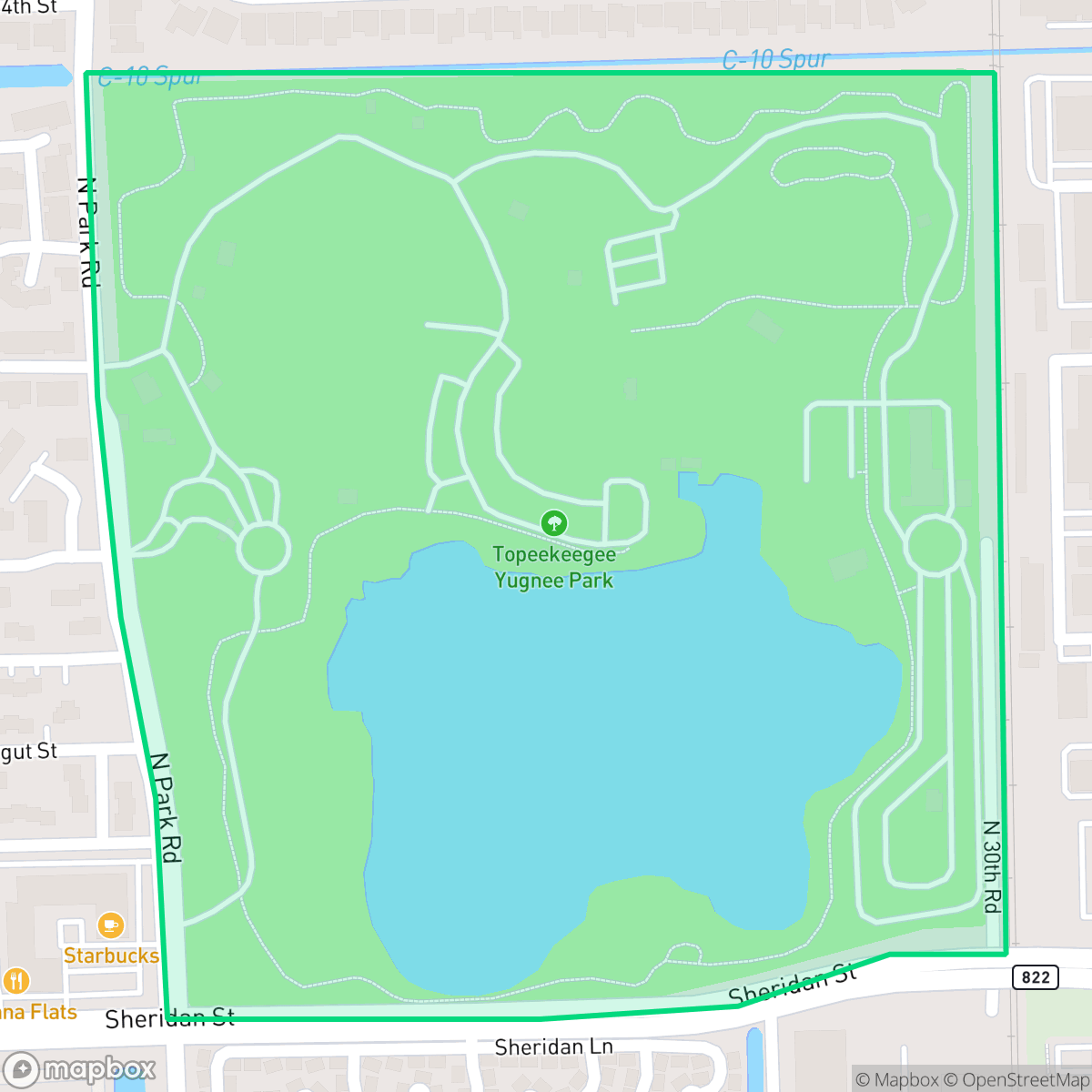
The T.Y. Park neighborhood in Hollywood, Florida, is centered around Topeekeegee Yugnee Park, a 138-acre recreational landmark that opened in 1971. The park’s name, derived from the Seminole language, translates to 'meeting or gathering place,' reflecting its historical role as a communal hub. The surrounding residential area primarily developed between the 1960s and early 1980s, featuring a mix of ranch-style single-family homes, mid-century modern architecture, and townhomes. The neighborhood is defined by its proximity to the park’s extensive green space, lake, and regional amenities, including the Castaway Island water complex and RV facilities. This integration of suburban residential development with a large-scale municipal park defines the area's character as a quiet, family-oriented enclave nestled between major transit corridors.
The neighborhood is defined by its suburban openness, featuring a mix of single-family homes and townhomes that benefit from a higher level of privacy than typical Hollywood density. The area maintains a manicured visual aesthetic, supported by high levels of health insurance coverage among its residents. Its layout encourages an active lifestyle, with extensive sidewalk networks that make it one of the more walkable enclaves in the city, providing a steady suburban rhythm that is slightly more active than the Hollywood average.
Prospective residents should weigh the benefits of local recreational access against the realities of the area. While the environment is highly dog-friendly and features a balanced demographic mix, the proximity to major transit infrastructure results in consistent road noise. Additionally, while specific flood risks remain under study, the area shows a higher potential for flooding compared to the broader city. The neighborhood is served by the Broward County School District, which currently faces significant structural and budgetary transitions despite maintaining some high-performing academic institutions.
Neighborhood Scores Across 15 Qualities
Residential spacing varies between townhomes and detached houses, offering more separation between neighbors than the typical Hollywood density. According to iHuus data, most structures maintain a consistent buffer zone provided by fenced backyards and side yards.
Extensive sidewalk networks and low-traffic residential loops make navigating the area on foot safe and efficient. According to iHuus data, the connectivity of this neighborhood is significantly higher than the Hollywood average.
Large homes, private pools, and well-maintained landscapes characterize this area. According to iHuus data, the visual quality of the neighborhood sits well above the Hollywood average.
Extensive green spaces, including a massive central park with trails and open fields, provide much more space for pet exercise than the Hollywood average. Accessible sidewalks and connected neighborhood paths make walking dogs safe from traffic.
Open land and scattered greenery are more prevalent here than in the rest of Hollywood. This provides a semi-rural feel characterized by a mix of single-family homes and integrated recreational spaces.
Active street life and a variety of local dining options provide a sense of activity that is slightly higher than the Hollywood average. Residents can expect a balanced environment where residential pockets are interspersed with functional services and wellness amenities.
Frequent sounds from nearby major roadways and transit infrastructure characterize the area. According to iHuus data, acoustic comfort in this neighborhood is slightly lower than the Hollywood average.
Air quality levels fluctuate between acceptable and unhealthy, with occasional concerns for sensitive groups. This environment remains slightly better than the Hollywood city average according to iHuus data.
Primarily residential and commercial in nature, this area lacks heavy industry and features only light commercial activity. While some warehouses are visible on the eastern edge, the presence of industrial zones is lower than the Hollywood average according to iHuus data.
Health insurance access among residents is significantly higher than the Hollywood average, according to iHuus data.
Political leanings in this area trend more conservative than the Hollywood average, according to iHuus data.
Residents encounter a diverse demographic spread of young adults, families, and seniors. This population distribution is more varied than the average found across Hollywood.
Flood risk levels remain undetermined because official federal studies are not yet complete for this area. According to iHuus data, the potential for flooding in TY Park is notably higher than the Hollywood average.
Address-Level Insights for TY Park


iHuus Neighborhood Intelligence Insights
Get address-level neighborhood insights for TY Park
- Street-level scores — see how individual blocks compare, not just neighborhood averages
- Micro-zone boundaries — identify quiet pockets, flood boundaries, and walkable clusters before you visit
- 15 dimensions in full — walkability, noise, air quality, school quality, insurance coverage, population age profile, urban/rural index, and more
- Boundary risk alerts — know if your address sits near a block boundary where scores drop, the kind of detail no listing will ever mention
- School insights — individual school ratings and insights, not just district-level data
- Compare before you commit — side-by-side data across neighborhoods, down to block precision
No credit card required
Compare with Any Neighborhood
| Dimension | TY Park | 441 Corridor |
|---|---|---|
| 🚶 Walkabilityavg 6.53 | ||
| 🔊 Acoustic Comfortavg 3.63 | ||
| 🤫 Privacy Indexavg 4.86 | ||
| 🎨 Visual Appealavg 6.02 | ||
| 🐕 Dog Friendlinessavg 5.22 | ||
| 🗺️ Urban-Rural Indexavg 5.78 | ||
| ✨ Neighborhood Vibeavg 3.98 | ||
| 🏥 Health Insurance Coverageavg 5.49 | ||
| 🌿 Air Qualityavg 5.56 | ||
| 🏭 Industrial Proximityavg 6.24 | ||
| 🌊 Flood Safetyavg 3.26 | ||
| 🗳️ Ideological Leanavg 4.88 | ||
| 👥 Population Age Profileavg 4.77 | ||
| 🔥 Fire Safety | ||
| 🏫 School Quality |
TY Park Rankings
School Districts Serving TY Park
School Insights for TY Park
Below average outcomes; significant attendance and academic challenges.
School Insights
See what's really behind every school rating near TY Park
- Individual school ratings — each school's own score with outcome context, not just a district average
- Enrollment & class size data — student-to-teacher ratio and how it compares to the state average
- Full demographics breakdown — ethnicity and gender composition for every school in the enrollment zone
- Every school in the district — all schools within the enrollment boundary ranked by rating, not just the closest one
- Grade levels & benchmarks — elementary through high school, with below/above state-average flags
No credit card required