North Central, Hollywood
Updated · 12,288 residents
North Central is a distinct residential enclave characterized by its diverse architectural heritage and suburban openness. While the area offers a steady rhythm of local services and moderate walkability, residents should anticipate noticeable traffic noise and limited public green space.
Key Highlights
About North Central
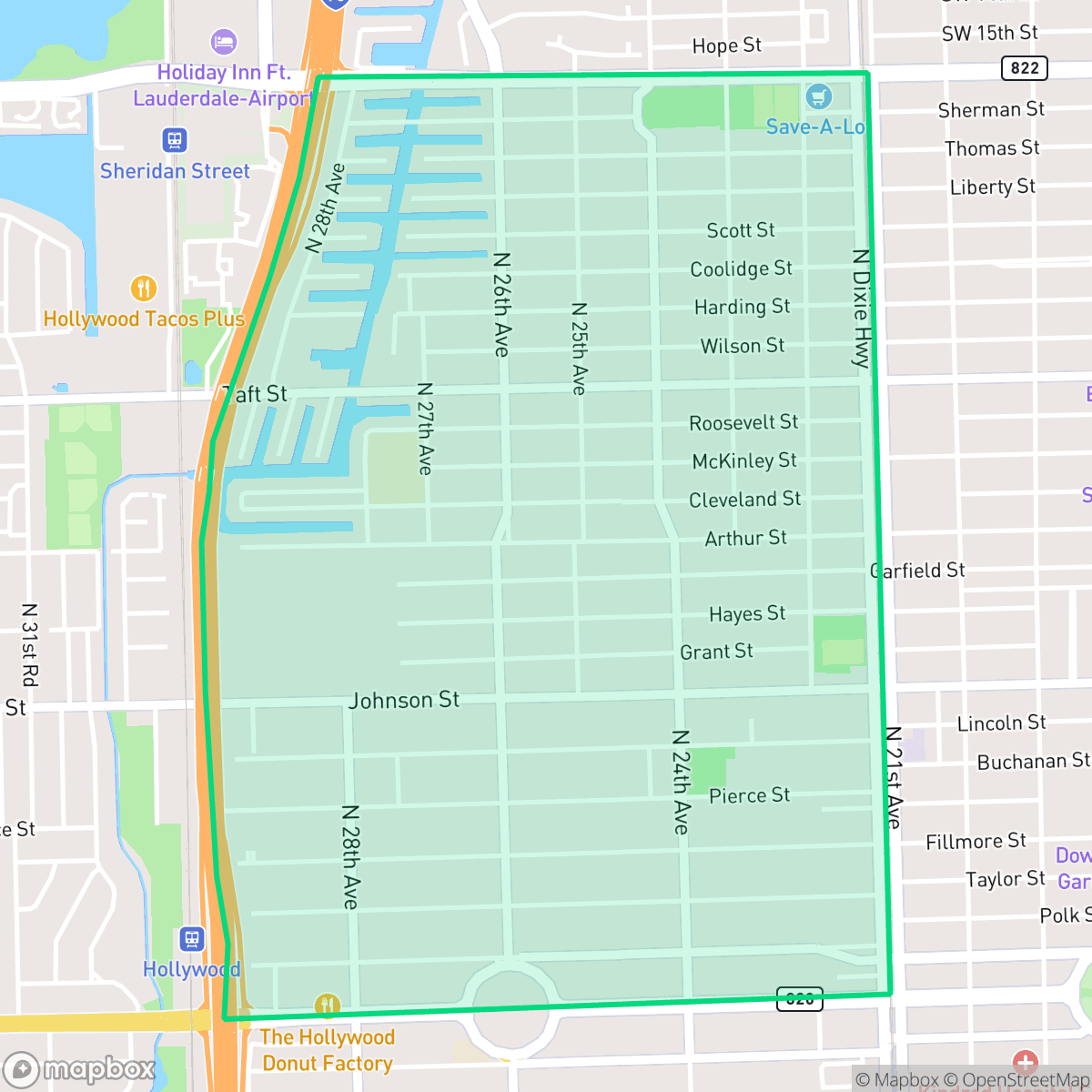
North Central in Hollywood, Florida, traces its origins to the 1920s as a vital residential zone within city founder Joseph Young’s “Dream City” blueprint. Positioned north of Hollywood Boulevard, the neighborhood served as a central keystone for the city's grid. Its architectural character is defined by a blend of 1940s Mediterranean Revival and Art Deco cottages alongside mid-century ranch-style homes, many featuring mature landscaping and canal-side settings. The area experienced significant expansion during the 1950s and 60s, evolving into a diverse community. Key local landmarks include the Stan Goldman Memorial Park, a hub for neighborhood gatherings, and the Colbert Museum Magnet School. Today, North Central remains a distinct, walkable enclave known for its resilient community spirit and a rich cultural tapestry that reflects decades of demographic evolution.
The neighborhood functions as a suburban landscape defined by a mix of single-family homes and light commercial blocks. It maintains a semi-rural feel due to scattered greenery and open land, providing a contrast to the denser urban core of Hollywood. Residents benefit from a balanced demographic profile, fostering a community that leans progressive in its political outlook. The area offers a steady social rhythm with access to various local services and dining options integrated into its varied suburban layout.
Prospective residents should consider the presence of light commercial activity and rail corridors, which contribute to elevated noise levels. While the area is moderately walkable, it faces specific challenges including moderate flood risk and limited public park access for pets. Health insurance coverage remains below the city average, and the local school district is currently navigating significant structural consolidation and budget adjustments. According to iHuus data, these factors create a unique living environment that balances suburban convenience with the complexities of an evolving urban grid.
Neighborhood Scores Across 15 Qualities
Housing density varies by block, featuring a mix of closely spaced homes and multi-family units that offer more separation than the Hollywood average. According to iHuus data, some areas feature wider setbacks while others present a more tightly packed residential grid.
Sidewalks and safe crossings are generally available along residential streets, though large highways and rail corridors act as significant barriers to movement. This level of pedestrian accessibility is roughly in line with the city average according to iHuus data.
Residential landscapes consist primarily of uniform tract housing with modest yards and boxy rooflines. This visual character is typical for the city average, featuring a mix of multi-family complexes and single-family homes with occasional private pools.
Walking opportunities for pets are primarily restricted to private backyards and narrow sidewalk verges, making the area slightly less dog friendly than the Hollywood average. While some sections feature large golf courses or central parks, much of the residential grid lacks accessible public green space.
A noticeable amount of open land and scattered greenery provides a more semi-rural feel compared to the denser urban profile of Hollywood. Residents will find a landscape characterized by suburban sprawl, featuring single-family homes interspersed with larger commercial blocks and golf courses.
Active mixed-use pockets provide a more vibrant social atmosphere than the typical Hollywood average. Residents can access a diverse range of dining, bars, and local services within a varied suburban landscape.
Frequent noise from nearby transit corridors and major roadways is common in this area. According to iHuus data, acoustic levels are slightly higher than the Hollywood average.
Air quality levels in North Central are slightly better than the Hollywood average, though residents may encounter occasional days with unhealthy conditions that could affect sensitive groups.
Light commercial activity and occasional warehouse traffic are more prevalent here than in the rest of Hollywood. While heavy industry is absent, residents should note the presence of a nearby rail corridor and an EPA Superfund site.
Health insurance accessibility in this area is below the Hollywood average, according to iHuus data.
Political leanings in this area favor liberal perspectives, trending notably more progressive than the Hollywood average according to iHuus data.
Residents live alongside a balanced spread of young adults, families, and older populations. This age distribution is slightly more varied than the average found across Hollywood.
Flood safety levels in this area are slightly higher than the Hollywood average, though a lack of detailed FEMA studies means long-term risk remains undetermined. Residents should exercise caution as localized drainage patterns have not been fully assessed by federal authorities.
Address-Level Insights for North Central


iHuus Neighborhood Intelligence Insights
Get address-level neighborhood insights for North Central
- Street-level scores — see how individual blocks compare, not just neighborhood averages
- Micro-zone boundaries — identify quiet pockets, flood boundaries, and walkable clusters before you visit
- 15 dimensions in full — walkability, noise, air quality, school quality, insurance coverage, population age profile, urban/rural index, and more
- Boundary risk alerts — know if your address sits near a block boundary where scores drop, the kind of detail no listing will ever mention
- School insights — individual school ratings and insights, not just district-level data
- Compare before you commit — side-by-side data across neighborhoods, down to block precision
No credit card required
Compare with Any Neighborhood
| Dimension | North Central | 441 Corridor |
|---|---|---|
| 🚶 Walkabilityavg 6.53 | ||
| 🔊 Acoustic Comfortavg 3.63 | ||
| 🤫 Privacy Indexavg 4.86 | ||
| 🎨 Visual Appealavg 6.02 | ||
| 🐕 Dog Friendlinessavg 5.22 | ||
| 🗺️ Urban-Rural Indexavg 5.78 | ||
| ✨ Neighborhood Vibeavg 3.98 | ||
| 🏥 Health Insurance Coverageavg 5.49 | ||
| 🌿 Air Qualityavg 5.56 | ||
| 🏭 Industrial Proximityavg 6.24 | ||
| 🌊 Flood Safetyavg 3.26 | ||
| 🗳️ Ideological Leanavg 4.88 | ||
| 👥 Population Age Profileavg 4.77 | ||
| 🔥 Fire Safety | ||
| 🏫 School Quality |
North Central Rankings
School Districts Serving North Central
School Insights for North Central
Below average outcomes; significant attendance and academic challenges.
School Insights
See what's really behind every school rating near North Central
- Individual school ratings — each school's own score with outcome context, not just a district average
- Enrollment & class size data — student-to-teacher ratio and how it compares to the state average
- Full demographics breakdown — ethnicity and gender composition for every school in the enrollment zone
- Every school in the district — all schools within the enrollment boundary ranked by rating, not just the closest one
- Grade levels & benchmarks — elementary through high school, with below/above state-average flags
No credit card required