Liberia, Hollywood
Updated · 2,154 residents
Liberia is a highly walkable community characterized by its grid layout and semi-rural atmosphere. Residents benefit from active local amenities and a central park, though the area experiences moderate traffic noise and mixed industrial proximity.
Key Highlights
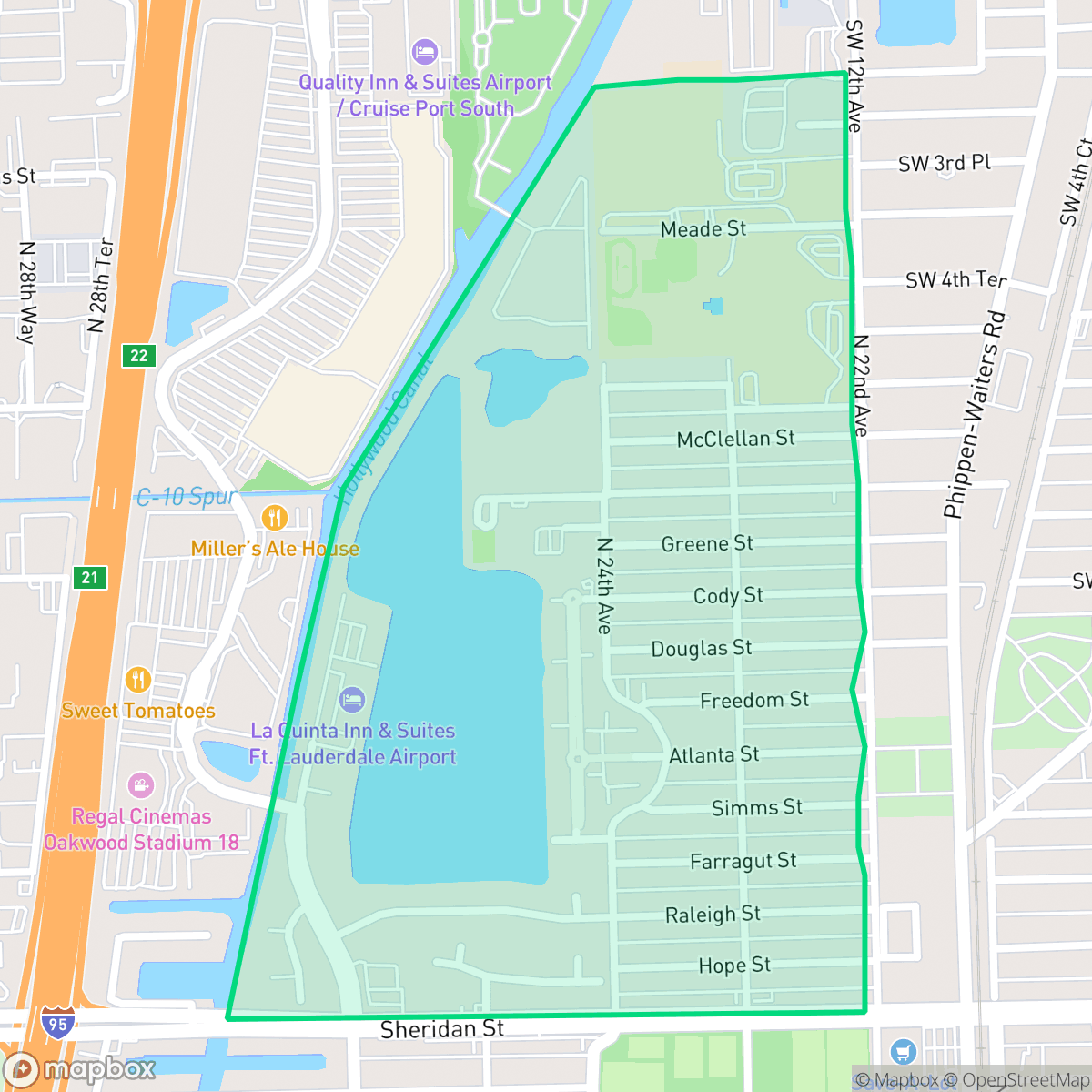
About Liberia
Established in 1923, two years before the city of Hollywood, Florida, Liberia was founded by developer Joseph W. Young as a planned community for Black residents. Designed to provide a self-sufficient enclave amidst Jim Crow-era segregation, the neighborhood featured a grid layout with a central park and dedicated land for schools and churches. For decades, Liberia served as a vibrant cultural hub with a thriving business district along J.A. Ely Boulevard, hosting notable performers like James Brown and Sam Cooke who were barred from other venues. The community was anchored by the historic Attucks High School, designed by architect Bayard Lukens and opened in 1927. In 2025, a state historical marker was unveiled at the intersection of Raleigh Street and J.A. Ely Boulevard to commemorate the neighborhood's legacy of resilience and its foundational role in Hollywood’s history.
The neighborhood maintains a distinct semi-rural feel, offering more open space and scattered woodland than the typical Hollywood urban core. It functions as an active suburban hub where residents have convenient access to various dining, fitness, and entertainment options. The well-connected street grid and continuous sidewalks make the area exceptionally accessible for pedestrians, while the central public park provides a dedicated space for outdoor recreation and pet owners. Politically, the community leans strongly liberal, reflecting a unique social character compared to the broader city.
Prospective residents should consider a few trade-offs, including moderate levels of traffic and industrial noise from nearby rail lines and busy streets. While the area offers a standard suburban aesthetic with closely spaced homes, it also faces challenges regarding limited access to health insurance and a degree of uncertainty regarding flood risk. The neighborhood is served by the Broward County School District, which currently navigates a period of systemic transition and budget consolidation despite maintaining several high-performing academic programs.
Neighborhood Scores Across 15 Qualities
Residential spacing offers a moderate level of separation, providing more buffer between neighbors than the Hollywood average. Some houses feature closely packed layouts with shared property lines, according to iHuus data.
Continuous sidewalks and a well-connected street grid make pedestrian travel easy throughout the area. This level of accessibility is notably higher than the Hollywood average, according to iHuus data.
Typical tract housing defines the local landscape, featuring closely spaced single-family homes with modest yards. This level of visual variety is consistent with the average found throughout Hollywood.
Wide grassy verges and a large central public park provide sufficient space for walking pets. According to iHuus data, these features make the area more dog friendly than the Hollywood average.
Open land and scattered woodland characterize this area, providing a more open landscape than the typical Hollywood urban core. According to iHuus data, the neighborhood maintains a higher degree of natural space and less dense development compared to the city average.
A steady mix of dining, fitness centers, and entertainment venues provides a level of activity that is notably higher than the Hollywood average. Residents can find various local amenities and walkable pockets, according to iHuus data.
Steady sounds from nearby busy streets are present throughout the area. This level of acoustic activity is slightly higher than the typical experience found in other parts of Hollywood.
Air quality remains mostly clean with only rare instances of elevated readings, representing a higher standard than the Hollywood city average according to iHuus data.
Light commercial activity and nearby rail lines contribute to moderate traffic and industrial noise. This level of industrial proximity is roughly comparable to the Hollywood average, according to iHuus data.
Health insurance coverage among residents is significantly lower than the Hollywood average, according to iHuus data. This lack of coverage may present challenges for accessing regular medical care and managing healthcare costs.
Political leanings in Liberia are predominantly liberal, representing a significant departure from the more politically balanced average seen across Hollywood.
A balanced demographic of young adults, families, and seniors defines the area. This age distribution remains consistent with the broader Hollywood city average.
Flood risk in this area remains undetermined due to a lack of detailed federal studies; however, the level of concern is slightly higher than the Hollywood average according to iHuus data.
Address-Level Insights for Liberia


iHuus Neighborhood Intelligence Insights
Get address-level neighborhood insights for Liberia
- Street-level scores — see how individual blocks compare, not just neighborhood averages
- Micro-zone boundaries — identify quiet pockets, flood boundaries, and walkable clusters before you visit
- 15 dimensions in full — walkability, noise, air quality, school quality, insurance coverage, population age profile, urban/rural index, and more
- Boundary risk alerts — know if your address sits near a block boundary where scores drop, the kind of detail no listing will ever mention
- School insights — individual school ratings and insights, not just district-level data
- Compare before you commit — side-by-side data across neighborhoods, down to block precision
No credit card required
Compare with Any Neighborhood
| Dimension | Liberia | 441 Corridor |
|---|---|---|
| 🚶 Walkabilityavg 6.53 | ||
| 🔊 Acoustic Comfortavg 3.63 | ||
| 🤫 Privacy Indexavg 4.86 | ||
| 🎨 Visual Appealavg 6.02 | ||
| 🐕 Dog Friendlinessavg 5.22 | ||
| 🗺️ Urban-Rural Indexavg 5.78 | ||
| ✨ Neighborhood Vibeavg 3.98 | ||
| 🏥 Health Insurance Coverageavg 5.49 | ||
| 🌿 Air Qualityavg 5.56 | ||
| 🏭 Industrial Proximityavg 6.24 | ||
| 🌊 Flood Safetyavg 3.26 | ||
| 🗳️ Ideological Leanavg 4.88 | ||
| 👥 Population Age Profileavg 4.77 | ||
| 🔥 Fire Safety | ||
| 🏫 School Quality |
Liberia Rankings
School Districts Serving Liberia
School Insights for Liberia
Below average outcomes; significant attendance and academic challenges.
School Insights
See what's really behind every school rating near Liberia
- Individual school ratings — each school's own score with outcome context, not just a district average
- Enrollment & class size data — student-to-teacher ratio and how it compares to the state average
- Full demographics breakdown — ethnicity and gender composition for every school in the enrollment zone
- Every school in the district — all schools within the enrollment boundary ranked by rating, not just the closest one
- Grade levels & benchmarks — elementary through high school, with below/above state-average flags
No credit card required