Original Section, Greenacres
Updated · 3,559 residents
The Original Section serves as the historic core of Greenacres, characterized by a functional suburban layout and a diverse mix of residents. While the area offers moderate walkability and a quiet residential environment, it maintains a balanced political landscape and a low industrial presence.
Key Highlights
About Original Section
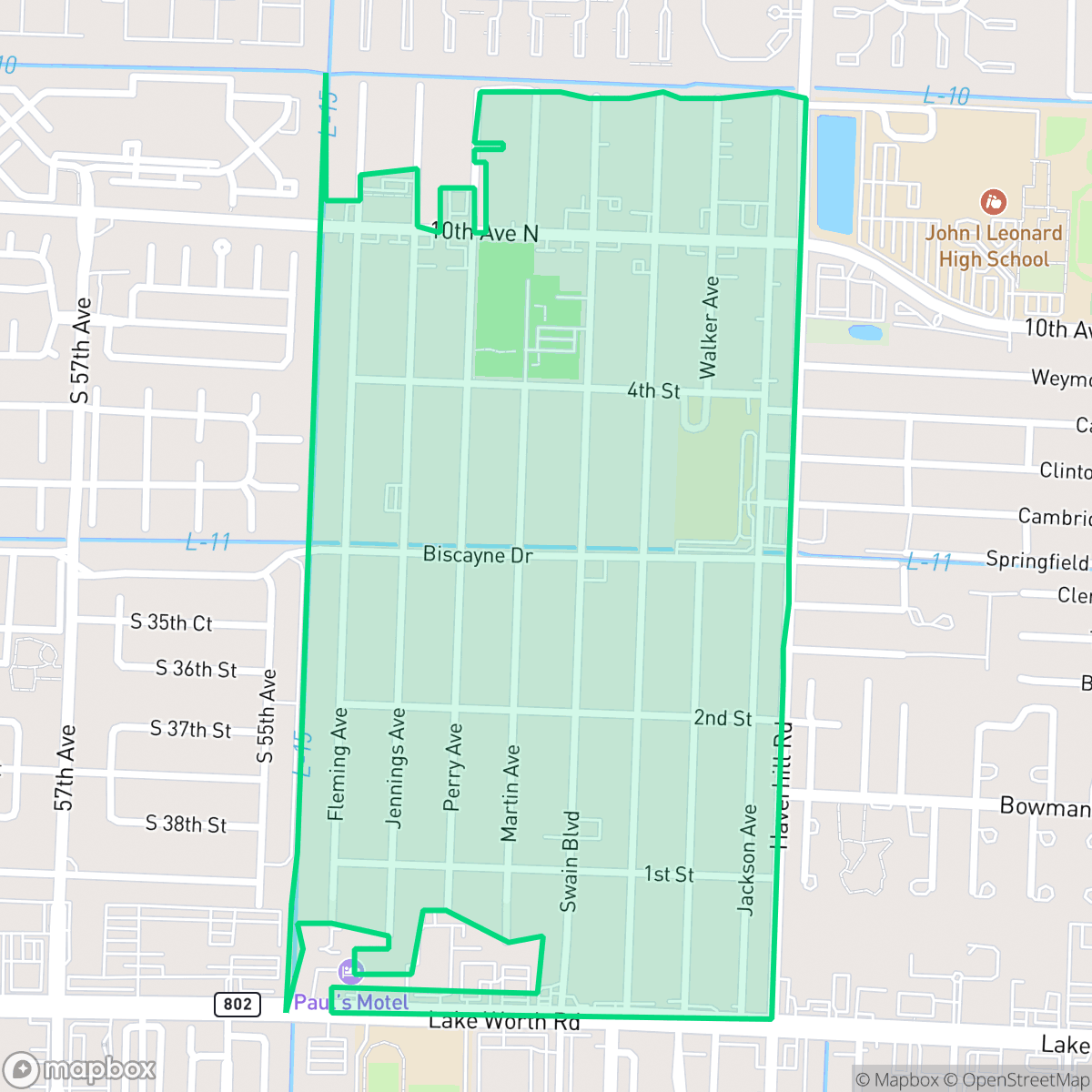
The 'Original Section' of Greenacres, Florida, represents the city’s foundational core, platted in 1923 by developer Lawrence Carter 'L.C.' Swain. Intended as a middle-class community during the 1920s Florida land boom, this area is situated one-half mile west of Military Trail and centers on Swain Boulevard. The neighborhood serves as a historical touchstone for the city, which was incorporated as 'Greenacres City' in 1926. Today, the area remains a distinct residential focal point, with the city government prioritizing it for targeted infrastructure improvements and historic preservation initiatives to celebrate its role as the birthplace of the community. Its development reflects the vision of Swain, who sought to provide accessible housing for working-class families, a legacy honored by the street bearing his name and the nearby L.C. Swain Middle School.
This foundational neighborhood functions as a practical suburban hub, blending single-family homes with apartment complexes. The area maintains a quiet, functional atmosphere that avoids the heavy industrial activity found in more commercialized zones. Residents benefit from a diverse age demographic, creating a community that spans from young adults to seniors within a landscape that is slightly more urban than the city average.
Prospective residents should note that the area presents specific trade-offs regarding daily living. While traffic noise is generally manageable, the neighborhood faces challenges with lower health insurance coverage rates and moderate air quality fluctuations. Pedestrian infrastructure is largely available, though gaps exist near busy intersections, and according to iHuus data, pet owners may find limited green space for outdoor activities compared to other parts of the city.
Neighborhood Scores Across 15 Qualities
Housing density fluctuates between tightly packed mobile home estates and more spaced single-family residences. According to iHuus data, this lack of consistent buffering results in lower privacy levels compared to the Greenacres average.
Sidewalks are available along many residential streets and main roads, though some interruptions exist near large campuses and high-traffic intersections. Pedestrian access is slightly below the Greenacres average due to occasional gaps in the network.
Standard tract housing and apartment complexes define the landscape, providing a modest suburban aesthetic that sits slightly below the city average. Most properties feature tidy yards and shared community amenities rather than large private estates.
Walking opportunities for pets are somewhat restricted because greenery is often limited to narrow verges or private lots. While a central park and athletic fields provide some utility, overall dog friendliness sits below the Greenacres average according to iHuus data.
Residential pockets feature a blend of single-family homes, apartment complexes, and commercial hubs. This landscape sits slightly more urban than the Greenacres average, characterized by dense suburban layouts rather than open farmland.
Daily activity remains subdued, offering a practical environment focused on suburban convenience and local amenities. This level of energy is consistent with the broader Greenacres area.
Steady traffic sounds from nearby busy streets are present, though the level of acoustic disturbance is notably lower than the Greenacres average according to iHuus data.
Air quality in this area fluctuates between acceptable and unhealthy levels, presenting occasional concerns for sensitive groups. This represents a slightly lower air quality standard than the Greenacres city average, according to iHuus data.
Primarily residential and light commercial areas define this neighborhood, offering a lack of heavy industrial hazards. According to iHuus data, the area contains fewer large-scale warehouses or manufacturing zones than the Greenacres average.
Health insurance access is notably lower than the Greenacres city average, according to iHuus data. Residents in this area face significantly higher rates of being uninsured compared to most other parts of the city.
Political leanings within this area are relatively evenly split between conservative and liberal perspectives. This reflects a more balanced ideological landscape than the slightly more conservative average seen across Greenacres.
Residents will find a balanced mix of young adults, families, and seniors living in the area. This demographic distribution is slightly more varied than the average found across Greenacres.
Residual flood risk exists within this area as it contains portions of the 500-year floodplain; however, safety levels are roughly comparable to the Greenacres city average according to iHuus data.
Address-Level Insights for Original Section


iHuus Neighborhood Intelligence Insights
Get address-level neighborhood insights for Original Section
- Street-level scores — see how individual blocks compare, not just neighborhood averages
- Micro-zone boundaries — identify quiet pockets, flood boundaries, and walkable clusters before you visit
- 15 dimensions in full — walkability, noise, air quality, school quality, insurance coverage, population age profile, urban/rural index, and more
- Boundary risk alerts — know if your address sits near a block boundary where scores drop, the kind of detail no listing will ever mention
- School insights — individual school ratings and insights, not just district-level data
- Compare before you commit — side-by-side data across neighborhoods, down to block precision
No credit card required
Compare with Any Neighborhood
| Dimension | Original Section | Buttonwood |
|---|---|---|
| 🚶 Walkabilityavg 7.82 | ||
| 🔊 Acoustic Comfortavg 3.24 | ||
| 🤫 Privacy Indexavg 5.16 | ||
| 🎨 Visual Appealavg 6.58 | ||
| 🐕 Dog Friendlinessavg 6.44 | ||
| 🗺️ Urban-Rural Indexavg 6.73 | ||
| ✨ Neighborhood Vibeavg 3.68 | ||
| 🏥 Health Insurance Coverageavg 3.73 | ||
| 🌿 Air Qualityavg 5.04 | ||
| 🏭 Industrial Proximityavg 7.87 | ||
| 🌊 Flood Safetyavg 6.43 | ||
| 🗳️ Ideological Leanavg 6.18 | ||
| 👥 Population Age Profileavg 4.76 | ||
| 🔥 Fire Safety | ||
| 🏫 School Quality |
Original Section Rankings
School Districts Serving Original Section
School Insights for Original Section
Below average outcomes; significant attendance and academic challenges.
School Insights
See what's really behind every school rating near Original Section
- Individual school ratings — each school's own score with outcome context, not just a district average
- Enrollment & class size data — student-to-teacher ratio and how it compares to the state average
- Full demographics breakdown — ethnicity and gender composition for every school in the enrollment zone
- Every school in the district — all schools within the enrollment boundary ranked by rating, not just the closest one
- Grade levels & benchmarks — elementary through high school, with below/above state-average flags
No credit card required