Sugar Foot, Gainesville
Updated · 473 residents
Sugar Foot is a quiet, semi-rural enclave in western Gainesville defined by its mid-century architecture and proximity to scenic conservation areas. While the neighborhood offers a polished aesthetic and high health insurance coverage, residents should be prepared for frequent aircraft noise and moderate flood risks.
Key Highlights
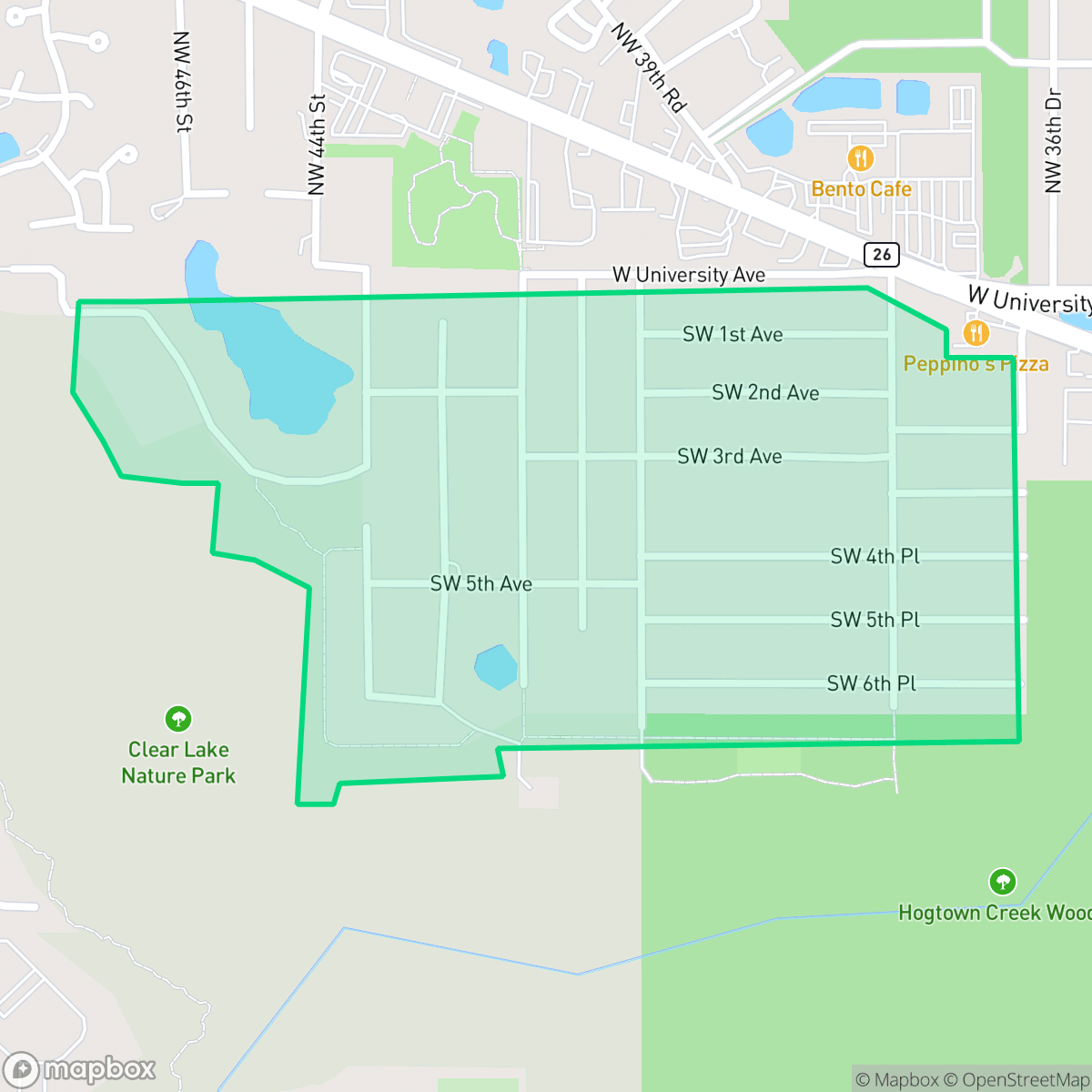
About Sugar Foot
Sugarfoot, a residential neighborhood in western Gainesville, Florida, began its development in the early 1950s and was formally annexed into the city in 1961. It is notable for being home to the Sugarfoot Community Improvement Association, recognized as the oldest neighborhood association in Gainesville. The neighborhood’s character is defined by its mid-century residential architecture and its integration with local natural landmarks, most notably Clear Lake, which serves as a central aesthetic feature. The area is bordered by several conservation and nature spaces, including the Sugarfoot Prairie Conservation Area and John Mahon Nature Park, the latter of which honors Dr. John Mahon, a prominent early resident and advocate for local environmental preservation. The neighborhood encompasses several distinct subdivisions, such as Anglewood, Fletcher Heights, Gwynn Oaks, and Holly Forest, maintaining a quiet, suburban atmosphere near the University of Florida.
Sugar Foot maintains a semi-rural character defined by its dispersed residential layout and integration with local natural landmarks. According to iHuus data, the area features a visually appealing environment with spacious properties that provide a greater sense of privacy than many other parts of the city. Residents benefit from clean air and access to various outdoor spaces, including nearby nature parks and greenways, which make the neighborhood particularly accommodating for dog owners. The atmosphere is generally quiet and community-oriented, reflecting a strong liberal leaning among its residents.
Prospective residents should weigh the benefits of this setting against specific livability trade-offs, most notably the persistent aircraft noise stemming from the nearby airport runway. While the neighborhood is more walkable than the Gainesville average, it remains a suburban pocket that prioritizes open space over density. Families should also be aware that the area falls under the Alachua County School District, where they will need to navigate the district's ongoing administrative and financial transitions when evaluating educational opportunities for their children.
Neighborhood Scores Across 15 Qualities
Residential spacing provides a reasonable buffer between neighbors, sitting slightly above the Gainesville average. Mixed density patterns mean some homes sit closer to others while others maintain more separation.
Pedestrian travel is supported by safe crossings and sidewalks located on one side of the street; this level of accessibility is higher than the Gainesville average, according to iHuus data.
Large residential properties and frequent upscale amenities contribute to an aesthetic that is notably more polished than the Gainesville average. Satellite imagery and iHuus data indicate a landscape characterized by spacious driveways and well-maintained surroundings.
Connected green spaces and wide, traffic-safe paths make this area more accommodating for dogs than the Gainesville average. According to iHuus data, these features provide reliable environments for outdoor exercise.
Open land and woodland areas are frequent throughout this neighborhood, providing a more dispersed residential setting than the Gainesville average. According to iHuus data, homes are often scattered among fields rather than concentrated in dense urban blocks.
Provides a more active atmosphere than the Gainesville average due to a mix of local dining destinations and accessible parks. Residents can experience a steady rhythm of activity ranging from quiet outdoor spaces near wildlife refuges to lively suburban pockets with diverse eateries.
Frequent aircraft noise from the nearby airport runway dominates the area. This level of acoustic disturbance is significantly higher than the Gainesville average, according to iHuus data.
Air quality in this area remains generally clear with only infrequent periods of elevated readings. This level of cleanliness is slightly higher than the Gainesville average, according to iHuus data.
Primarily residential with only occasional light commercial activity, this area lacks the heavy industry found in other parts of Gainesville. While residents may encounter some transit traffic or utility odors near local gas stations and service centers, the neighborhood remains largely free of large-scale industrial facilities.
Health insurance accessibility is notably higher in Sugar Foot than the Gainesville average, according to iHuus data. Residents benefit from a significantly greater proportion of covered individuals compared to the rest of the city.
Voting patterns and census indicators show a significantly more liberal leaning than the Gainesville average, according to iHuus data.
A balanced range of young adults, families, and older residents defines the area. This age distribution is consistent with the broader Gainesville population, according to iHuus data.
Flood risk in this area is slightly higher than the Gainesville average, though official FEMA studies for this specific location remain incomplete. According to iHuus data, residents should maintain awareness of local drainage and seasonal water levels.
Address-Level Insights for Sugar Foot


iHuus Neighborhood Intelligence Insights
Get address-level neighborhood insights for Sugar Foot
- Street-level scores — see how individual blocks compare, not just neighborhood averages
- Micro-zone boundaries — identify quiet pockets, flood boundaries, and walkable clusters before you visit
- 15 dimensions in full — walkability, noise, air quality, school quality, insurance coverage, population age profile, urban/rural index, and more
- Boundary risk alerts — know if your address sits near a block boundary where scores drop, the kind of detail no listing will ever mention
- School insights — individual school ratings and insights, not just district-level data
- Compare before you commit — side-by-side data across neighborhoods, down to block precision
No credit card required
Compare with Any Neighborhood
| Dimension | Sugar Foot | Ashton |
|---|---|---|
| 🚶 Walkabilityavg 5.49 | ||
| 🔊 Acoustic Comfortavg 3.45 | ||
| 🤫 Privacy Indexavg 5.77 | ||
| 🎨 Visual Appealavg 5.61 | ||
| 🐕 Dog Friendlinessavg 6.73 | ||
| 🗺️ Urban-Rural Indexavg 7.16 | ||
| ✨ Neighborhood Vibeavg 2.63 | ||
| 🏥 Health Insurance Coverageavg 6.36 | ||
| 🌿 Air Qualityavg 6.49 | ||
| 🏭 Industrial Proximityavg 6.6 | ||
| 🌊 Flood Safetyavg 4.63 | ||
| 🗳️ Ideological Leanavg 7.36 | ||
| 👥 Population Age Profileavg 4.16 | ||
| 🔥 Fire Safety | ||
| 🏫 School Quality |
Sugar Foot Rankings
School Districts Serving Sugar Foot
School Insights for Sugar Foot
Below average outcomes; significant attendance and academic challenges.
School Insights
See what's really behind every school rating near Sugar Foot
- Individual school ratings — each school's own score with outcome context, not just a district average
- Enrollment & class size data — student-to-teacher ratio and how it compares to the state average
- Full demographics breakdown — ethnicity and gender composition for every school in the enrollment zone
- Every school in the district — all schools within the enrollment boundary ranked by rating, not just the closest one
- Grade levels & benchmarks — elementary through high school, with below/above state-average flags
No credit card required