Porters Community, Gainesville
Updated · 502 residents
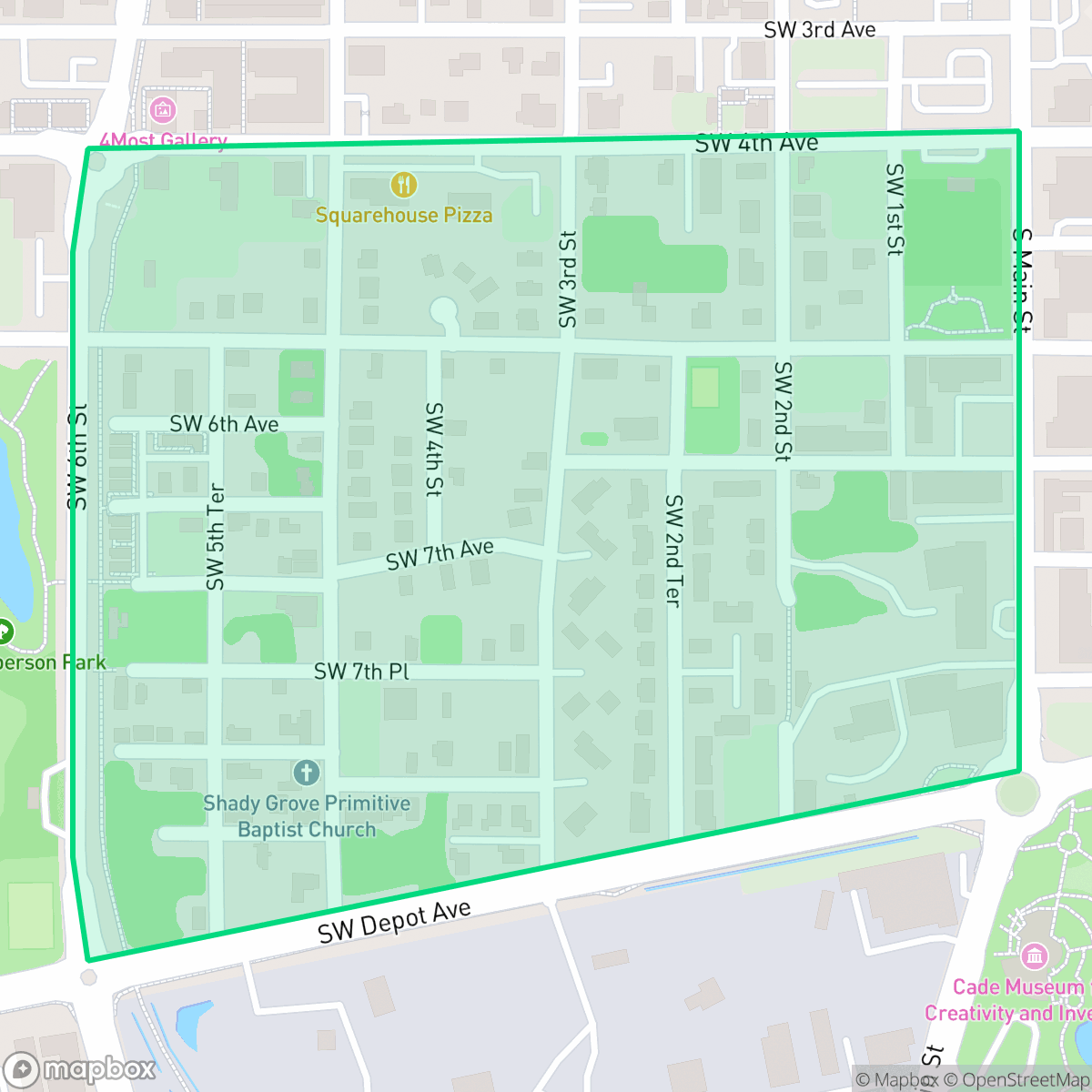
The Porters Community is a historic and culturally significant neighborhood situated between downtown Gainesville and the University of Florida. Known for its high walkability and vibrant, high-energy atmosphere, the area offers residents a central urban experience with excellent access to local landmarks and cultural institutions.
Key Highlights
About Porters Community
Established in 1884 by Dr. Watson Porter and his wife Olivia, the Porters Community is one of Gainesville’s oldest African American neighborhoods. Located between downtown and the University of Florida, it was uniquely founded during an era when land ownership for Black residents was rare, as Dr. Porter sold property exclusively to Black families. The neighborhood is characterized by its resilient, multi-generational community and historic small wood-frame houses. A significant landmark is the Shady Grove Primitive Baptist Church, organized in 1894, which served as a vital hub for the local NAACP during the Civil Rights Era. Today, the community is defined by its strong sense of place and ongoing efforts to preserve its identity against encroaching urban development, often utilizing a resident-led "neighborhood narrative" to advocate for its shared history and future.
The area functions as a high-energy urban hub, characterized by a dense mix of dining, nightlife, and cultural venues. Its location provides residents with immediate access to major institutions, including the Hippodrome State Theatre and nearby college campuses. The neighborhood layout is highly walkable, featuring a dense street grid and frequent traffic calming measures that prioritize pedestrian connectivity. According to iHuus data, residents benefit from exceptionally clean air and high health insurance coverage, contributing to a stable and health-conscious living environment.
While the area offers a unique, semi-rural feel through its interspersed open land and wooded patches, prospective residents should be aware of the acoustic environment. The neighborhood experiences a steady hum of traffic noise from nearby busy streets. Additionally, while the community is primarily residential, there is a surface mining site near the center that may occasionally cause dust or noise. The area is best suited for young adults and those who prioritize proximity to urban amenities and a strong sense of community identity over suburban seclusion.
Neighborhood Scores Across 15 Qualities
Residential spacing varies between detached homes and shared-wall apartments, offering slightly more separation between neighbors than the Gainesville average.
Pedestrian connectivity is excellent due to a dense street grid, frequent sidewalks, and traffic calming roundabouts. This area offers much higher walkability than the Gainesville average according to iHuus data.
Residential scenery consists of modest housing and apartment complexes with shared amenities. This area offers a slightly more varied visual landscape than the Gainesville average, though it lacks large private estates or luxury architecture.
Tree-lined streets and proximity to Depot Park offer ample green space for walking dogs. According to iHuus data, the availability of sidewalk verges and park access is consistent with the city average.
Open land and wooded areas are frequently interspersed with scattered homes, providing a more spacious environment than the denser urban core of Gainesville. This layout offers a transition between residential blocks and natural landscapes according to iHuus data.
Constant movement and a dense mix of dining, nightlife, and cultural landmarks create a highly active environment that is significantly more vibrant than the Gainesville average. This walkable district serves as a central hub for social interaction near major institutions like Santa Fe College and the Hippodrome State Theatre.
A steady hum of local traffic from a nearby busy street characterizes the area. According to iHuus data, acoustic comfort in this neighborhood is notably higher than the Gainesville average.
Air quality remains exceptionally high and poses little to no health concern. This level of cleanliness significantly exceeds the Gainesville city average, according to iHuus data.
Industrial presence is minimal in this area, though a surface mining site near the center may cause occasional dust and noise. Aside from some utility infrastructure in the southeast corner, the landscape is primarily comprised of residential and institutional buildings, making it cleaner than the Gainesville average according to iHuus data.
Health insurance access among residents is notably higher than the Gainesville average, according to iHuus data.
Voting patterns and census indicators reflect a much more liberal leaning than the Gainesville average, according to iHuus data.
Young adults make up the majority of the population, creating a demographic profile that is slightly younger than the Gainesville average according to iHuus data.
Flood risk in this area remains undetermined due to a lack of detailed FEMA studies, though the potential for flooding is slightly higher than the Gainesville average according to iHuus data.
Address-Level Insights for Porters Community


iHuus Neighborhood Intelligence Insights
Get address-level neighborhood insights for Porters Community
- Street-level scores — see how individual blocks compare, not just neighborhood averages
- Micro-zone boundaries — identify quiet pockets, flood boundaries, and walkable clusters before you visit
- 15 dimensions in full — walkability, noise, air quality, school quality, insurance coverage, population age profile, urban/rural index, and more
- Boundary risk alerts — know if your address sits near a block boundary where scores drop, the kind of detail no listing will ever mention
- School insights — individual school ratings and insights, not just district-level data
- Compare before you commit — side-by-side data across neighborhoods, down to block precision
No credit card required
Compare with Any Neighborhood
| Dimension | Porters Community | Ashton |
|---|---|---|
| 🚶 Walkabilityavg 5.49 | ||
| 🔊 Acoustic Comfortavg 3.45 | ||
| 🤫 Privacy Indexavg 5.77 | ||
| 🎨 Visual Appealavg 5.61 | ||
| 🐕 Dog Friendlinessavg 6.73 | ||
| 🗺️ Urban-Rural Indexavg 7.16 | ||
| ✨ Neighborhood Vibeavg 2.63 | ||
| 🏥 Health Insurance Coverageavg 6.36 | ||
| 🌿 Air Qualityavg 6.49 | ||
| 🏭 Industrial Proximityavg 6.6 | ||
| 🌊 Flood Safetyavg 4.63 | ||
| 🗳️ Ideological Leanavg 7.36 | ||
| 👥 Population Age Profileavg 4.16 | ||
| 🔥 Fire Safety | ||
| 🏫 School Quality |
Porters Community Rankings
School Districts Serving Porters Community
School Insights for Porters Community
Below average outcomes; significant attendance and academic challenges.
School Insights
See what's really behind every school rating near Porters Community
- Individual school ratings — each school's own score with outcome context, not just a district average
- Enrollment & class size data — student-to-teacher ratio and how it compares to the state average
- Full demographics breakdown — ethnicity and gender composition for every school in the enrollment zone
- Every school in the district — all schools within the enrollment boundary ranked by rating, not just the closest one
- Grade levels & benchmarks — elementary through high school, with below/above state-average flags
No credit card required