Palm Terrace, Gainesville
Updated · 256 residents
Palm Terrace is a quiet, historically significant community defined by its spacious, custom-built estates and lush, semi-rural landscape. While the neighborhood remains primarily car-dependent due to a lack of sidewalks, it offers residents a peaceful, private environment with clean air and strong access to healthcare.
Key Highlights
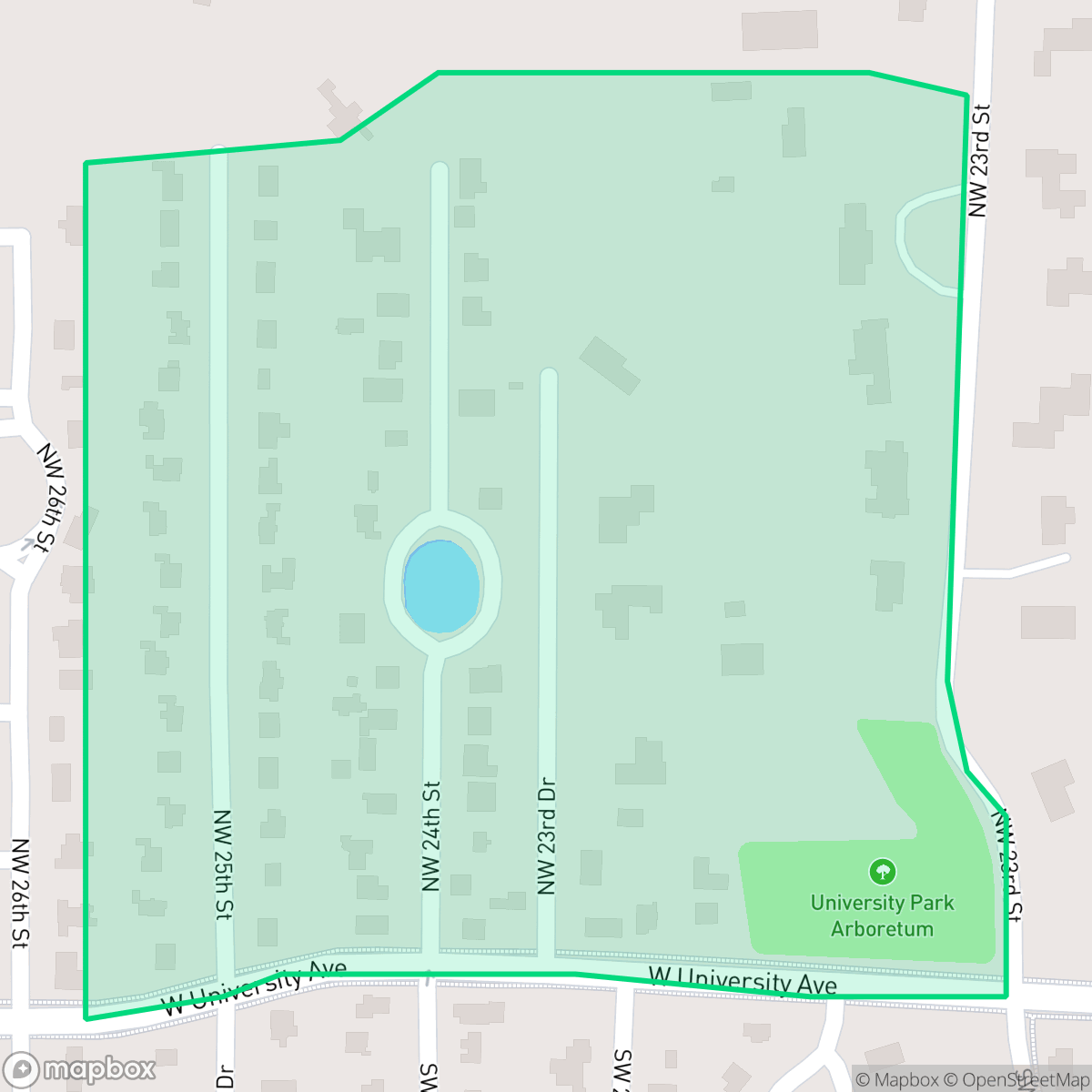
About Palm Terrace
Established around 1925, Palm Terrace is a historically significant neighborhood in Gainesville, Florida, developed to support the growth of the nearby University of Florida. As part of the city's university-related thematic areas, the neighborhood was designed to accommodate faculty and university staff, contributing to its distinct 'university town' character. Palm Terrace features a collection of residences dating back to the 1920s, which remain important to the city's architectural history. Often grouped with neighboring districts like Hibiscus Park and Golfview, the area reflects the early 20th-century expansion of Gainesville’s residential landscape, providing a tangible link to the historical development of the university community.
The area is characterized by high visual appeal, featuring large lots and significant separation between homes that ensures a private living experience. Residents enjoy a strictly residential atmosphere, completely free from industrial activity or commercial noise. The landscape feels distinctly open and rural, with dense greenery that contributes to a serene setting, even as it maintains a functional connection to the broader Gainesville university community.
According to iHuus data, the neighborhood is best suited for those who prioritize privacy and a quiet, car-oriented lifestyle over high-density walkability. While the local environment is pet-friendly and features clean air, the area does experience some moderate traffic noise from nearby roads. Families should be aware that while the local school district includes high-performing institutions, it is currently navigating significant administrative and financial volatility.
Neighborhood Scores Across 15 Qualities
Large lot sizes and significant separation between homes provide a higher level of seclusion than the Gainesville average. This spacing contributes to an increased sense of privacy for residents, according to iHuus data.
Low traffic volumes and calm streets make for pleasant strolls, though the lack of sidewalks distinguishes this area from more pedestrian-oriented parts of Gainesville. According to iHuus data, walking is slightly more feasible here than in the city average.
Large estates with custom architecture and significant privacy buffers provide a much more visually refined environment than the Gainesville average. According to iHuus data, the area is characterized by high-end amenities and lush greenery.
Accessible green spaces and wide, low-traffic paths make this area slightly more accommodating for dog owners than the Gainesville average.
Dense forest and agricultural land characterize this area, offering a much more secluded environment than the typical Gainesville setting. According to iHuus data, there is very little built-up infrastructure or residential density in this neighborhood.
Daily activity is notably higher than the Gainesville average due to proximity to university hubs, though much of the area remains a low-key, semi-rural residential environment. While certain pockets near campus offer accessible dining and coffee shops, most parts of the neighborhood are primarily car-oriented and lack dense commercial activity.
Steady traffic sounds from a nearby busy street are present. According to iHuus data, acoustic comfort levels here are higher than the Gainesville average.
Air quality in this area remains mostly clean with rare instances of elevated readings; according to iHuus data, these conditions are slightly better than the Gainesville average.
Industrial activity and nearby hazard sites are entirely absent from this area. Residents benefit from a strictly residential environment that lacks the warehouses and heavy facilities found more frequently elsewhere in Gainesville.
Health insurance access is exceptionally high among Palm Terrace residents, far surpassing the Gainesville average according to iHuus data.
Voting patterns and census indicators show a much more liberal leaning than the Gainesville average, according to iHuus data.
Residents live alongside a varied demographic of young adults, families, and older individuals; according to iHuus data, this age distribution is slightly more balanced than the Gainesville average.
Flood risk in this area is slightly higher than the Gainesville average, though official FEMA studies for this specific location remain incomplete.
Address-Level Insights for Palm Terrace


iHuus Neighborhood Intelligence Insights
Get address-level neighborhood insights for Palm Terrace
- Street-level scores — see how individual blocks compare, not just neighborhood averages
- Micro-zone boundaries — identify quiet pockets, flood boundaries, and walkable clusters before you visit
- 15 dimensions in full — walkability, noise, air quality, school quality, insurance coverage, population age profile, urban/rural index, and more
- Boundary risk alerts — know if your address sits near a block boundary where scores drop, the kind of detail no listing will ever mention
- School insights — individual school ratings and insights, not just district-level data
- Compare before you commit — side-by-side data across neighborhoods, down to block precision
No credit card required
Compare with Any Neighborhood
| Dimension | Palm Terrace | Ashton |
|---|---|---|
| 🚶 Walkabilityavg 5.49 | ||
| 🔊 Acoustic Comfortavg 3.45 | ||
| 🤫 Privacy Indexavg 5.77 | ||
| 🎨 Visual Appealavg 5.61 | ||
| 🐕 Dog Friendlinessavg 6.73 | ||
| 🗺️ Urban-Rural Indexavg 7.16 | ||
| ✨ Neighborhood Vibeavg 2.63 | ||
| 🏥 Health Insurance Coverageavg 6.36 | ||
| 🌿 Air Qualityavg 6.49 | ||
| 🏭 Industrial Proximityavg 6.6 | ||
| 🌊 Flood Safetyavg 4.63 | ||
| 🗳️ Ideological Leanavg 7.36 | ||
| 👥 Population Age Profileavg 4.16 | ||
| 🔥 Fire Safety | ||
| 🏫 School Quality |
Palm Terrace Rankings
School Districts Serving Palm Terrace
School Insights for Palm Terrace
Below average outcomes; significant attendance and academic challenges.
School Insights
See what's really behind every school rating near Palm Terrace
- Individual school ratings — each school's own score with outcome context, not just a district average
- Enrollment & class size data — student-to-teacher ratio and how it compares to the state average
- Full demographics breakdown — ethnicity and gender composition for every school in the enrollment zone
- Every school in the district — all schools within the enrollment boundary ranked by rating, not just the closest one
- Grade levels & benchmarks — elementary through high school, with below/above state-average flags
No credit card required