Seminole Park Historic District, Fort Myers
Updated · 231 residents
Seminole Park Historic District is a quiet, highly walkable neighborhood defined by its well-preserved, upscale architecture and central green space. Residents benefit from a clean, residential environment with easy access to pedestrian-friendly streets, though traffic noise remains a consistent presence.
Key Highlights
About Seminole Park Historic District
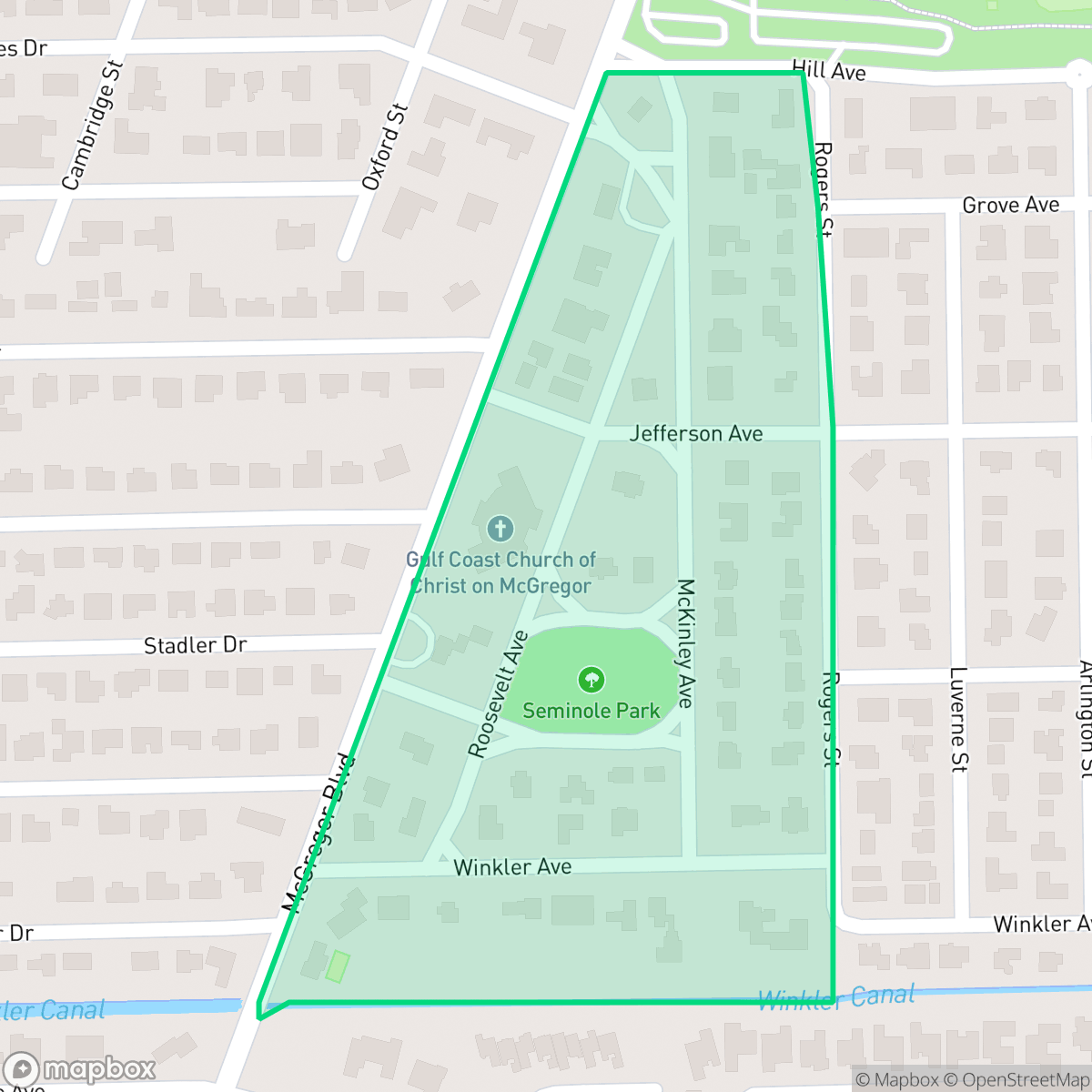
The Seminole Park Historic District in Fort Myers, Florida, emerged during the Florida land boom of the 1920s as part of the city's suburban expansion beyond its downtown core. Developed by Charles A. Stadler, the neighborhood was designed to accommodate the growing middle and upper-middle-class populations. It is characterized by its well-preserved architectural stock, which features a mix of Mediterranean Revival, Colonial Revival, and Craftsman Bungalow designs. The district is noted for its tranquil, tree-lined streets and the three-acre Seminole Park, which serves as the neighborhood's central green space. Situated near the historic McGregor Boulevard corridor, the area remains a testament to the residential development trends of the early 20th century, with many homes meticulously maintained or restored to reflect their original historical character.
The neighborhood offers a polished visual landscape characterized by manicured lawns and established homes. With a focus on residential and light commercial use, it maintains a distinct suburban feel that is free from industrial activity. The area fosters a balanced demographic mix, bringing together young professionals, families, and retirees in an environment that prioritizes community stability.
Prospective residents should note that while the district is highly walkable and provides better health insurance coverage than the city average, it does experience moderate traffic noise from nearby thoroughfares. The area is situated within a flood-prone zone, though it maintains higher safety levels than many surrounding parts of Fort Myers. It is best suited for those seeking a tranquil, established community that values historical charm and a pedestrian-oriented lifestyle.
Neighborhood Scores Across 15 Qualities
Residential spacing provides a moderate level of separation between homes. According to iHuus data, the neighborhood offers slightly more buffer between neighbors than the Fort Myers average.
Pedestrian movement is easy throughout the district due to a dense network of sidewalks and low-traffic residential streets. This level of accessibility is significantly higher than the Fort Myers average, according to iHuus data.
Large, well-maintained homes and private waterfront properties contribute to a visual landscape that is significantly more polished than the Fort Myers average. According to iHuus data, residents will find frequent upscale amenities such as manicured lawns and private backyard pools throughout the district.
Wide grassy verges and low traffic residential streets offer favorable conditions for walking dogs. According to iHuus data, this area provides better opportunities for pet exercise than the Fort Myers average.
Residential streets feature a blend of single-family homes and multi-family units within a setting that feels slightly less open than the Fort Myers average. According to iHuus data, the area maintains a settled suburban density rather than a true rural landscape.
Low commercial density creates a subdued atmosphere, though local dining options and nearby parks provide slightly more activity than the Fort Myers average according to iHuus data.
A steady hum of local traffic persists due to proximity to busy streets, though acoustic conditions remain more tranquil than the Fort Myers average according to iHuus data.
Air quality levels typically fluctuate between acceptable and unhealthy ranges, presenting occasional concerns for sensitive groups. According to iHuus data, conditions in this district are slightly better than the average seen across Fort Myers.
Industrial activity is virtually non-existent within the district, offering a much cleaner environment than the Fort Myers average. According to iHuus data, the area is comprised strictly of residential and light commercial uses with no detected warehouses or hazardous facilities.
Health insurance accessibility is notably higher in this district than the Fort Myers average, according to iHuus data.
Conservative political views hold a majority within the district, though there is a modest opposing presence. According to iHuus data, this leans slightly more conservative than the Fort Myers city average.
Residents live alongside a balanced mix of young professionals, families, and seniors. This demographic spread is slightly lower than the Fort Myers average, according to iHuus data.
Residual flood risks exist within this area as it falls inside a 500-year floodplain; however, safety levels remain notably higher than the Fort Myers average according to iHuus data.
Address-Level Insights for Seminole Park Historic District


iHuus Neighborhood Intelligence Insights
Get address-level neighborhood insights for Seminole Park Historic District
- Street-level scores — see how individual blocks compare, not just neighborhood averages
- Micro-zone boundaries — identify quiet pockets, flood boundaries, and walkable clusters before you visit
- 15 dimensions in full — walkability, noise, air quality, school quality, insurance coverage, population age profile, urban/rural index, and more
- Boundary risk alerts — know if your address sits near a block boundary where scores drop, the kind of detail no listing will ever mention
- School insights — individual school ratings and insights, not just district-level data
- Compare before you commit — side-by-side data across neighborhoods, down to block precision
No credit card required
Compare with Any Neighborhood
| Dimension | Seminole Park Historic District | Bowling Green |
|---|---|---|
| 🚶 Walkabilityavg 6.32 | ||
| 🔊 Acoustic Comfortavg 3.27 | ||
| 🤫 Privacy Indexavg 5.75 | ||
| 🎨 Visual Appealavg 6.48 | ||
| 🐕 Dog Friendlinessavg 5.85 | ||
| 🗺️ Urban-Rural Indexavg 6.87 | ||
| ✨ Neighborhood Vibeavg 2.85 | ||
| 🏥 Health Insurance Coverageavg 5.41 | ||
| 🌿 Air Qualityavg 5.73 | ||
| 🏭 Industrial Proximityavg 7.26 | ||
| 🌊 Flood Safetyavg 5.01 | ||
| 🗳️ Ideological Leanavg 3.37 | ||
| 👥 Population Age Profileavg 5.39 | ||
| 🔥 Fire Safety | ||
| 🏫 School Quality |
Seminole Park Historic District Rankings
School Districts Serving Seminole Park Historic District
School Insights for Seminole Park Historic District
Below average outcomes; significant attendance and academic challenges.
School Insights
See what's really behind every school rating near Seminole Park Historic District
- Individual school ratings — each school's own score with outcome context, not just a district average
- Enrollment & class size data — student-to-teacher ratio and how it compares to the state average
- Full demographics breakdown — ethnicity and gender composition for every school in the enrollment zone
- Every school in the district — all schools within the enrollment boundary ranked by rating, not just the closest one
- Grade levels & benchmarks — elementary through high school, with below/above state-average flags
No credit card required