South Middle River, Fort Lauderdale
Updated · 8,614 residents
South Middle River is a diverse, semi-rural enclave characterized by its extensive sidewalk network and abundant greenery. Residents enjoy a walkable environment with a balanced demographic mix, though they should be prepared for consistent ambient traffic noise and potential flood risks.
Key Highlights
About South Middle River
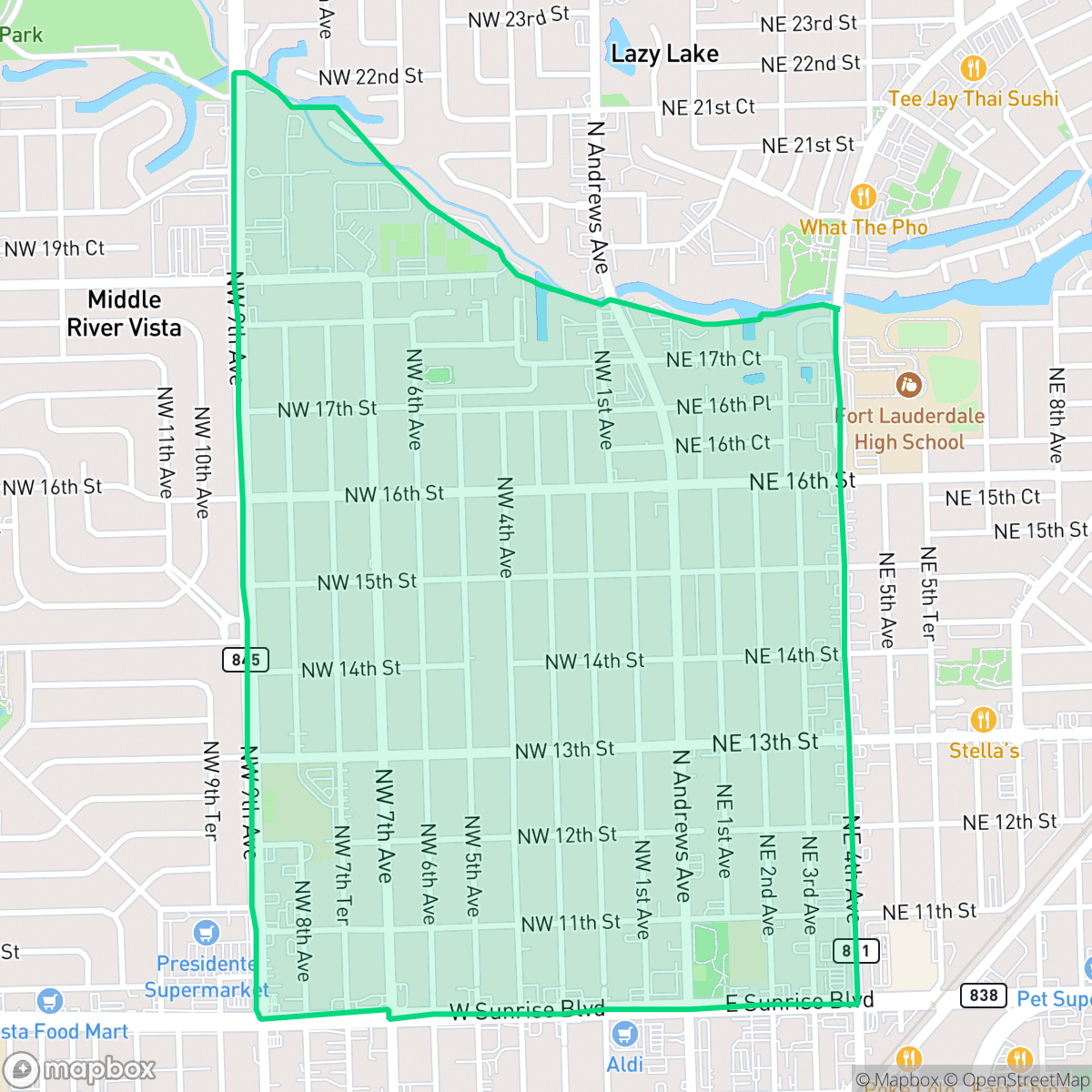
South Middle River, one of Fort Lauderdale's largest and most diverse neighborhoods, developed alongside the city's 1920s expansion, with significant residential growth occurring following World War II. The area features a distinct architectural mix ranging from Spanish Eclectic and Mission Revival styles to classic Florida bungalows and post-war ranch homes. Anchored by Warfield Park—the city's oldest park—the neighborhood is defined by its tree-lined streets and a unique local character where residents often encounter roaming peacocks. Culturally, the community is recognized for its significant Haitian and West Indian heritage and a long-standing, active civic association established in 1987. Positioned along the South Fork of the Middle River, the neighborhood maintains a strong sense of identity through its diverse demographic composition and commitment to preserving its established, residential atmosphere.
The area offers a spacious, semi-rural atmosphere that feels distinct from the dense urban core of Fort Lauderdale. With a strong commitment to civic engagement and a diverse cultural identity, it provides a quiet, tree-lined setting where residents benefit from reliable pedestrian infrastructure. The neighborhood maintains a consistent level of activity, featuring local eateries and wellness services that cater to a wide range of age groups and maintain a strong liberal-leaning community spirit. Prospective residents should weigh the benefits of this accessible, community-focused environment against certain environmental and infrastructural trade-offs. While the area provides cleaner air than the city average, it is situated within a designated floodplain and experiences a constant hum of traffic from nearby transit corridors. Additionally, while the local school district faces significant budgetary and enrollment challenges, the region remains a viable option for those seeking a balance of suburban openness and walkability.
Neighborhood Scores Across 15 Qualities
Housing density remains moderate with a mix of spaced lots and closer-set multi-family structures. According to iHuus data, the amount of buffer between neighbors is slightly higher than the Fort Lauderdale average.
Consistent sidewalk networks and safe crossings throughout much of the residential grid make walking more efficient here than in the rest of Fort Lauderdale. While major arterials can present occasional barriers, many routes connect easily to local commercial corridors and parks.
Residential views consist mainly of uniform tract housing with modest yards and boxy rooflines. While some pockets feature manicured lawns and private pools, the overall visual landscape sits slightly below the Fort Lauderdale average.
Access to public dog walking areas varies significantly by street, as some sections feature large nature preserves and canal-side paths while others rely almost entirely on private fenced yards. This level of amenity is slightly above the Fort Lauderdale average according to iHuus data.
Frequent open land and scattered homes amidst woodland provide a more spacious feel than much of Fort Lauderdale. According to iHuus data, this area maintains a slightly higher degree of open space and greenery compared to the city average.
Vibrant pockets of dining, cafes, and transit hubs offer a more active atmosphere than the Fort Lauderdale average. Residents can find a steady mix of amenities ranging from local eateries to wellness services within several walkable suburban clusters.
Local traffic from nearby busy streets creates a consistent level of ambient noise. This acoustic environment remains slightly more active than the average for Fort Lauderdale.
Air quality remains mostly clean with rare instances of elevated readings. According to iHuus data, these levels are notably better than the Fort Lauderdale city average.
Primarily residential in character, this area lacks heavy manufacturing but experiences higher levels of truck traffic and noise near major corridors than the Fort Lauderdale average. Residents should note that while large-scale industrial hazards are absent, some proximity to warehouses, rail lines, and a nearby Superfund site exists.
Health insurance coverage among residents is lower than the Fort Lauderdale average, according to iHuus data. This indicates a higher proportion of uninsured individuals compared to other parts of the city.
Voting patterns and census indicators show a significantly more liberal leaning than the Fort Lauderdale average, according to iHuus data.
Residents will find a balanced mix of young adults, families, and seniors living in the area. According to iHuus data, this demographic spread is largely consistent with the broader Fort Lauderdale population.
Significant flood risk exists here due to the area's location within a designated floodplain; according to iHuus data, this level of vulnerability is consistent with the broader Fort Lauderdale area.
Address-Level Insights for South Middle River


iHuus Neighborhood Intelligence Insights
Get address-level neighborhood insights for South Middle River
- Street-level scores — see how individual blocks compare, not just neighborhood averages
- Micro-zone boundaries — identify quiet pockets, flood boundaries, and walkable clusters before you visit
- 15 dimensions in full — walkability, noise, air quality, school quality, insurance coverage, population age profile, urban/rural index, and more
- Boundary risk alerts — know if your address sits near a block boundary where scores drop, the kind of detail no listing will ever mention
- School insights — individual school ratings and insights, not just district-level data
- Compare before you commit — side-by-side data across neighborhoods, down to block precision
No credit card required
Compare with Any Neighborhood
| Dimension | South Middle River | Bal Harbour |
|---|---|---|
| 🚶 Walkabilityavg 6.6 | ||
| 🔊 Acoustic Comfortavg 3.24 | ||
| 🤫 Privacy Indexavg 5.33 | ||
| 🎨 Visual Appealavg 6.66 | ||
| 🐕 Dog Friendlinessavg 4.88 | ||
| 🗺️ Urban-Rural Indexavg 6.04 | ||
| ✨ Neighborhood Vibeavg 4.63 | ||
| 🏥 Health Insurance Coverageavg 6.16 | ||
| 🌿 Air Qualityavg 6.61 | ||
| 🏭 Industrial Proximityavg 6.49 | ||
| 🌊 Flood Safetyavg 3.54 | ||
| 🗳️ Ideological Leanavg 6.3 | ||
| 👥 Population Age Profileavg 5.2 | ||
| 🔥 Fire Safety | ||
| 🏫 School Quality |
South Middle River Rankings
School Districts Serving South Middle River
School Insights for South Middle River
Below average outcomes; significant attendance and academic challenges.
School Insights
See what's really behind every school rating near South Middle River
- Individual school ratings — each school's own score with outcome context, not just a district average
- Enrollment & class size data — student-to-teacher ratio and how it compares to the state average
- Full demographics breakdown — ethnicity and gender composition for every school in the enrollment zone
- Every school in the district — all schools within the enrollment boundary ranked by rating, not just the closest one
- Grade levels & benchmarks — elementary through high school, with below/above state-average flags
No credit card required