Shady Banks, Fort Lauderdale
Updated · 1,461 residents
Shady Banks is a quiet, semi-rural enclave in Fort Lauderdale defined by its upscale waterfront residences and lush, tree-lined streets. While the area offers a spacious atmosphere with clean air, residents often contend with traffic noise from nearby transit corridors and limited pedestrian access.
Key Highlights
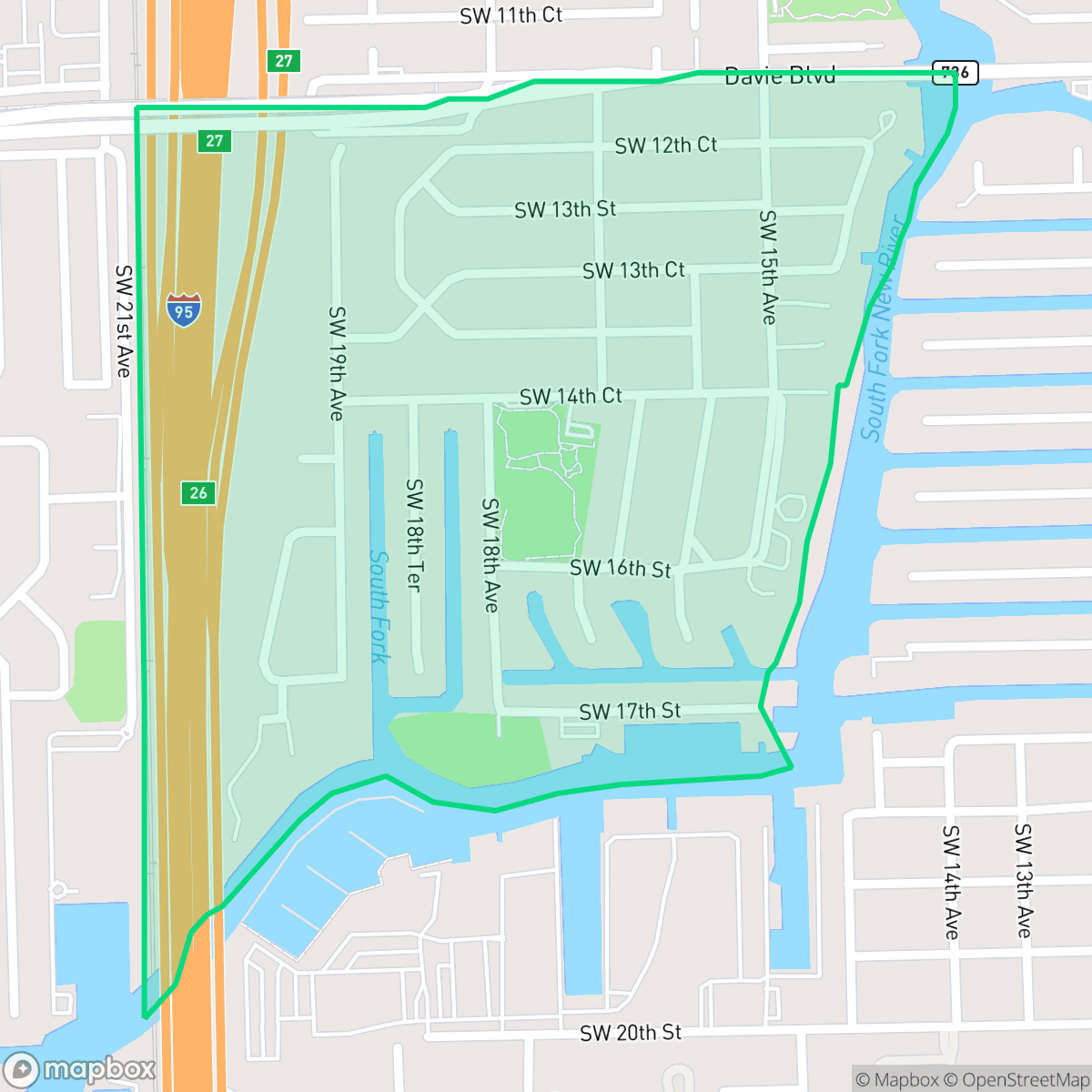
About Shady Banks
Shady Banks is a residential neighborhood in Fort Lauderdale situated along the banks of the South Fork of the New River. Historically, the area gained a reputation for its secluded riverfront access, which, according to local lore, was once utilized by illicit smugglers to transport goods via boat docks integrated into residential structures. Today, the neighborhood is characterized by its lush, tree-lined streets and significant green spaces, including Hortt Park—which occupies the site of the former Hortt School—and the Bill Keith Preserve, a four-acre riverfront nature area established in 2005. The neighborhood maintains a distinct community identity supported by the Shady Banks Civic Association, which organizes local events. It has been the subject of city-led architectural resource surveys, reflecting its collection of mid-century residential stock and its evolution into a quiet, suburban-style enclave within the city.
The area stands out for its unique blend of suburban privacy and scenic riverfront views. Large single-family homes with private docks and swimming pools contribute to a visually appealing landscape that feels more open than the typical urban core of Fort Lauderdale. According to iHuus data, the neighborhood maintains a cleaner air profile than the average found throughout the city. The atmosphere is generally subdued, catering to those who prefer a quiet residential environment over the bustle of the city center.
Prospective residents should consider the practical trade-offs of living in this location. The neighborhood faces a high risk of flooding, making flood insurance a standard necessity for property owners. Additionally, while the streets are picturesque, the presence of major highways and railway lines creates significant barriers to walking and contributes to frequent traffic noise. The area is best suited for individuals who prioritize a spacious, semi-rural aesthetic and waterfront access, provided they are prepared for the logistical challenges of a fragmented pedestrian environment and the need for comprehensive flood protection.
Neighborhood Scores Across 15 Qualities
Housing density varies throughout the area, ranging from closely packed units to standard suburban spacing. According to iHuus data, this level of privacy is slightly higher than the Fort Lauderdale average.
Sidewalks are available along many residential streets, but large highways and railway corridors act as significant barriers to pedestrian movement. This makes navigating the neighborhood on foot slightly more difficult than in other parts of Fort Lauderdale.
Scenic views of private docks and swimming pools are common throughout this area. According to iHuus data, the neighborhood features a higher density of large homes and premium amenities than the Fort Lauderdale average.
Public green space and accessible parks are scarce in this area. Narrow sidewalks and limited park access make it less dog friendly than the rest of Fort Lauderdale, according to iHuus data.
Open land and scattered residential pockets provide a more spacious feel than the typical Fort Lauderdale urban core. This semi-rural setting features a mix of woodland and single-family homes that is slightly less dense than the city average.
Local activity is primarily residential and subdued, offering a quieter atmosphere than the average Fort Lauderdale neighborhood. Commercial options are limited to small clusters of dining and service providers scattered throughout the area.
Continuous sound from nearby major roadways and transit corridors characterizes the area. According to iHuus data, acoustic disturbance levels are slightly higher than the Fort Lauderdale average.
Air quality remains consistently high with rare instances of elevated readings. This level of cleanliness is notably better than the average found throughout Fort Lauderdale, according to iHuus data.
Heavy industrial activity is largely absent, though residents may encounter light commercial traffic and minor utility odors near local service stations. According to iHuus data, this area maintains a cleaner profile regarding industrial proximity than the Fort Lauderdale average.
Health insurance enrollment in Shady Banks is slightly below the Fort Lauderdale average, according to iHuus data. Residents may find fewer subsidized coverage options available within the immediate area compared to other parts of the city.
Political leanings in Shady Banks align closely with the broader Fort Lauderdale area, characterized by a liberal majority and a modest opposing presence according to iHuus data.
Residents live in a demographic landscape that features a relatively even distribution of young adults, families, and older individuals. This population spread is largely consistent with the broader Fort Lauderdale area, according to iHuus data.
Significant flood risk exists here as parts of the area fall within the 100-year floodplain; this level of risk is slightly higher than the Fort Lauderdale average. According to iHuus data, residents should anticipate that flood insurance will likely be a requirement for properties in this neighborhood.
Address-Level Insights for Shady Banks


iHuus Neighborhood Intelligence Insights
Get address-level neighborhood insights for Shady Banks
- Street-level scores — see how individual blocks compare, not just neighborhood averages
- Micro-zone boundaries — identify quiet pockets, flood boundaries, and walkable clusters before you visit
- 15 dimensions in full — walkability, noise, air quality, school quality, insurance coverage, population age profile, urban/rural index, and more
- Boundary risk alerts — know if your address sits near a block boundary where scores drop, the kind of detail no listing will ever mention
- School insights — individual school ratings and insights, not just district-level data
- Compare before you commit — side-by-side data across neighborhoods, down to block precision
No credit card required
Compare with Any Neighborhood
| Dimension | Shady Banks | Bal Harbour |
|---|---|---|
| 🚶 Walkabilityavg 6.6 | ||
| 🔊 Acoustic Comfortavg 3.24 | ||
| 🤫 Privacy Indexavg 5.33 | ||
| 🎨 Visual Appealavg 6.66 | ||
| 🐕 Dog Friendlinessavg 4.88 | ||
| 🗺️ Urban-Rural Indexavg 6.04 | ||
| ✨ Neighborhood Vibeavg 4.63 | ||
| 🏥 Health Insurance Coverageavg 6.16 | ||
| 🌿 Air Qualityavg 6.61 | ||
| 🏭 Industrial Proximityavg 6.49 | ||
| 🌊 Flood Safetyavg 3.54 | ||
| 🗳️ Ideological Leanavg 6.3 | ||
| 👥 Population Age Profileavg 5.2 | ||
| 🔥 Fire Safety | ||
| 🏫 School Quality |
Shady Banks Rankings
School Districts Serving Shady Banks
School Insights for Shady Banks
Below average outcomes; significant attendance and academic challenges.
School Insights
See what's really behind every school rating near Shady Banks
- Individual school ratings — each school's own score with outcome context, not just a district average
- Enrollment & class size data — student-to-teacher ratio and how it compares to the state average
- Full demographics breakdown — ethnicity and gender composition for every school in the enrollment zone
- Every school in the district — all schools within the enrollment boundary ranked by rating, not just the closest one
- Grade levels & benchmarks — elementary through high school, with below/above state-average flags
No credit card required