Seven Isles, Fort Lauderdale
Updated · 1,003 residents
Seven Isles is a prestigious waterfront enclave in Fort Lauderdale defined by its seven peninsulas and deep-water canals that support large, luxury estates. While the area offers a quiet, upscale atmosphere, residents should be aware of significant flood risks and occasional noise from nearby flight paths and transit routes.
Key Highlights
About Seven Isles
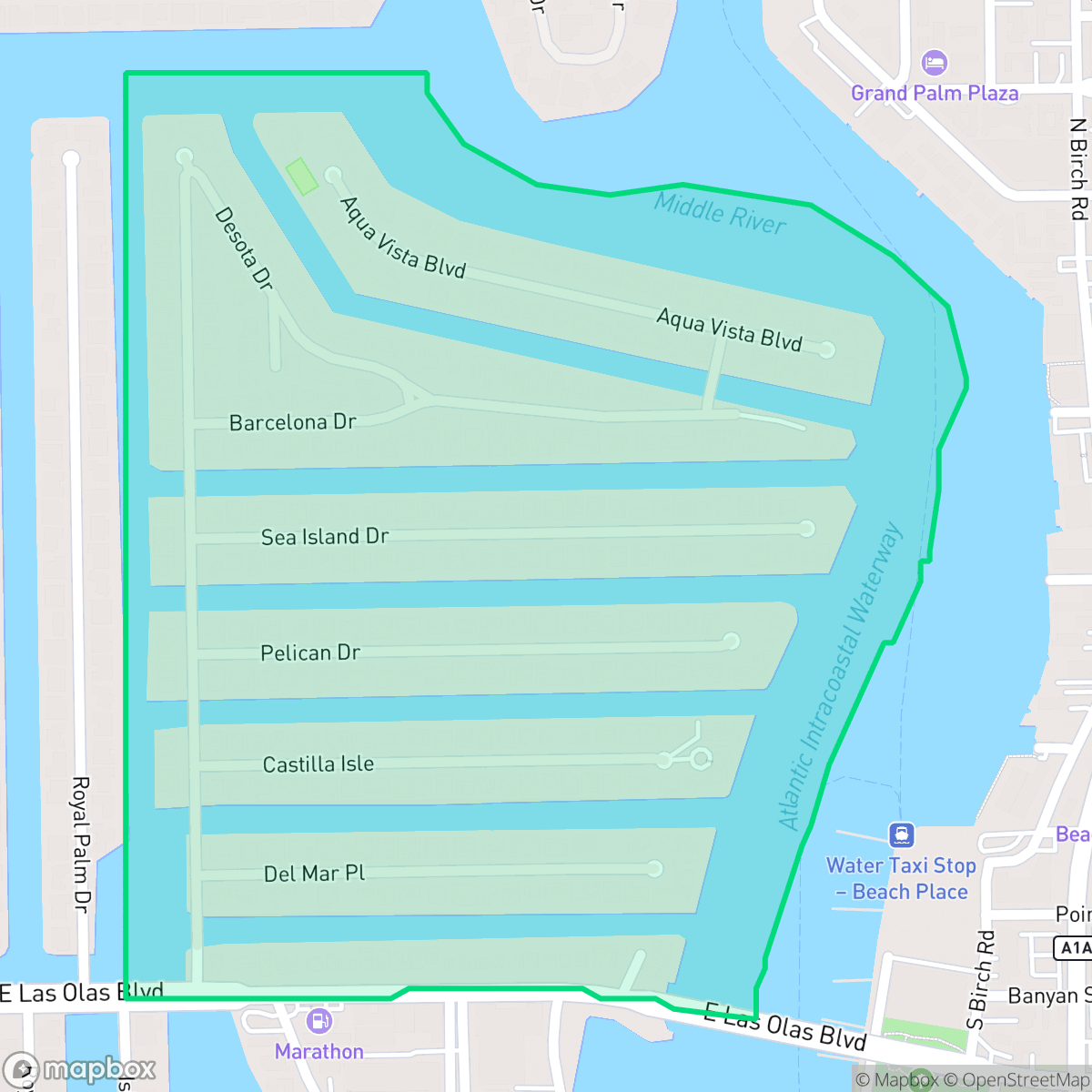
Developed during the 1920s Florida land boom, Seven Isles was carved from mangrove marshes by developer W.F. Morang, who utilized finger-island dredging to create a waterfront enclave. Originally marketed as 'Lauderdale Isles' and 'Lauderdale Shores,' the project was halted by the 1926 hurricane and material shortages, which also ended construction of the planned Croissantania hotel on Aqua Vista Boulevard. A historical vestige of this era remains: a surviving pedestal from Morang’s original twin-column gateway stands near East Las Olas Boulevard. Though initially platted with 50-foot lots, the neighborhood evolved through post-war growth and subsequent re-platting into a prestigious community of large, single-family estates. Today, the neighborhood is defined by its seven distinct peninsulas, deep-water canals, and a private, guard-gated character that emphasizes its maritime heritage.
The area provides a semi-rural feel within the city, characterized by manicured landscapes, private pools, and expansive properties that overlook the water. It maintains a subdued, suburban rhythm that appeals to those seeking privacy and a maritime-focused lifestyle. According to iHuus data, the neighborhood is notably free from heavy industry, contributing to a tranquil environment despite the presence of some noise from regional transit and aircraft.
Prospective residents should consider that the community is better suited for those who prioritize aesthetic appeal and waterfront access over walkability or public green space. The lack of continuous sidewalks and limited local parks makes it less ideal for dog owners, while the designated floodplain status necessitates careful consideration of insurance requirements. With a predominantly mature population, the area offers a stable, quiet residential experience for those who value exclusivity and high-quality local amenities.
Neighborhood Scores Across 15 Qualities
Residential spacing offers a moderate level of seclusion with some buffer between neighbors. According to iHuus data, houses are occasionally situated closely on narrow strips of land, though the overall privacy levels remain similar to the Fort Lauderdale average.
Low-traffic finger streets provide a safe environment for strolling, though the lack of continuous sidewalks makes it slightly less walkable than the Fort Lauderdale average.
Extensive waterfront estates, private pools, and large yachts create a highly manicured landscape that is significantly more visually impressive than the Fort Lauderdale average. According to iHuus data, the area is characterized by premium amenities and expansive properties.
Residential streets feature narrow verges and a lack of direct access to public parks. Most available greenery consists of private yards along the canals, making this area less dog friendly than much of Fort Lauderdale according to iHuus data.
Open land and scattered greenery provide a more semi-rural atmosphere than the typical Fort Lauderdale urban landscape. Residents may find a mix of canal-side homes situated near pockets of woodland, according to iHuus data.
Subdued activity levels and a suburban atmosphere define this area, which feels slightly less active than the Fort Lauderdale average. Residents can access local parks and waterfront dining, though the neighborhood lacks the dense energy of more urban districts according to iHuus data.
Frequent sounds from nearby major transit routes and flight paths characterize the area. According to iHuus data, noise levels are slightly higher than the typical experience found across Fort Lauderdale.
Air quality remains consistently good with only rare instances of elevated readings; levels are roughly in line with the Fort Lauderdale average according to iHuus data.
Residential streets and green spaces are largely free from heavy industry, offering a much quieter environment than the Fort Lauderdale average. According to iHuus data, the area contains only occasional light commercial uses such as small restaurants or nearby marina infrastructure.
Health insurance accessibility is exceptionally high among residents, significantly surpassing the Fort Lauderdale city average according to iHuus data.
Political leanings in this area are relatively even, representing a more moderate split than the more liberal leaning seen across much of Fort Lauderdale.
Older adults comprise the majority of the population, representing a more mature demographic than seen in much of Fort Lauderdale. According to iHuus data, there is only a modest presence of younger residents in this area.
Located within a designated floodplain, this area faces significant flood risks that are higher than the Fort Lauderdale average. Residents should expect potential requirements for flood insurance according to iHuus data.
Address-Level Insights for Seven Isles


iHuus Neighborhood Intelligence Insights
Get address-level neighborhood insights for Seven Isles
- Street-level scores — see how individual blocks compare, not just neighborhood averages
- Micro-zone boundaries — identify quiet pockets, flood boundaries, and walkable clusters before you visit
- 15 dimensions in full — walkability, noise, air quality, school quality, insurance coverage, population age profile, urban/rural index, and more
- Boundary risk alerts — know if your address sits near a block boundary where scores drop, the kind of detail no listing will ever mention
- School insights — individual school ratings and insights, not just district-level data
- Compare before you commit — side-by-side data across neighborhoods, down to block precision
No credit card required
Compare with Any Neighborhood
| Dimension | Seven Isles | Bal Harbour |
|---|---|---|
| 🚶 Walkabilityavg 6.6 | ||
| 🔊 Acoustic Comfortavg 3.24 | ||
| 🤫 Privacy Indexavg 5.33 | ||
| 🎨 Visual Appealavg 6.66 | ||
| 🐕 Dog Friendlinessavg 4.88 | ||
| 🗺️ Urban-Rural Indexavg 6.04 | ||
| ✨ Neighborhood Vibeavg 4.63 | ||
| 🏥 Health Insurance Coverageavg 6.16 | ||
| 🌿 Air Qualityavg 6.61 | ||
| 🏭 Industrial Proximityavg 6.49 | ||
| 🌊 Flood Safetyavg 3.54 | ||
| 🗳️ Ideological Leanavg 6.3 | ||
| 👥 Population Age Profileavg 5.2 | ||
| 🔥 Fire Safety | ||
| 🏫 School Quality |
Seven Isles Rankings
School Districts Serving Seven Isles
School Insights for Seven Isles
Below average outcomes; significant attendance and academic challenges.
School Insights
See what's really behind every school rating near Seven Isles
- Individual school ratings — each school's own score with outcome context, not just a district average
- Enrollment & class size data — student-to-teacher ratio and how it compares to the state average
- Full demographics breakdown — ethnicity and gender composition for every school in the enrollment zone
- Every school in the district — all schools within the enrollment boundary ranked by rating, not just the closest one
- Grade levels & benchmarks — elementary through high school, with below/above state-average flags
No credit card required