Sailboat Bend, Fort Lauderdale
Updated · 2,623 residents
Sailboat Bend is a historic riverfront enclave defined by its architectural charm and bohemian atmosphere. While the area offers a walkable grid and picturesque waterfront views, residents should prepare for frequent traffic noise and a high risk of flooding.
Key Highlights
About Sailboat Bend
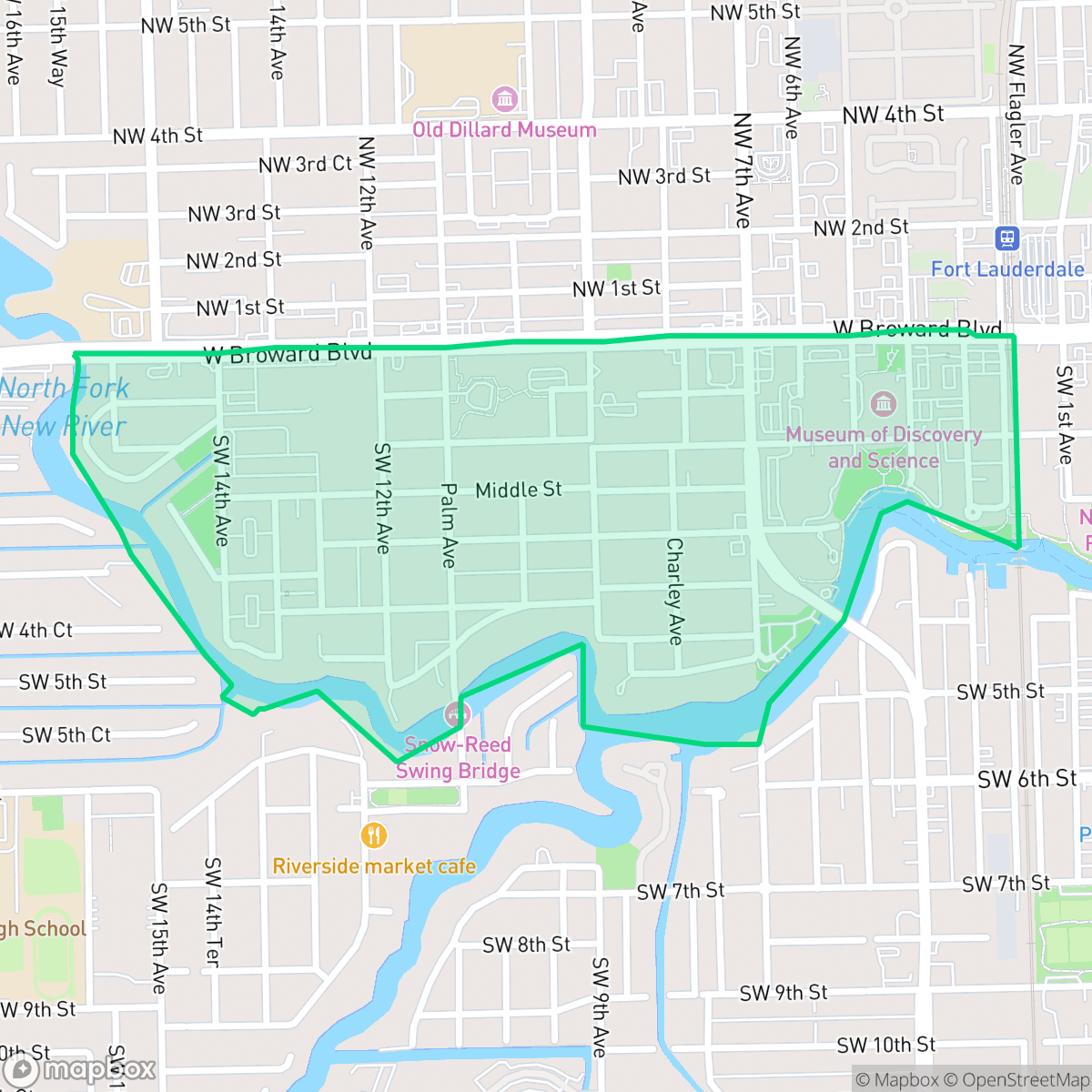
Sailboat Bend, Fort Lauderdale’s first designated historic district, is a riverfront neighborhood named for its location along a prominent bend in the New River. Originally settled as a working-class community in the early 1900s, it features a rich collection of 1920s and 1930s bungalows and Mission Revival-style homes. The area holds deep historical significance, with evidence of early Tequesta habitation and potential ties to the Second Seminole War. A defining landmark is the 1922 swing bridge, one of the few remaining examples of its kind in Florida. After a period of decline, the neighborhood was revitalized in the 1980s by residents who preserved its unique architectural character and lush, tree-lined streets. Today, it remains a distinct, bohemian enclave that serves as a historic contrast to the modern development of downtown Fort Lauderdale.
The area serves as a distinct residential pocket that maintains a balanced mix of single-family homes and multi-story dwellings. Its visual appeal is anchored by expansive canal views and well-maintained estates, creating an environment that feels more polished than many surrounding locales. The community fosters a diverse generational mix, attracting both young professionals and older residents who appreciate the neighborhood's liberal-leaning social climate and active, yet suburban, pace of life.
Prospective residents should weigh the aesthetic benefits against several practical considerations. The neighborhood experiences persistent sounds from nearby transit and flight paths, and its location within a floodplain necessitates careful attention to insurance requirements. While the streets are generally pedestrian-friendly, the privacy levels vary significantly between waterfront properties and more densely packed interior lots. Families should also consider the broader context of the Broward County School District, which currently manages significant budgetary and operational shifts while maintaining its core academic pillars.
Neighborhood Scores Across 15 Qualities
Residential spacing varies throughout the area; waterfront estates provide more separation, while inland homes and multi-family units sit closer together than the Fort Lauderdale average.
Sidewalk connectivity is consistent throughout the residential streets, offering slightly better pedestrian access than the Fort Lauderdale average. While tree canopy sometimes obscures paths, many areas feature a reliable grid and pedestrian bridges over the river.
Waterfront properties featuring private docks, large boats, and well-maintained estates provide a visual landscape that is more polished than the Fort Lauderdale average. According to iHuus data, the presence of numerous private pools and expansive canals contributes to an aesthetically pleasing environment.
Access to public parks and wide walking verges is somewhat restricted due to the predominance of private residential yards. This area offers slightly better pet accessibility than the Fort Lauderdale average, though most greenery consists of private property along canal edges.
Residential streets and green spaces are distributed in equal measure, matching the typical urban-rural balance found across Fort Lauderdale. This landscape features a mix of single-family homes and multi-story dwellings nestled within a dense suburban grid.
Active pockets of dining and entertainment are balanced by quieter, suburban residential areas near local parks. This level of activity sits slightly above the Fort Lauderdale average according to iHuus data.
Persistent sounds from nearby transit corridors and flight paths characterize the area. According to iHuus data, noise levels are slightly higher than the Fort Lauderdale average.
Air quality remains consistently clear with rare instances of elevated readings, performing significantly better than the Fort Lauderdale average according to iHuus data.
Industrial presence is minimal throughout most of the area, though some light commercial warehouses and a utility substation are located near the eastern edge. According to iHuus data, this neighborhood maintains a lower level of industrial proximity compared to the Fort Lauderdale average.
Health insurance access among residents is slightly below the Fort Lauderdale average, according to iHuus data.
Political leanings in this area are notably more liberal than the Fort Lauderdale average. According to iHuus data, the community maintains a liberal majority with a modest opposing presence.
Residents experience a diverse age distribution ranging from young professionals to older adults. This demographic spread is slightly more varied than the average seen across Fort Lauderdale, according to iHuus data.
Frequent flooding risks exist due to the area's location within a designated floodplain, which is slightly higher than the Fort Lauderdale average. Residents should expect that flood insurance will likely be required for properties in this neighborhood according to iHuus data.
Address-Level Insights for Sailboat Bend


iHuus Neighborhood Intelligence Insights
Get address-level neighborhood insights for Sailboat Bend
- Street-level scores — see how individual blocks compare, not just neighborhood averages
- Micro-zone boundaries — identify quiet pockets, flood boundaries, and walkable clusters before you visit
- 15 dimensions in full — walkability, noise, air quality, school quality, insurance coverage, population age profile, urban/rural index, and more
- Boundary risk alerts — know if your address sits near a block boundary where scores drop, the kind of detail no listing will ever mention
- School insights — individual school ratings and insights, not just district-level data
- Compare before you commit — side-by-side data across neighborhoods, down to block precision
No credit card required
Compare with Any Neighborhood
| Dimension | Sailboat Bend | Bal Harbour |
|---|---|---|
| 🚶 Walkabilityavg 6.6 | ||
| 🔊 Acoustic Comfortavg 3.24 | ||
| 🤫 Privacy Indexavg 5.33 | ||
| 🎨 Visual Appealavg 6.66 | ||
| 🐕 Dog Friendlinessavg 4.88 | ||
| 🗺️ Urban-Rural Indexavg 6.04 | ||
| ✨ Neighborhood Vibeavg 4.63 | ||
| 🏥 Health Insurance Coverageavg 6.16 | ||
| 🌿 Air Qualityavg 6.61 | ||
| 🏭 Industrial Proximityavg 6.49 | ||
| 🌊 Flood Safetyavg 3.54 | ||
| 🗳️ Ideological Leanavg 6.3 | ||
| 👥 Population Age Profileavg 5.2 | ||
| 🔥 Fire Safety | ||
| 🏫 School Quality |
Sailboat Bend Rankings
School Districts Serving Sailboat Bend
School Insights for Sailboat Bend
Below average outcomes; significant attendance and academic challenges.
School Insights
See what's really behind every school rating near Sailboat Bend
- Individual school ratings — each school's own score with outcome context, not just a district average
- Enrollment & class size data — student-to-teacher ratio and how it compares to the state average
- Full demographics breakdown — ethnicity and gender composition for every school in the enrollment zone
- Every school in the district — all schools within the enrollment boundary ranked by rating, not just the closest one
- Grade levels & benchmarks — elementary through high school, with below/above state-average flags
No credit card required