Riverside Park, Fort Lauderdale
Updated · 3,890 residents
Riverside Park is a tranquil, historic neighborhood defined by its unique peninsular setting between the forks of the New River. Residents enjoy a polished aesthetic with waterfront estates and mature oak-lined streets, though the area faces challenges from high traffic noise and limited public green spaces.
Key Highlights
About Riverside Park
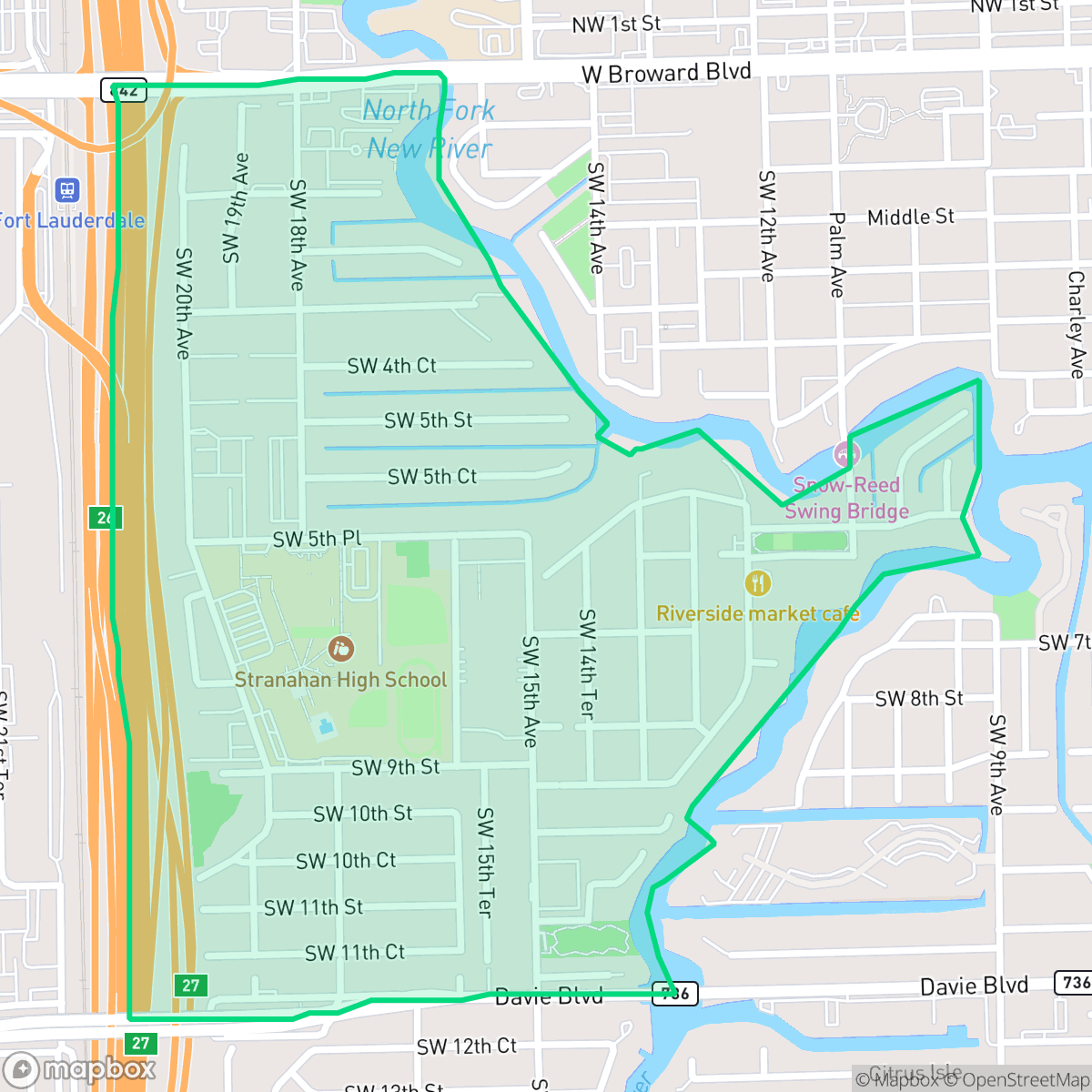
Riverside Park is a historic neighborhood situated on a peninsula between the North and South Forks of the New River in Fort Lauderdale. Dating back to the early 1900s, the area originally served as a trading point for produce transported along the river. Residential development expanded significantly in the 1950s to support post-WWII growth. The neighborhood is defined by its eclectic architecture, live oak-canopied streets, and its connection to the city via a historic swing bridge. A prominent local landmark is the 'Little Florida' residence, a home uniquely shaped like the state of Florida. In 1973, residents formed the Riverside Park Residents' Association to address local challenges, fostering a strong community identity that remains active today through initiatives like the 'Green Your Routine' program.
The area maintains a distinct suburban character, blending single-family homes with multi-story apartment clusters. Its visual appeal is bolstered by private docks and swimming pools, creating an upscale atmosphere that feels separated from the city's denser urban core. While the neighborhood offers a quiet, liberal-leaning community, it is notably exposed to noise from major transit corridors and freight logistics hubs. According to iHuus data, the area provides a diverse age demographic, though residents should be aware that the local school district is currently navigating significant budgetary and operational transitions.
Prospective residents should note that the neighborhood is located within a designated floodplain, which often necessitates flood insurance. Walkability is hampered by significant rail and highway barriers, making it better suited for those who rely on personal vehicles rather than pedestrians. While the area is largely quiet, the combination of transit-related noise and limited public park access makes it a specific fit for those prioritizing waterfront living over proximity to urban amenities.
Neighborhood Scores Across 15 Qualities
Housing density varies across the area, with waterfront estates providing more separation than closer-set inland homes and apartment clusters. Residents can expect more spacing than typical for Fort Lauderdale, though some denser pockets feature structures positioned quite near one another according to iHuus data.
Residential streets offer low traffic and heavy tree canopy, though major highway and rail corridors significantly limit connectivity. Walking ease falls below the Fort Lauderdale average due to these large-scale transit barriers.
Properties often feature private docks, swimming pools, and large waterfront lots. This visual landscape is slightly more polished than the Fort Lauderdale average, according to iHuus data.
Publicly accessible green space and park access are relatively sparse within the neighborhood. Most vegetation consists of private residential yards and narrow street verges, making it slightly below the Fort Lauderdale average for dog-friendly amenities.
Residential layouts feature a mix of single-family homes and multi-story apartments situated within a suburban landscape. This area presents more open land and scattered greenery than the typical urban density found in Fort Lauderdale.
Local activity levels are lower than the Fort Lauderdale average, as the area primarily functions as a tranquil residential landscape with limited commercial density. While some pockets offer moderate walkability near local parks and dining, much of the neighborhood is characterized by a subdued, suburban atmosphere.
Frequent disturbances from nearby transit corridors and heavy traffic patterns characterize this area. According to iHuus data, noise levels are notably higher than the Fort Lauderdale average.
Air quality remains consistently high with rare instances of elevated readings. This level of cleanliness is notably better than the Fort Lauderdale average, according to iHuus data.
Primarily residential in nature, this area features occasional light commercial activity and warehouses that bring moderate traffic. Some portions near the eastern edge experience higher noise levels from logistics hubs and freight movement compared to the city average, according to iHuus data.
Health insurance enrollment in this area is lower than the Fort Lauderdale average, according to iHuus data.
Political leanings in this area trend significantly more liberal than the Fort Lauderdale average. Residents may find a community with distinct progressive values according to iHuus data.
Residents live alongside a balanced demographic of young professionals, families, and seniors. This age distribution is largely in line with the Fort Lauderdale average according to iHuus data.
Properties in this area are situated within a designated floodplain, making flood insurance a typical requirement for residents. This level of vulnerability is slightly higher than the average seen across Fort Lauderdale.
Address-Level Insights for Riverside Park


iHuus Neighborhood Intelligence Insights
Get address-level neighborhood insights for Riverside Park
- Street-level scores — see how individual blocks compare, not just neighborhood averages
- Micro-zone boundaries — identify quiet pockets, flood boundaries, and walkable clusters before you visit
- 15 dimensions in full — walkability, noise, air quality, school quality, insurance coverage, population age profile, urban/rural index, and more
- Boundary risk alerts — know if your address sits near a block boundary where scores drop, the kind of detail no listing will ever mention
- School insights — individual school ratings and insights, not just district-level data
- Compare before you commit — side-by-side data across neighborhoods, down to block precision
No credit card required
Compare with Any Neighborhood
| Dimension | Riverside Park | Bal Harbour |
|---|---|---|
| 🚶 Walkabilityavg 6.6 | ||
| 🔊 Acoustic Comfortavg 3.24 | ||
| 🤫 Privacy Indexavg 5.33 | ||
| 🎨 Visual Appealavg 6.66 | ||
| 🐕 Dog Friendlinessavg 4.88 | ||
| 🗺️ Urban-Rural Indexavg 6.04 | ||
| ✨ Neighborhood Vibeavg 4.63 | ||
| 🏥 Health Insurance Coverageavg 6.16 | ||
| 🌿 Air Qualityavg 6.61 | ||
| 🏭 Industrial Proximityavg 6.49 | ||
| 🌊 Flood Safetyavg 3.54 | ||
| 🗳️ Ideological Leanavg 6.3 | ||
| 👥 Population Age Profileavg 5.2 | ||
| 🔥 Fire Safety | ||
| 🏫 School Quality |
Riverside Park Rankings
School Districts Serving Riverside Park
School Insights for Riverside Park
Below average outcomes; significant attendance and academic challenges.
School Insights
See what's really behind every school rating near Riverside Park
- Individual school ratings — each school's own score with outcome context, not just a district average
- Enrollment & class size data — student-to-teacher ratio and how it compares to the state average
- Full demographics breakdown — ethnicity and gender composition for every school in the enrollment zone
- Every school in the district — all schools within the enrollment boundary ranked by rating, not just the closest one
- Grade levels & benchmarks — elementary through high school, with below/above state-average flags
No credit card required