Riverland Village, Fort Lauderdale
Updated · 2,065 residents
Riverland Village offers a tranquil, suburban atmosphere defined by its mid-century architecture and scenic canal-front properties. The neighborhood provides a quiet, low-traffic environment that appeals to those seeking a retreat from the bustle of central Fort Lauderdale.
Key Highlights
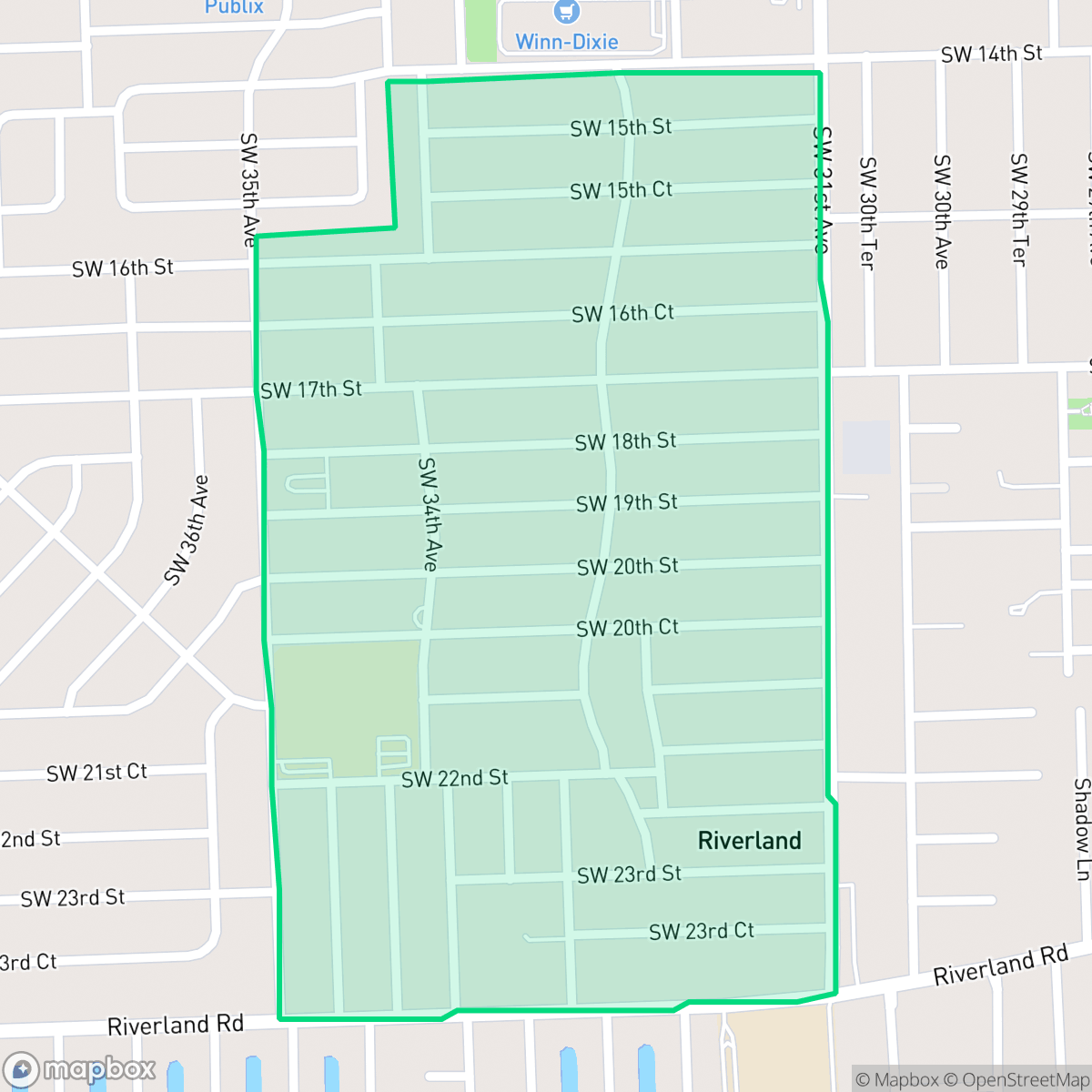
About Riverland Village
Riverland Village, located in southwest Fort Lauderdale, was primarily developed in the mid-1950s as a seasonal retreat for winter residents. Originally a census-designated place outside city limits, the neighborhood was officially annexed by the City of Fort Lauderdale in 2002. Its architectural character is defined by a concentration of mid-century ranch homes and bungalows situated on spacious lots. The neighborhood is geographically linked to the South Fork of the New River, with the South Fork New River Greenway providing recreational access to the waterway. A central landmark for the community is Riverland Park, which serves as a hub for local families. Known for its quiet, tree-lined streets, Riverland Village maintains a distinct residential identity that balances its mid-century suburban roots with its modern status as an established Fort Lauderdale neighborhood.
This area is characterized by its well-manicured residential streets and an abundance of mature tree cover, creating a distinct visual appeal that stands out from more dense parts of the city. Residents enjoy a relatively quiet acoustic environment, with minimal industrial presence and a layout that emphasizes privacy through moderate spacing between homes. The neighborhood functions as a low-key suburban hub, where the pace of life remains slow and the focus is on residential comfort and access to the local waterway. While the area offers a serene lifestyle, prospective residents should be aware of the elevated flood risk associated with its geography, which often necessitates specific insurance considerations. Pedestrian accessibility is somewhat limited due to an inconsistent sidewalk network, making personal vehicles the primary mode of transportation. Additionally, while the community benefits from its proximity to green spaces, families should consider the current landscape of the Broward County school district, which is navigating a period of significant structural and budgetary change.
Neighborhood Scores Across 15 Qualities
Residential spacing provides a moderate level of separation between neighbors, which is slightly higher than the Fort Lauderdale average. While some areas feature clustered homes with narrow side yards, many properties maintain enough distance or vegetation to offer a buffer from adjacent structures.
Low-traffic residential grids provide safe walking conditions despite an inconsistent sidewalk network. According to iHuus data, pedestrian accessibility in this area is slightly lower than the Fort Lauderdale average.
Large homes with private pools and canal-front boat docks characterize the landscape, offering a more polished aesthetic than the Fort Lauderdale average. According to iHuus data, the area features well-manicured properties and expansive driveways typical of affluent residential pockets.
Wide green verges and proximity to large athletic fields make this area slightly more dog friendly than the Fort Lauderdale average. While many homes feature private backyards, public park access varies depending on your specific street.
Residential streets feature significant tree cover and canal systems, providing a slightly more open and less dense feel than the Fort Lauderdale average. This landscape consists of established suburban grids with scattered greenery and low-rise structures.
Residential streets and canal-side properties provide a subdued atmosphere with limited commercial activity. This area is less active than the Fort Lauderdale average, functioning primarily as a low-key suburban hub for essential services and local dining.
Acoustic levels are noticeably lower than the Fort Lauderdale average, consisting primarily of infrequent distant traffic or trains. Residents can expect a much more tranquil environment compared to more central parts of the city.
Air remains mostly clean with rare instances of elevated readings. This level of air quality is notably better than the Fort Lauderdale average, according to iHuus data.
Minimal heavy industry exists within the area, as the landscape consists primarily of residential zones and light commercial structures. This neighborhood features significantly fewer industrial hazards compared to the Fort Lauderdale average, according to iHuus data.
Health insurance coverage among residents is notably lower than the Fort Lauderdale average, according to iHuus data. This indicates a higher proportion of uninsured individuals living in the area compared to most parts of the city.
Political views in this area are evenly split between conservative and liberal leanings, making it more politically diverse than the Fort Lauderdale average according to iHuus data.
Residents live alongside a balanced mix of young adults, families, and older populations. This demographic spread is slightly lower than the Fort Lauderdale average, according to iHuus data.
Property within the 100-year floodplain carries an elevated risk of flooding, which typically necessitates flood insurance. This level of vulnerability is slightly higher than the Fort Lauderdale city average, according to iHuus data.
Address-Level Insights for Riverland Village


iHuus Neighborhood Intelligence Insights
Get address-level neighborhood insights for Riverland Village
- Street-level scores — see how individual blocks compare, not just neighborhood averages
- Micro-zone boundaries — identify quiet pockets, flood boundaries, and walkable clusters before you visit
- 15 dimensions in full — walkability, noise, air quality, school quality, insurance coverage, population age profile, urban/rural index, and more
- Boundary risk alerts — know if your address sits near a block boundary where scores drop, the kind of detail no listing will ever mention
- School insights — individual school ratings and insights, not just district-level data
- Compare before you commit — side-by-side data across neighborhoods, down to block precision
No credit card required
Compare with Any Neighborhood
| Dimension | Riverland Village | Bal Harbour |
|---|---|---|
| 🚶 Walkabilityavg 6.6 | ||
| 🔊 Acoustic Comfortavg 3.24 | ||
| 🤫 Privacy Indexavg 5.33 | ||
| 🎨 Visual Appealavg 6.66 | ||
| 🐕 Dog Friendlinessavg 4.88 | ||
| 🗺️ Urban-Rural Indexavg 6.04 | ||
| ✨ Neighborhood Vibeavg 4.63 | ||
| 🏥 Health Insurance Coverageavg 6.16 | ||
| 🌿 Air Qualityavg 6.61 | ||
| 🏭 Industrial Proximityavg 6.49 | ||
| 🌊 Flood Safetyavg 3.54 | ||
| 🗳️ Ideological Leanavg 6.3 | ||
| 👥 Population Age Profileavg 5.2 | ||
| 🔥 Fire Safety | ||
| 🏫 School Quality |
Riverland Village Rankings
School Districts Serving Riverland Village
School Insights for Riverland Village
Below average outcomes; significant attendance and academic challenges.
School Insights
See what's really behind every school rating near Riverland Village
- Individual school ratings — each school's own score with outcome context, not just a district average
- Enrollment & class size data — student-to-teacher ratio and how it compares to the state average
- Full demographics breakdown — ethnicity and gender composition for every school in the enrollment zone
- Every school in the district — all schools within the enrollment boundary ranked by rating, not just the closest one
- Grade levels & benchmarks — elementary through high school, with below/above state-average flags
No credit card required