River Garden Sweeting Estate, Fort Lauderdale
Updated · 305 residents
River Garden Sweeting Estate is a quiet, semi-rural community in northwest Fort Lauderdale defined by its mid-century residential architecture and open green spaces. While the area offers clean air and a relaxed atmosphere, residents should be prepared for significant noise from nearby transit corridors and a higher vulnerability to flooding.
Key Highlights
About River Garden Sweeting Estate
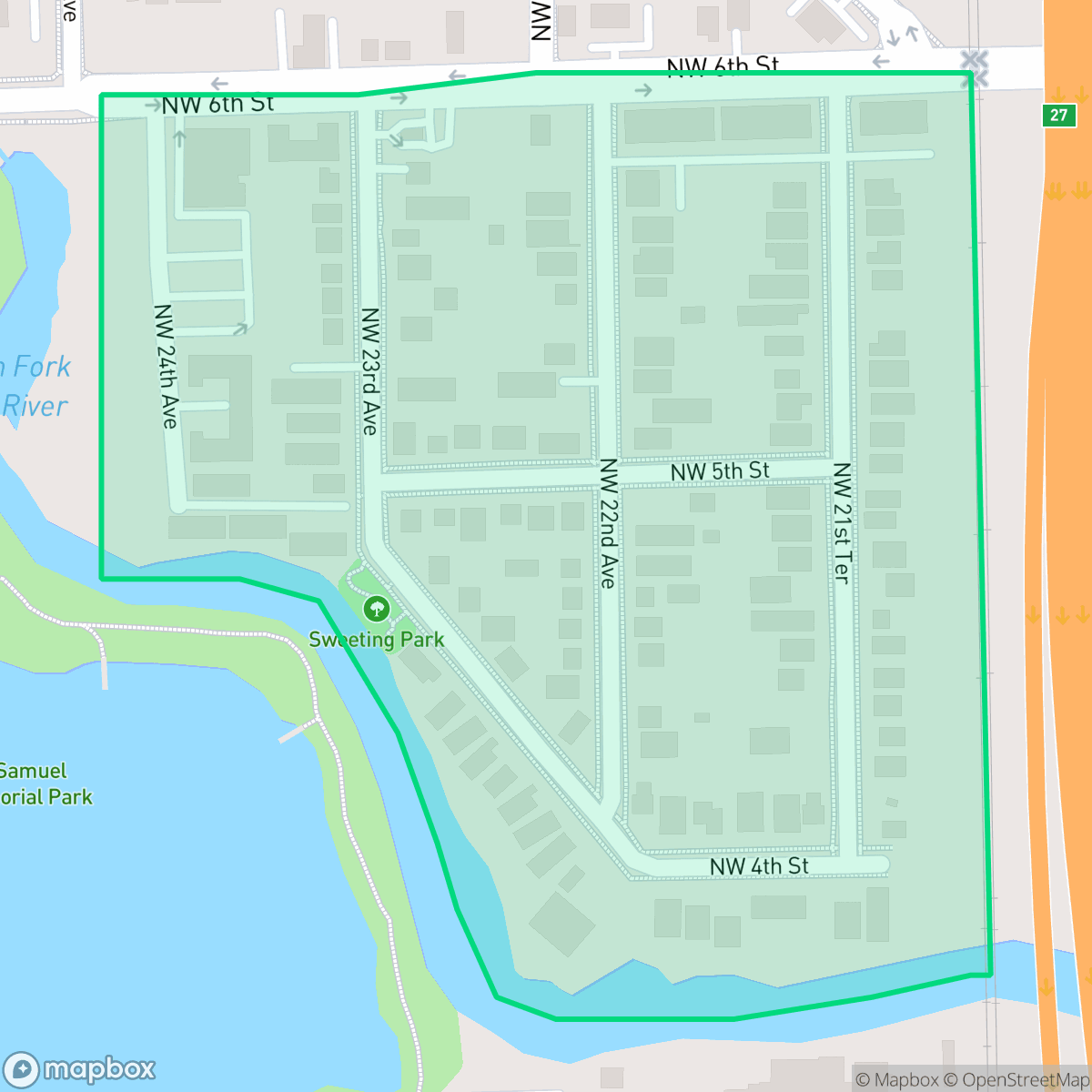
River Garden Sweeting Estate is a residential neighborhood in Fort Lauderdale's northwest sector, primarily developed during the post-WWII era with housing stock dating from the 1940s through the 1960s. The neighborhood holds cultural significance due to the historic Sweeting Estate, which served as a vital community hub during the mid-20th century. During an era of segregation, the estate's grounds provided a necessary venue for African-American community gatherings, including meetings for the first Debutante Cotillion in Broward County in 1954, as local hotels and ballrooms were inaccessible. Today, the area remains an established residential community characterized by its mid-century architectural roots and its role in the social and cultural history of Fort Lauderdale’s African-American community.
The neighborhood maintains a subdued suburban rhythm, characterized by a blend of residential blocks and light industrial presence. The landscape features a semi-rural feel with scattered woodland and open spaces that differentiate it from the denser urban core of Fort Lauderdale. Residents benefit from high levels of health insurance coverage and a notably liberal political environment, fostering a diverse demographic mix that leans toward middle-aged and older households.
Living in this area requires navigating specific environmental and logistical trade-offs. The proximity to major highways and rail lines creates notable acoustic disturbances and physical barriers that limit pedestrian connectivity. Furthermore, properties are situated within a designated floodplain, necessitating careful consideration of insurance requirements. The area is best suited for those who value a quiet, established community atmosphere and are comfortable with the inherent challenges of living near major transit infrastructure.
Neighborhood Scores Across 15 Qualities
Residential spacing is consistent with the Fort Lauderdale average, offering a mix of closely packed housing and small yard buffers. Some areas feature higher density with apartment blocks situated near tightly clustered homes.
Quiet residential streets allow for easy movement, but the presence of a major highway and rail line creates significant obstacles for pedestrians. This area offers less pedestrian connectivity than the Fort Lauderdale average due to these physical barriers.
Uniform tract housing and small residential lots define the area, offering less visual variety than the Fort Lauderdale average. According to iHuus data, the landscape is characterized by simple rooflines and limited private greenery.
Walking areas for dogs are primarily concentrated near the central lake, though narrow sidewalks and proximity to highway corridors limit overall accessibility. This level of dog friendliness sits slightly below the Fort Lauderdale average, according to iHuus data.
Open land and scattered greenery provide a more semi-rural atmosphere than most of Fort Lauderdale. Residents will find a landscape featuring frequent open spaces and woodland interspersed with suburban housing.
Local activity levels are slightly below the Fort Lauderdale average, characterized by a quiet mix of residential blocks and light industrial zones. Residents can access various local eateries and transit hubs, though the area maintains a more subdued atmosphere than busier urban centers.
Frequent acoustic disturbances from nearby transit corridors are common in this area. According to iHuus data, noise levels are significantly higher than the Fort Lauderdale average due to proximity to major roadways and infrastructure.
Air remains consistently clean with infrequent instances of poor air quality. According to iHuus data, the atmosphere in this area is significantly fresher than the Fort Lauderdale average.
Active commercial utility and light industrial activities, such as printing services and storage facilities, are present alongside residential areas. This results in slightly more heavy vehicle traffic and transit activity than the Fort Lauderdale average.
Health insurance coverage among residents is relatively high, appearing more widespread in this area than the Fort Lauderdale average according to iHuus data.
Voting patterns and census indicators in River Garden Sweeting Estate reflect a significantly more liberal leaning than the Fort Lauderdale average, according to iHuus data.
Residents live alongside a varied mix of young adults, families, and seniors; according to iHuus data, this age distribution is slightly more concentrated toward middle-aged and older populations than the Fort Lauderdale average.
Properties in this area are located within a designated floodplain, which implies a higher vulnerability to flooding than the Fort Lauderdale average. According to iHuus data, residents should expect a significant likelihood of needing flood insurance for their homes.
Address-Level Insights for River Garden Sweeting Estate


iHuus Neighborhood Intelligence Insights
Get address-level neighborhood insights for River Garden Sweeting Estate
- Street-level scores — see how individual blocks compare, not just neighborhood averages
- Micro-zone boundaries — identify quiet pockets, flood boundaries, and walkable clusters before you visit
- 15 dimensions in full — walkability, noise, air quality, school quality, insurance coverage, population age profile, urban/rural index, and more
- Boundary risk alerts — know if your address sits near a block boundary where scores drop, the kind of detail no listing will ever mention
- School insights — individual school ratings and insights, not just district-level data
- Compare before you commit — side-by-side data across neighborhoods, down to block precision
No credit card required
Compare with Any Neighborhood
| Dimension | River Garden Sweeting Estate | Bal Harbour |
|---|---|---|
| 🚶 Walkabilityavg 6.6 | ||
| 🔊 Acoustic Comfortavg 3.24 | ||
| 🤫 Privacy Indexavg 5.33 | ||
| 🎨 Visual Appealavg 6.66 | ||
| 🐕 Dog Friendlinessavg 4.88 | ||
| 🗺️ Urban-Rural Indexavg 6.04 | ||
| ✨ Neighborhood Vibeavg 4.63 | ||
| 🏥 Health Insurance Coverageavg 6.16 | ||
| 🌿 Air Qualityavg 6.61 | ||
| 🏭 Industrial Proximityavg 6.49 | ||
| 🌊 Flood Safetyavg 3.54 | ||
| 🗳️ Ideological Leanavg 6.3 | ||
| 👥 Population Age Profileavg 5.2 | ||
| 🔥 Fire Safety | ||
| 🏫 School Quality |
River Garden Sweeting Estate Rankings
School Districts Serving River Garden Sweeting Estate
School Insights for River Garden Sweeting Estate
Below average outcomes; significant attendance and academic challenges.
School Insights
See what's really behind every school rating near River Garden Sweeting Estate
- Individual school ratings — each school's own score with outcome context, not just a district average
- Enrollment & class size data — student-to-teacher ratio and how it compares to the state average
- Full demographics breakdown — ethnicity and gender composition for every school in the enrollment zone
- Every school in the district — all schools within the enrollment boundary ranked by rating, not just the closest one
- Grade levels & benchmarks — elementary through high school, with below/above state-average flags
No credit card required