Melrose Park, Fort Lauderdale
Updated · 7,047 residents
Melrose Park is a distinct residential community in western Fort Lauderdale, defined by its circular street patterns and mid-century architectural charm. The area offers high walkability and well-maintained suburban aesthetics, providing a quiet, family-oriented environment with diverse cultural roots.
Key Highlights
About Melrose Park
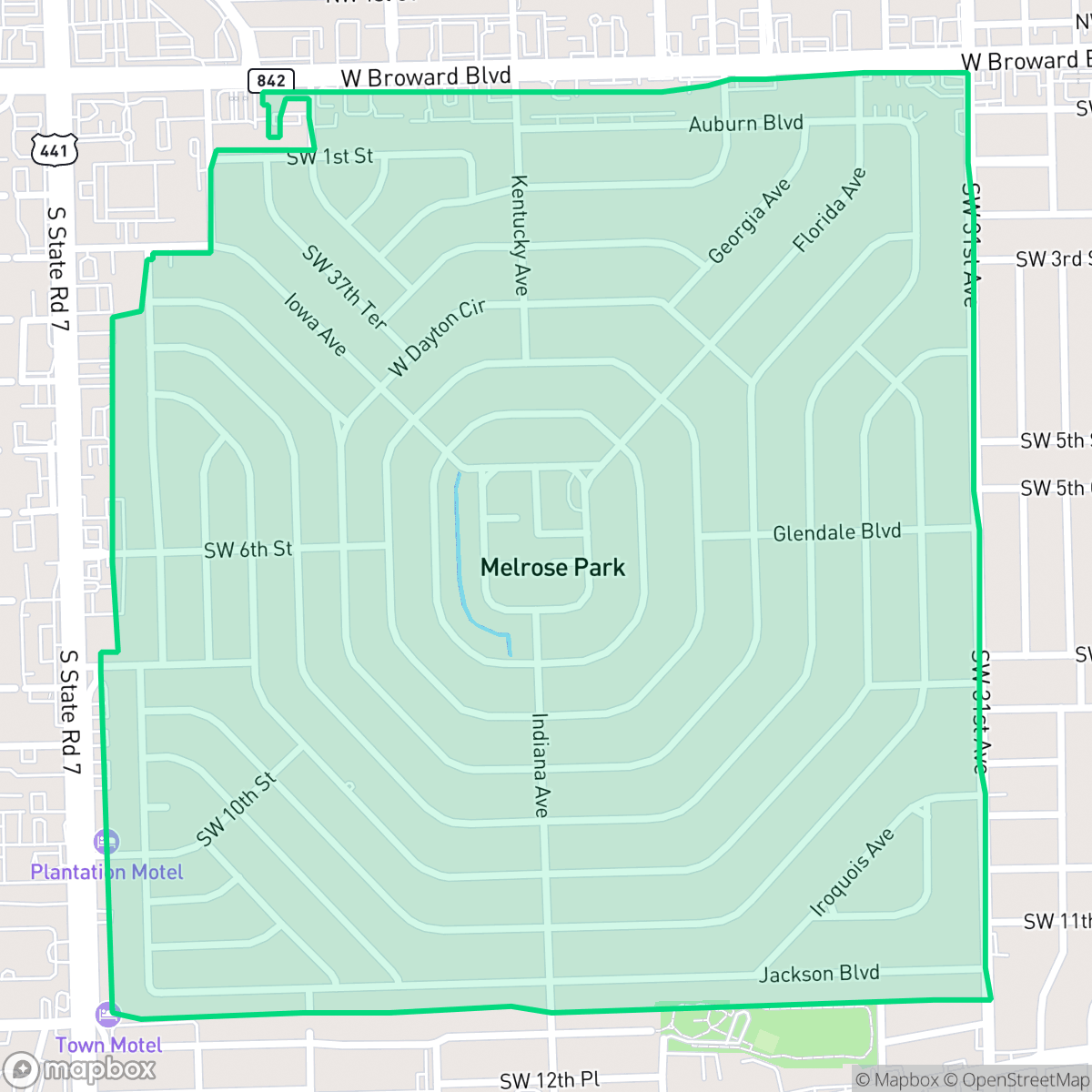
Melrose Park, located in western Fort Lauderdale, was developed during the 1950s and 1960s to meet post-WWII housing demand. It is distinctively recognized by its unique circular street pattern and mid-century architectural style, characterized by single-story homes featuring terrazzo floors and aluminum jalousie windows. Originally a census-designated place, the neighborhood was officially annexed by the City of Fort Lauderdale in 2002. Historically marketed as a suburban subdivision for families moving from the North, the area has evolved into a diverse community with strong Caribbean cultural influences. The neighborhood is anchored by the active Melrose Park Homeowners Association, formed in the early 1960s, which has played a central role in local infrastructure and beautification projects, including the installation of monument signage and solar lighting at its signature circular intersections.
The neighborhood features a highly walkable layout, with continuous sidewalk networks and low-traffic residential loops that make it safer for pedestrians than many other parts of the city. Residents enjoy a well-maintained suburban landscape, characterized by manicured lawns and spacious driveways that give the community an upscale, established feel. The demographic profile is notably balanced, hosting a mix of young professionals, families, and seniors who contribute to a stable and diverse local atmosphere. While the area maintains a subdued rhythm, it provides a functional, quiet living experience for those seeking a departure from the high-density urban core.
Prospective residents should consider several trade-offs when evaluating the area. According to iHuus data, the neighborhood faces a moderate flood risk, and residents should remain informed about potential vulnerabilities during heavy rain events. While the residential streets are generally peaceful, the area is subject to noticeable traffic noise from nearby transit corridors and infrastructure. Additionally, those looking to relocate should be aware of a nearby Superfund site that may impact local soil or water quality, as well as lower-than-average local access to health insurance coverage.
Neighborhood Scores Across 15 Qualities
Residential spacing varies across the area, with some neighbors sharing close property lines while others enjoy more buffered yards. This level of density and privacy is consistent with the average found throughout Fort Lauderdale.
Continuous sidewalk networks and low-traffic residential loops provide safer pedestrian navigation than the Fort Lauderdale average. Most residential streets feature dedicated paths and a layout that naturally slows through traffic.
Manicured lawns, large home footprints, and frequent private swimming pools contribute to a visual landscape that is slightly more upscale than the Fort Lauderdale average. According to iHuus data, many properties feature spacious driveways and proximity to golf course amenities.
Green verges between sidewalks and roads provide ample space for dog walking, especially near local school athletic fields. According to iHuus data, the availability of these grassy margins is slightly above the Fort Lauderdale average.
Characterized by a dense suburban grid, this area features a high concentration of single-family homes and commercial corridors that feels slightly more developed than the Fort Lauderdale average. According to iHuus data, the landscape is primarily composed of residential blocks interspersed with institutional structures and shopping strips.
Local activity levels are slightly lower than the Fort Lauderdale average, characterized by a mix of quiet residential pockets and specific commercial corridors that host various dining and wellness services. While some areas function as lively local hubs with high walkability, other sections remain largely low-key and residential according to iHuus data.
Frequent noise from nearby transit corridors and infrastructure impacts the area, though it remains slightly less disruptive than many other parts of Fort Lauderdale according to iHuus data.
Air quality remains consistently clear with very few instances of pollution. According to iHuus data, levels in this area are notably better than the Fort Lauderdale average.
Primarily residential in character, this area contains far less industrial activity than the Fort Lauderdale average. While some light commercial units and utility facilities are present, residents should be aware of a nearby Superfund site that may impact local soil or water quality according to iHuus data.
Health insurance accessibility in Melrose Park is below the Fort Lauderdale average, according to iHuus data. Residents may find fewer local options for coverage compared to other areas within the city.
Voting patterns and census indicators reflect a significantly more liberal political landscape than the Fort Lauderdale average, according to iHuus data.
Residents live alongside a varied mix of young professionals, families, and seniors. This demographic spread is slightly more balanced across age brackets than the average found in Fort Lauderdale.
Flood risk in this area is slightly higher than the Fort Lauderdale average, though a lack of detailed FEMA studies makes current susceptibility difficult to fully determine. Residents should remain aware of potential vulnerabilities during heavy rain events according to iHuus data.
Address-Level Insights for Melrose Park


iHuus Neighborhood Intelligence Insights
Get address-level neighborhood insights for Melrose Park
- Street-level scores — see how individual blocks compare, not just neighborhood averages
- Micro-zone boundaries — identify quiet pockets, flood boundaries, and walkable clusters before you visit
- 15 dimensions in full — walkability, noise, air quality, school quality, insurance coverage, population age profile, urban/rural index, and more
- Boundary risk alerts — know if your address sits near a block boundary where scores drop, the kind of detail no listing will ever mention
- School insights — individual school ratings and insights, not just district-level data
- Compare before you commit — side-by-side data across neighborhoods, down to block precision
No credit card required
Compare with Any Neighborhood
| Dimension | Melrose Park | Bal Harbour |
|---|---|---|
| 🚶 Walkabilityavg 6.6 | ||
| 🔊 Acoustic Comfortavg 3.24 | ||
| 🤫 Privacy Indexavg 5.33 | ||
| 🎨 Visual Appealavg 6.66 | ||
| 🐕 Dog Friendlinessavg 4.88 | ||
| 🗺️ Urban-Rural Indexavg 6.04 | ||
| ✨ Neighborhood Vibeavg 4.63 | ||
| 🏥 Health Insurance Coverageavg 6.16 | ||
| 🌿 Air Qualityavg 6.61 | ||
| 🏭 Industrial Proximityavg 6.49 | ||
| 🌊 Flood Safetyavg 3.54 | ||
| 🗳️ Ideological Leanavg 6.3 | ||
| 👥 Population Age Profileavg 5.2 | ||
| 🔥 Fire Safety | ||
| 🏫 School Quality |
Melrose Park Rankings
School Districts Serving Melrose Park
School Insights for Melrose Park
Below average outcomes; significant attendance and academic challenges.
School Insights
See what's really behind every school rating near Melrose Park
- Individual school ratings — each school's own score with outcome context, not just a district average
- Enrollment & class size data — student-to-teacher ratio and how it compares to the state average
- Full demographics breakdown — ethnicity and gender composition for every school in the enrollment zone
- Every school in the district — all schools within the enrollment boundary ranked by rating, not just the closest one
- Grade levels & benchmarks — elementary through high school, with below/above state-average flags
No credit card required