Lauderdale Manors, Fort Lauderdale
Updated · 8,818 residents
Lauderdale Manors is a residential community in northwest Fort Lauderdale defined by its mid-century layout and proximity to the expansive Mills Pond Park. While the area offers a quiet, suburban atmosphere with a diverse demographic, residents experience higher noise levels from nearby transit corridors and should be aware of the local flood risk.
Key Highlights
About Lauderdale Manors
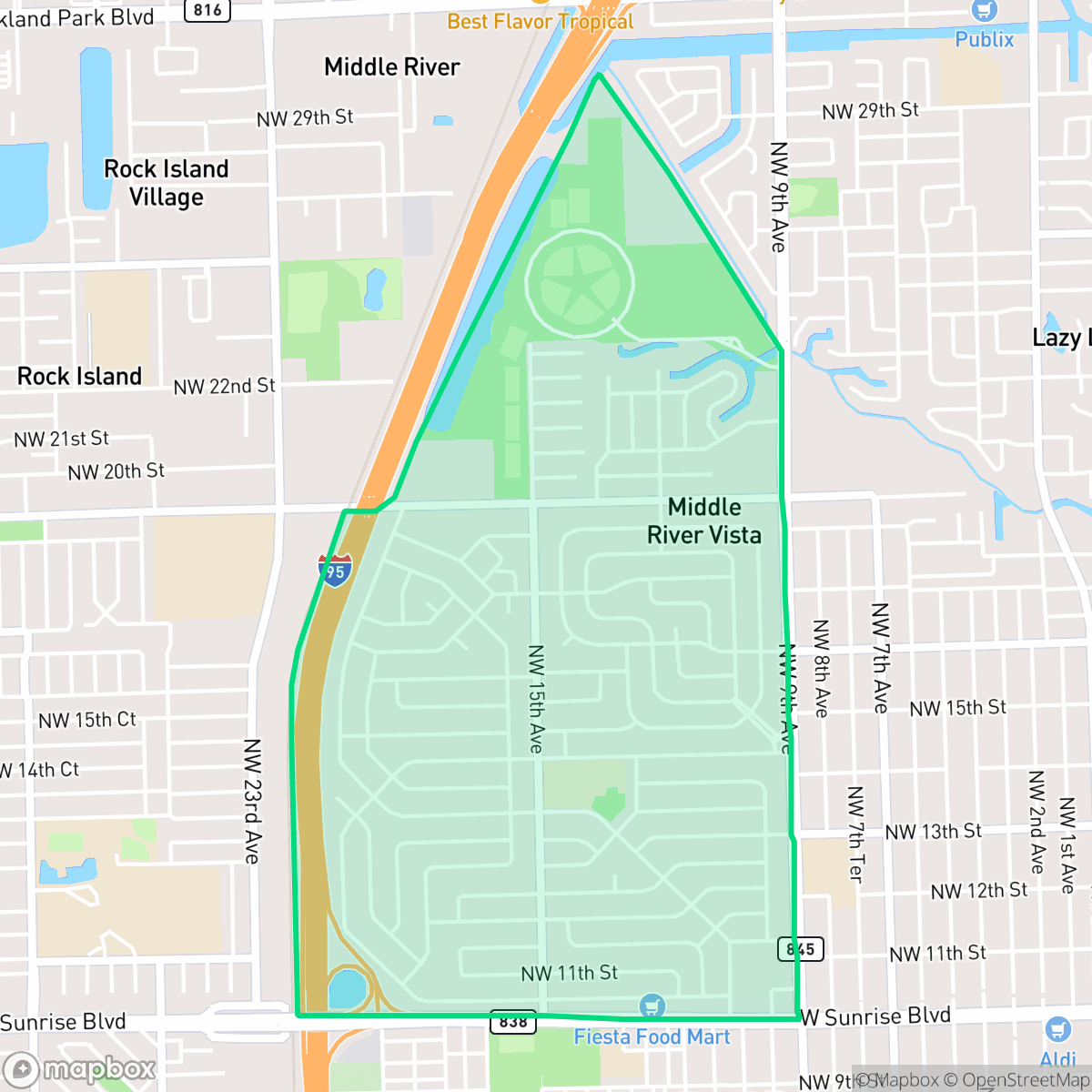
Lauderdale Manors, located in the northwest section of Fort Lauderdale, was established in 1950 as a major post-war residential development. Built on a portion of the failed 1920s-era Chateau Park subdivision, the neighborhood is notable for its unique mid-century planning, which featured a layout of east-west courts rather than traditional through streets. The area expanded rapidly throughout the 1950s, with developers like Albert Construction Company using promotional community square dances to attract Midwesterners to the growing suburb. Today, the neighborhood is characterized by its established single-family homes and its proximity to Mills Pond Park, a significant 150-acre recreational space. The community has evolved into a diverse residential area, maintaining its mid-century suburban character while serving as a central hub for families and long-term residents.
The neighborhood features a semi-rural feel with more open land and greenery than much of the city. Residents benefit from moderate privacy and a layout that balances single-family homes with access to large recreational spaces like the 150-acre Mills Pond Park. The community maintains a stable, functional environment that appeals to those seeking a traditional suburban lifestyle within the broader Fort Lauderdale region.
Prospective residents should consider specific trade-offs, including persistent noise from nearby railway lines and major transit routes. The area is situated within a designated floodplain, which may impact insurance requirements. While the neighborhood provides a balanced demographic mix, access to health insurance is lower than the city average. Those looking for a quiet, established community will find the area suitable, provided they account for these environmental and infrastructure factors.
Neighborhood Scores Across 15 Qualities
Residential spacing provides a moderate level of buffer between neighbors, which is slightly higher than the Fort Lauderdale average. Some areas feature closely packed structures in a grid pattern, though homes located along canal lots benefit from increased separation.
Sidewalks are present along main roads and within park areas, though a major highway and rail corridor create notable barriers for pedestrians. This level of connectivity is roughly in line with the city average, as some residential streets feature obscured or absent walkways.
Uniform tract housing and modest yards characterize this area, making it slightly less visually varied than the Fort Lauderdale average. Some pockets feature larger homes with private pools, though much of the neighborhood consists of densely spaced residences with shared amenities.
Access to large multi-field parks and nature preserves provides more space for pets than the Fort Lauderdale average. While some residential blocks feature narrow verges, many areas offer ample walking routes along green canal buffers.
Residential layouts here offer a semi-rural feel with more open land and scattered greenery than most of Fort Lauderdale. This blend of single-family homes and pockets of woodland provides a slightly less dense environment compared to the city average.
Activity levels in this area are generally subdued compared to the Fort Lauderdale average. Most pockets of the neighborhood focus on residential life and civic institutions, though some segments near transit hubs or local parks offer more active dining and social options.
Persistent noise from nearby major transit corridors and railway lines makes this area significantly louder than the Fort Lauderdale average. Residents may experience frequent disturbances from heavy traffic and industrial activity according to iHuus data.
Air quality remains consistently high with rare instances of elevated readings; according to iHuus data, these levels are better than the Fort Lauderdale average.
Light industrial activities and commercial services, such as storage facilities and gas stations, introduce moderate truck traffic and utility odors to the area. According to iHuus data, this level of industrial proximity is slightly lower than the Fort Lauderdale average, though a nearby Superfund site remains a consideration for environmental awareness.
Health insurance access among residents is lower than the Fort Lauderdale average, according to iHuus data. This indicates a higher proportion of uninsured individuals living in the area compared to much of the city.
Voting patterns and census indicators show a predominantly liberal political leaning that is notably higher than the Fort Lauderdale average, according to iHuus data.
Residents live alongside a balanced mix of young professionals, families, and seniors. This demographic spread is slightly more varied than the typical profile found elsewhere in Fort Lauderdale.
Properties in this area are situated within a designated floodplain, which may necessitate flood insurance. This level of risk is slightly higher than the average found throughout Fort Lauderdale.
Address-Level Insights for Lauderdale Manors


iHuus Neighborhood Intelligence Insights
Get address-level neighborhood insights for Lauderdale Manors
- Street-level scores — see how individual blocks compare, not just neighborhood averages
- Micro-zone boundaries — identify quiet pockets, flood boundaries, and walkable clusters before you visit
- 15 dimensions in full — walkability, noise, air quality, school quality, insurance coverage, population age profile, urban/rural index, and more
- Boundary risk alerts — know if your address sits near a block boundary where scores drop, the kind of detail no listing will ever mention
- School insights — individual school ratings and insights, not just district-level data
- Compare before you commit — side-by-side data across neighborhoods, down to block precision
No credit card required
Compare with Any Neighborhood
| Dimension | Lauderdale Manors | Bal Harbour |
|---|---|---|
| 🚶 Walkabilityavg 6.6 | ||
| 🔊 Acoustic Comfortavg 3.24 | ||
| 🤫 Privacy Indexavg 5.33 | ||
| 🎨 Visual Appealavg 6.66 | ||
| 🐕 Dog Friendlinessavg 4.88 | ||
| 🗺️ Urban-Rural Indexavg 6.04 | ||
| ✨ Neighborhood Vibeavg 4.63 | ||
| 🏥 Health Insurance Coverageavg 6.16 | ||
| 🌿 Air Qualityavg 6.61 | ||
| 🏭 Industrial Proximityavg 6.49 | ||
| 🌊 Flood Safetyavg 3.54 | ||
| 🗳️ Ideological Leanavg 6.3 | ||
| 👥 Population Age Profileavg 5.2 | ||
| 🔥 Fire Safety | ||
| 🏫 School Quality |
Lauderdale Manors Rankings
School Districts Serving Lauderdale Manors
School Insights for Lauderdale Manors
Below average outcomes; significant attendance and academic challenges.
School Insights
See what's really behind every school rating near Lauderdale Manors
- Individual school ratings — each school's own score with outcome context, not just a district average
- Enrollment & class size data — student-to-teacher ratio and how it compares to the state average
- Full demographics breakdown — ethnicity and gender composition for every school in the enrollment zone
- Every school in the district — all schools within the enrollment boundary ranked by rating, not just the closest one
- Grade levels & benchmarks — elementary through high school, with below/above state-average flags
No credit card required