Lake Ridge, Fort Lauderdale
Updated · 2,466 residents
Lake Ridge is a highly walkable enclave characterized by its mid-century ranch-style architecture and a vibrant, active atmosphere. While the area offers convenient access to local dining and fitness hubs, residents should anticipate steady traffic noise and the need for flood insurance due to its location in a designated floodplain.
Key Highlights
About Lake Ridge
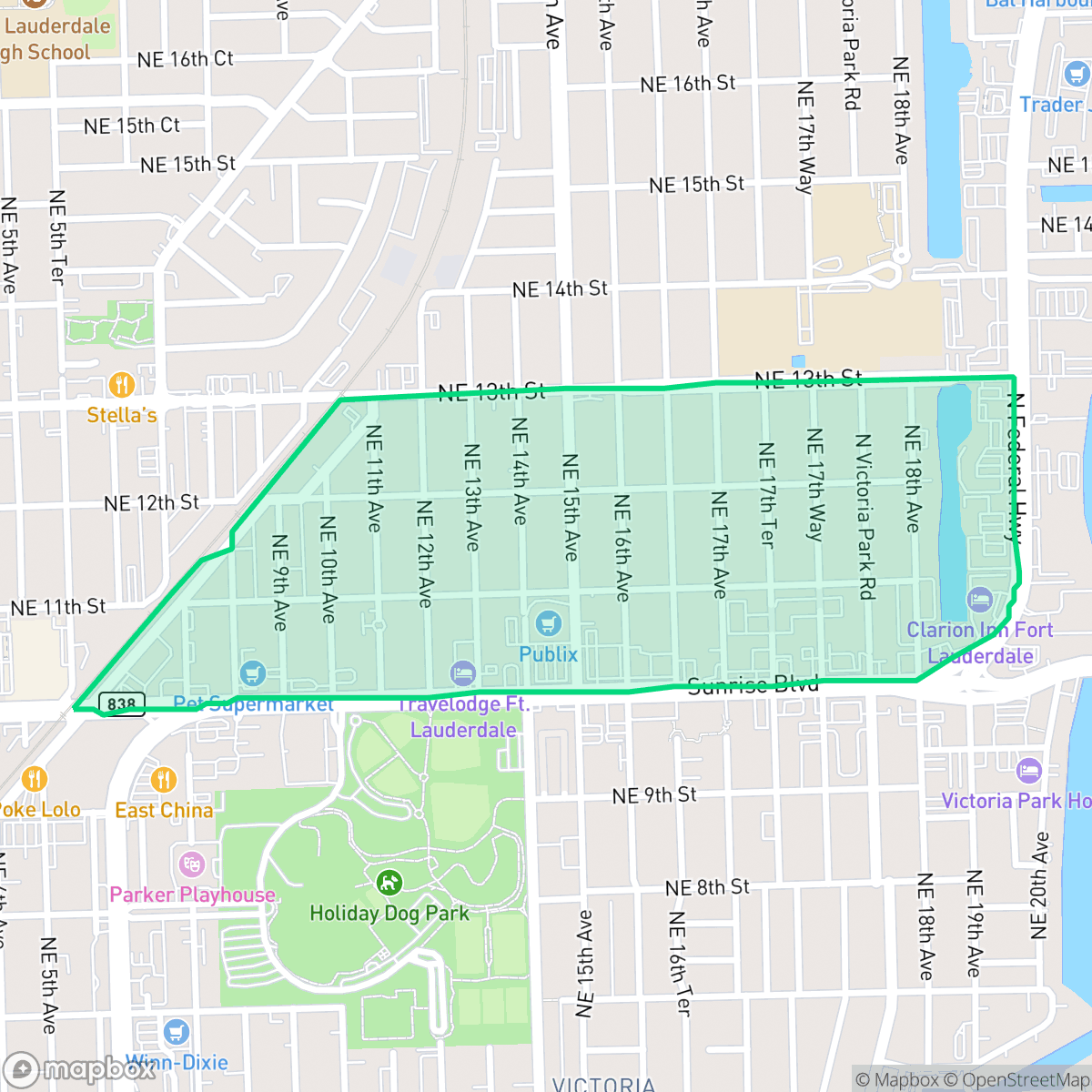
Lake Ridge, a residential neighborhood in Fort Lauderdale, traces its development to the 1940s and 1950s, when former marshland was drained to accommodate the city's northward expansion. The neighborhood derives its name from the distinctive ridge of land that separates the Tarpon River from the Intracoastal Waterway, a geography characterized by freshwater finger lakes and canals. Architecturally, Lake Ridge is defined by its collection of post-war, ranch-style homes, with notable examples still preserved along NE 16th Terrace and NE 11th Avenue. Historically, the area served as a hub for young families during the post-war boom, anchored by early community institutions like the former Lake Ridge Elementary School. Today, the neighborhood remains a distinct enclave bounded by Sunrise Boulevard, NE 13th Street, Federal Highway, and the railroad tracks near Dixie Highway.
Beyond its historical roots, the neighborhood serves as an active suburban hub with a dense mix of commerce, fitness studios, and local breweries. The area maintains a semi-rural character in certain pockets, featuring patches of woodland and fields that contrast with its residential density. Its high walkability makes it a practical choice for those who prefer navigating the community on foot, with well-developed pedestrian infrastructure and safe street crossings according to iHuus data. Prospective residents should consider the trade-offs of living in this established locale. While the community offers a balanced age demographic and strong health insurance coverage, the acoustic environment is influenced by consistent traffic noise from surrounding busy streets. Additionally, the area is situated within a designated floodplain, necessitating flood insurance for many properties. It is well-suited for individuals seeking a pedestrian-friendly lifestyle in a central location, provided they are comfortable with the inherent environmental and acoustic realities of the region.
Neighborhood Scores Across 15 Qualities
Residential spacing provides a moderate level of seclusion with some buffers between neighbors, appearing slightly more private than the Fort Lauderdale average. According to iHuus data, housing density varies between closely spaced homes and areas with more distinct gaps between structures.
Pedestrian infrastructure is well-developed with sidewalks and safe crossings, offering much better walkability than the Fort Lauderdale average. While some larger commercial blocks can interrupt the grid, many areas feature high-density sidewalks and dedicated pedestrian-priority zones according to iHuus data.
Residential streets feature a mix of single-family homes and apartments with many shared pool complexes. The visual landscape is largely comparable to the rest of Fort Lauderdale.
Access to public green space for pets is better than the Fort Lauderdale average, particularly due to the large central park and proximity to Holiday Park. While some residential streets feature limited sidewalk verges, dog owners benefit from significant nearby recreational fields.
Frequent open land and scattered homes create a more semi-rural feel than the typical Fort Lauderdale urban density. According to iHuus data, this area features significant patches of woodland and fields interspersed with low-density residential pockets.
Vibrant clusters of dining, fitness studios, and local breweries create a much more energetic atmosphere than the typical Fort Lauderdale neighborhood. Residents can find a dense mix of commerce and social hubs that offer significantly higher activity levels than the city average.
Local traffic from nearby busy streets creates a continuous hum that is slightly more noticeable than in other parts of Fort Lauderdale, according to iHuus data.
Air quality in Lake Ridge fluctuates between acceptable and unhealthy levels, sitting slightly below the Fort Lauderdale average. Residents with respiratory sensitivities may notice occasional periods of concern according to iHuus data.
Light commercial activity and occasional utility odors are present, but the area lacks heavy industry. According to iHuus data, the level of industrial proximity is slightly lower than the Fort Lauderdale average.
Health insurance enrollment among residents is higher than the Fort Lauderdale average, according to iHuus data.
Political leanings in Lake Ridge are more liberal than the average found throughout Fort Lauderdale, according to iHuus data.
A varied demographic of young adults, families, and seniors resides here; this creates a slightly more balanced age distribution than the Fort Lauderdale average according to iHuus data.
Properties in this area are located within a designated floodplain, meaning flood insurance is typically required. According to iHuus data, the level of flood risk in Lake Ridge is similar to the average found throughout Fort Lauderdale.
Address-Level Insights for Lake Ridge


iHuus Neighborhood Intelligence Insights
Get address-level neighborhood insights for Lake Ridge
- Street-level scores — see how individual blocks compare, not just neighborhood averages
- Micro-zone boundaries — identify quiet pockets, flood boundaries, and walkable clusters before you visit
- 15 dimensions in full — walkability, noise, air quality, school quality, insurance coverage, population age profile, urban/rural index, and more
- Boundary risk alerts — know if your address sits near a block boundary where scores drop, the kind of detail no listing will ever mention
- School insights — individual school ratings and insights, not just district-level data
- Compare before you commit — side-by-side data across neighborhoods, down to block precision
No credit card required
Compare with Any Neighborhood
| Dimension | Lake Ridge | Bal Harbour |
|---|---|---|
| 🚶 Walkabilityavg 6.6 | ||
| 🔊 Acoustic Comfortavg 3.24 | ||
| 🤫 Privacy Indexavg 5.33 | ||
| 🎨 Visual Appealavg 6.66 | ||
| 🐕 Dog Friendlinessavg 4.88 | ||
| 🗺️ Urban-Rural Indexavg 6.04 | ||
| ✨ Neighborhood Vibeavg 4.63 | ||
| 🏥 Health Insurance Coverageavg 6.16 | ||
| 🌿 Air Qualityavg 6.61 | ||
| 🏭 Industrial Proximityavg 6.49 | ||
| 🌊 Flood Safetyavg 3.54 | ||
| 🗳️ Ideological Leanavg 6.3 | ||
| 👥 Population Age Profileavg 5.2 | ||
| 🔥 Fire Safety | ||
| 🏫 School Quality |
Lake Ridge Rankings
School Districts Serving Lake Ridge
School Insights for Lake Ridge
Below average outcomes; significant attendance and academic challenges.
School Insights
See what's really behind every school rating near Lake Ridge
- Individual school ratings — each school's own score with outcome context, not just a district average
- Enrollment & class size data — student-to-teacher ratio and how it compares to the state average
- Full demographics breakdown — ethnicity and gender composition for every school in the enrollment zone
- Every school in the district — all schools within the enrollment boundary ranked by rating, not just the closest one
- Grade levels & benchmarks — elementary through high school, with below/above state-average flags
No credit card required