Imperial Point, Fort Lauderdale
Updated · 6,229 residents
Imperial Point is a quiet, suburban enclave in Fort Lauderdale, recognized for its mid-century architecture and scenic waterfront properties. The area offers a tranquil, low-key atmosphere with high visual appeal, though residents should expect moderate traffic noise and limited public green space.
Key Highlights
About Imperial Point
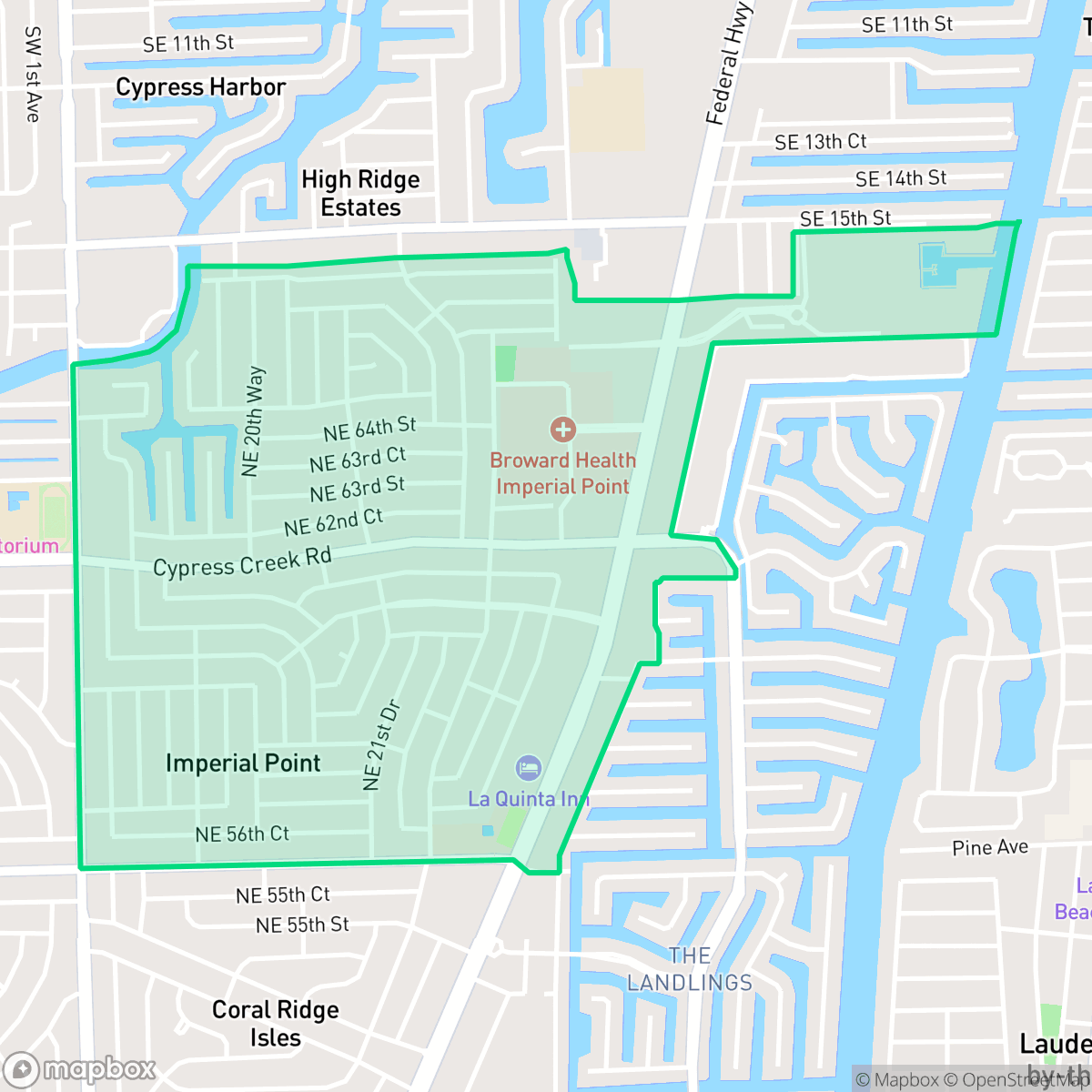
Developed starting in 1960 by the Haft-Gaines Company, Imperial Point was envisioned as a state-of-the-art residential enclave for retirees. The neighborhood gained national attention for its "all-electric" homes, which were outfitted with General Electric appliances and marketed in publications like Life Magazine. Built on a tract of land featuring pristine white sand and pine forests, the community was designed with a focus on customization, with model rows such as the "Street of Dreams" showcasing evolving 1960s architectural trends. Over the decade, the neighborhood transitioned from retirement living to accommodate families, introducing split-level and two-story designs. Today, the community is defined by its mid-century origins, the Imperial Point Civic Association, and its proximity to the Broward Health Imperial Point medical center, maintaining its character through active neighborhood events and a blend of waterfront and dry-lot homes.
The neighborhood provides a distinct suburban experience characterized by its manicured landscapes and extensive canal-front homes. It maintains a calm, residential rhythm with minimal industrial activity, making it a peaceful retreat from the busier urban corridors of the city. The visual appeal is a defining feature, as private pools and docks contribute to an upscale aesthetic that remains largely tucked away from major commercial hubs.
Prospective residents will find a community with a diverse age demographic and high levels of health insurance coverage. While the area is generally accessible by sidewalk, the presence of canal barriers and major arterials can influence local mobility. Those considering the neighborhood should note the moderate flood risk and the variable air quality, as well as the limited availability of public parks for pet owners. It is well-suited for individuals seeking a quiet, established environment with a conservative-leaning social atmosphere.
Neighborhood Scores Across 15 Qualities
Housing spacing varies throughout the area, ranging from closely clustered homes to more spread out waterfront properties. According to iHuus data, this level of privacy is slightly higher than the Fort Lauderdale average.
Residential streets offer safe, low-traffic walking paths with consistent sidewalks; however, high-traffic arterials and canal barriers can limit connectivity. This level of walkability is roughly in line with the Fort Lauderdale average.
Manicured landscapes, private pools, and extensive canal-front properties with boat docks characterize this area. According to iHuus data, the visual quality of the neighborhood is notably higher than the Fort Lauderdale average.
Public parks and wide sidewalk verges are scarce throughout most residential blocks, making the area less dog friendly than the Fort Lauderdale average. While some central athletic fields exist, much of the neighborhood's greenery is contained within private backyards.
Open land and scattered greenery are more prevalent here than in the typical Fort Lauderdale area. This provides a semi-rural feel through a mosaic of single-family homes and waterfront developments, according to iHuus data.
Residential pockets here offer a subdued atmosphere with limited commercial activity, creating a calmer environment than the Fort Lauderdale average. While some waterfront areas feature lively dining clusters, much of the neighborhood remains a low-key suburban landscape.
Steady sounds from local traffic are present due to nearby busy streets, though the acoustic environment remains more tranquil than the Fort Lauderdale average according to iHuus data.
Air conditions in this area fluctuate between acceptable and unhealthy levels. According to iHuus data, the air quality is slightly lower than the Fort Lauderdale city average.
Largely residential streets and light commercial pockets ensure much lower industrial density than the Fort Lauderdale average. While some utility traffic and minor odors may occur near central service areas, there is no presence of heavy industry or significant hazardous facilities.
Health insurance accessibility in Imperial Point is notably higher than the Fort Lauderdale average, according to iHuus data.
Political leanings in this area trend conservative, representing a notable departure from the more liberal leaning seen across Fort Lauderdale. According to iHuus data, the neighborhood maintains a conservative majority with a modest opposing presence.
Residents live alongside a balanced mix of young adults, families, and seniors. According to iHuus data, this demographic spread is slightly more varied than the average found across Fort Lauderdale.
Flood risk in this area is slightly higher than the Fort Lauderdale average due to an undetermined risk status from FEMA. According to iHuus data, detailed flood studies for this specific neighborhood have not yet been completed.
Address-Level Insights for Imperial Point


iHuus Neighborhood Intelligence Insights
Get address-level neighborhood insights for Imperial Point
- Street-level scores — see how individual blocks compare, not just neighborhood averages
- Micro-zone boundaries — identify quiet pockets, flood boundaries, and walkable clusters before you visit
- 15 dimensions in full — walkability, noise, air quality, school quality, insurance coverage, population age profile, urban/rural index, and more
- Boundary risk alerts — know if your address sits near a block boundary where scores drop, the kind of detail no listing will ever mention
- School insights — individual school ratings and insights, not just district-level data
- Compare before you commit — side-by-side data across neighborhoods, down to block precision
No credit card required
Compare with Any Neighborhood
| Dimension | Imperial Point | Bal Harbour |
|---|---|---|
| 🚶 Walkabilityavg 6.6 | ||
| 🔊 Acoustic Comfortavg 3.24 | ||
| 🤫 Privacy Indexavg 5.33 | ||
| 🎨 Visual Appealavg 6.66 | ||
| 🐕 Dog Friendlinessavg 4.88 | ||
| 🗺️ Urban-Rural Indexavg 6.04 | ||
| ✨ Neighborhood Vibeavg 4.63 | ||
| 🏥 Health Insurance Coverageavg 6.16 | ||
| 🌿 Air Qualityavg 6.61 | ||
| 🏭 Industrial Proximityavg 6.49 | ||
| 🌊 Flood Safetyavg 3.54 | ||
| 🗳️ Ideological Leanavg 6.3 | ||
| 👥 Population Age Profileavg 5.2 | ||
| 🔥 Fire Safety | ||
| 🏫 School Quality |
Imperial Point Rankings
School Districts Serving Imperial Point
School Insights for Imperial Point
Below average outcomes; significant attendance and academic challenges.
School Insights
See what's really behind every school rating near Imperial Point
- Individual school ratings — each school's own score with outcome context, not just a district average
- Enrollment & class size data — student-to-teacher ratio and how it compares to the state average
- Full demographics breakdown — ethnicity and gender composition for every school in the enrollment zone
- Every school in the district — all schools within the enrollment boundary ranked by rating, not just the closest one
- Grade levels & benchmarks — elementary through high school, with below/above state-average flags
No credit card required