Hendricks and Venice Isles, Fort Lauderdale
Updated · 497 residents
Hendricks and Venice Isles is a quiet, water-centric residential enclave featuring luxury estates and boutique condominiums situated just north of the Las Olas Boulevard corridor. The area offers high walkability and clean air, though residents should be prepared for a higher risk of flooding and limited public green space.
Key Highlights
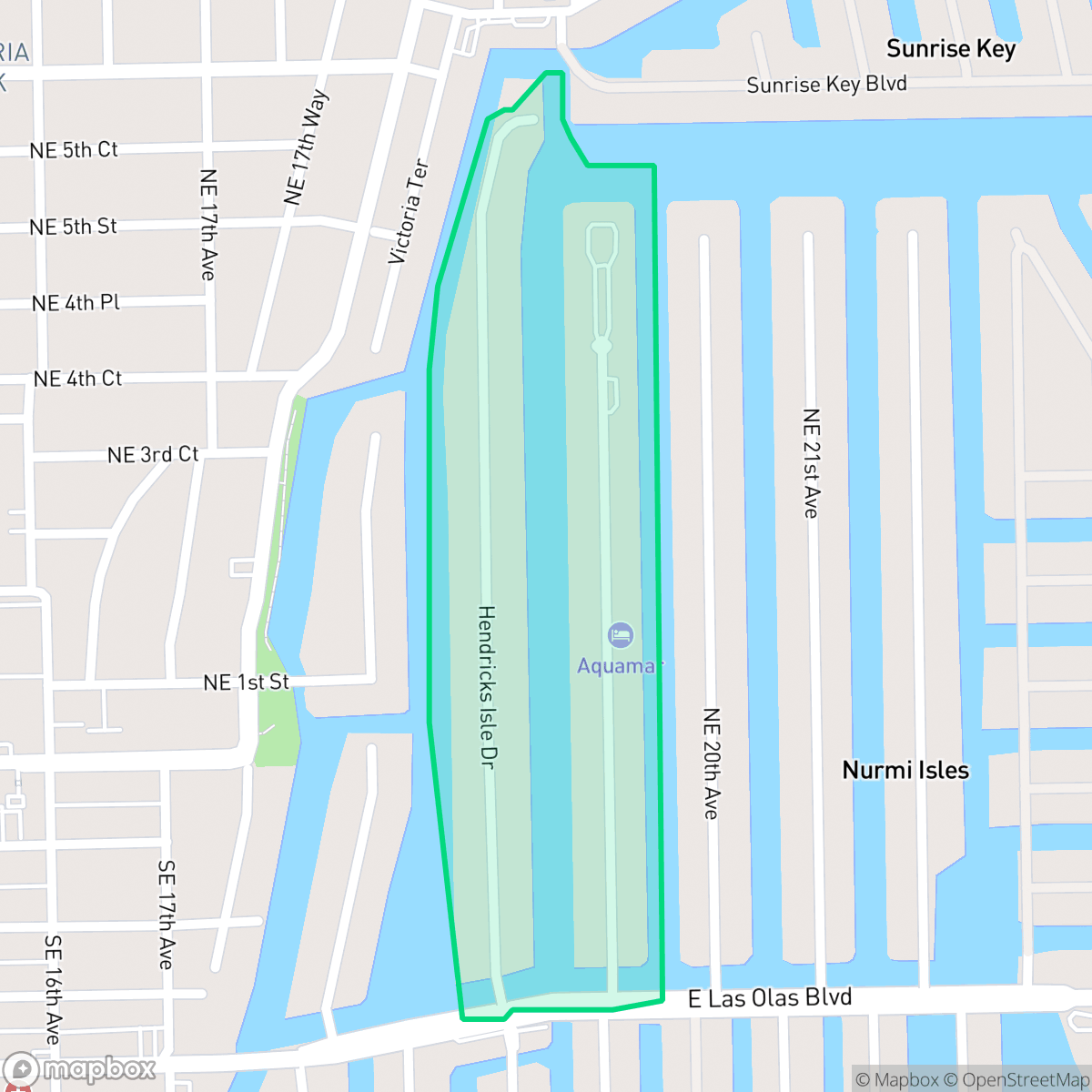
About Hendricks and Venice Isles
Hendricks and Venice Isles are part of the finger islands developed in Fort Lauderdale during the 1920s land boom by W. F. Morang & Sons, who utilized land-filling techniques inspired by Venice, Italy. Following the 1926 hurricane and the onset of the Great Depression, the isles remained largely vacant for nearly two decades. Development resumed in the late 1940s and 1950s, with Victor Nurmi notably contributing to the Isle of Venice, where he promoted apartment construction in the Art Deco style. Historically recognized for their "live-a-board" boating culture, the islands have undergone a significant transformation from mid-century "mom and pop" apartment complexes to modern luxury boutique condominiums and townhomes, reflecting the neighborhood's evolution into an upscale, water-centric residential enclave situated just north of the vibrant Las Olas Boulevard corridor.
The area is defined by its peaceful residential atmosphere and strong connection to the water, where private docks and luxury yachts are common sights. Residents benefit from a highly navigable street grid that encourages pedestrian activity, while the absence of heavy industry ensures a quiet, clean environment. The neighborhood maintains a balanced demographic, attracting a mix of families and professionals who value a tranquil lifestyle in a scenic, upscale setting.
Prospective residents should note that the neighborhood is located within a floodplain, which often necessitates flood insurance. While the streets are easy to walk, the relative lack of public parks and green space makes the area less ideal for dog owners. The consistent hum of traffic from nearby thoroughfares provides a steady background noise, though the overall environment remains more subdued than the broader Fort Lauderdale average. It is well-suited for those who prioritize water access and a central location over expansive public recreational facilities.
Neighborhood Scores Across 15 Qualities
Residential spacing varies between dense mid-rise units and larger waterfront estates, providing more separation than the Fort Lauderdale average. According to iHuus data, some homes sit close to neighbors while others benefit from significant natural buffers.
Pedestrian movement is facilitated by a dense grid of low-traffic residential streets with consistent sidewalks. According to iHuus data, this neighborhood offers better walkability than the Fort Lauderdale average.
Large estates with private pools and luxury yachts docked in canals define the scenery. This area offers a more scenic environment than most of Fort Lauderdale according to iHuus data.
Public greenery and wide grassy verges are scarce in this area, as most vegetation is confined to private backyards. According to iHuus data, the lack of accessible public park space makes this neighborhood less dog friendly than the Fort Lauderdale average.
Scattered homes and open land provide a more semi-rural atmosphere than most of Fort Lauderdale. This area features a mix of low-density residential plots and waterfront developments according to iHuus data.
Activity levels are generally subdued and functional, falling slightly below the Fort Lauderdale average. While some areas near transit hubs and parks provide localized pockets of movement, the area primarily maintains a calm, residential atmosphere.
Local traffic from nearby busy streets creates a consistent background noise, though this level of acoustic activity remains more tranquil than the Fort Lauderdale average according to iHuus data.
Air quality remains mostly clean with rare instances of elevated readings; according to iHuus data, these conditions are notably better than the Fort Lauderdale average.
Heavy industry and hazardous facilities are entirely absent from this area. According to iHuus data, the neighborhood remains significantly more free of industrial proximity than the Fort Lauderdale average.
Health insurance enrollment among residents is significantly higher than the Fort Lauderdale average, according to iHuus data.
Political views in this area are evenly split between conservative and liberal leanings, making it slightly more moderate than the broader Fort Lauderdale average according to iHuus data.
A balanced mix of young adults, families, and older residents characterizes the area. According to iHuus data, this demographic variety is more diverse than the typical age distribution found across Fort Lauderdale.
Property locations within this area fall inside the 100 year floodplain, which implies a higher risk of flooding than most parts of Fort Lauderdale. According to iHuus data, residents should expect that flood insurance will likely be required for properties here.
Address-Level Insights for Hendricks and Venice Isles


iHuus Neighborhood Intelligence Insights
Get address-level neighborhood insights for Hendricks and Venice Isles
- Street-level scores — see how individual blocks compare, not just neighborhood averages
- Micro-zone boundaries — identify quiet pockets, flood boundaries, and walkable clusters before you visit
- 15 dimensions in full — walkability, noise, air quality, school quality, insurance coverage, population age profile, urban/rural index, and more
- Boundary risk alerts — know if your address sits near a block boundary where scores drop, the kind of detail no listing will ever mention
- School insights — individual school ratings and insights, not just district-level data
- Compare before you commit — side-by-side data across neighborhoods, down to block precision
No credit card required
Compare with Any Neighborhood
| Dimension | Hendricks and Venice Isles | Bal Harbour |
|---|---|---|
| 🚶 Walkabilityavg 6.6 | ||
| 🔊 Acoustic Comfortavg 3.24 | ||
| 🤫 Privacy Indexavg 5.33 | ||
| 🎨 Visual Appealavg 6.66 | ||
| 🐕 Dog Friendlinessavg 4.88 | ||
| 🗺️ Urban-Rural Indexavg 6.04 | ||
| ✨ Neighborhood Vibeavg 4.63 | ||
| 🏥 Health Insurance Coverageavg 6.16 | ||
| 🌿 Air Qualityavg 6.61 | ||
| 🏭 Industrial Proximityavg 6.49 | ||
| 🌊 Flood Safetyavg 3.54 | ||
| 🗳️ Ideological Leanavg 6.3 | ||
| 👥 Population Age Profileavg 5.2 | ||
| 🔥 Fire Safety | ||
| 🏫 School Quality |
Hendricks and Venice Isles Rankings
School Districts Serving Hendricks and Venice Isles
School Insights for Hendricks and Venice Isles
Below average outcomes; significant attendance and academic challenges.
School Insights
See what's really behind every school rating near Hendricks and Venice Isles
- Individual school ratings — each school's own score with outcome context, not just a district average
- Enrollment & class size data — student-to-teacher ratio and how it compares to the state average
- Full demographics breakdown — ethnicity and gender composition for every school in the enrollment zone
- Every school in the district — all schools within the enrollment boundary ranked by rating, not just the closest one
- Grade levels & benchmarks — elementary through high school, with below/above state-average flags
No credit card required