Flagler Heights, Fort Lauderdale
Updated · 2,755 residents
Flagler Heights is a highly walkable urban enclave known for its vibrant arts scene, mural-covered streets, and dense concentration of dining and entertainment venues. While the area offers a high-energy lifestyle with excellent local amenities, residents should note the higher levels of ambient traffic noise and significant flood vulnerability.
Key Highlights
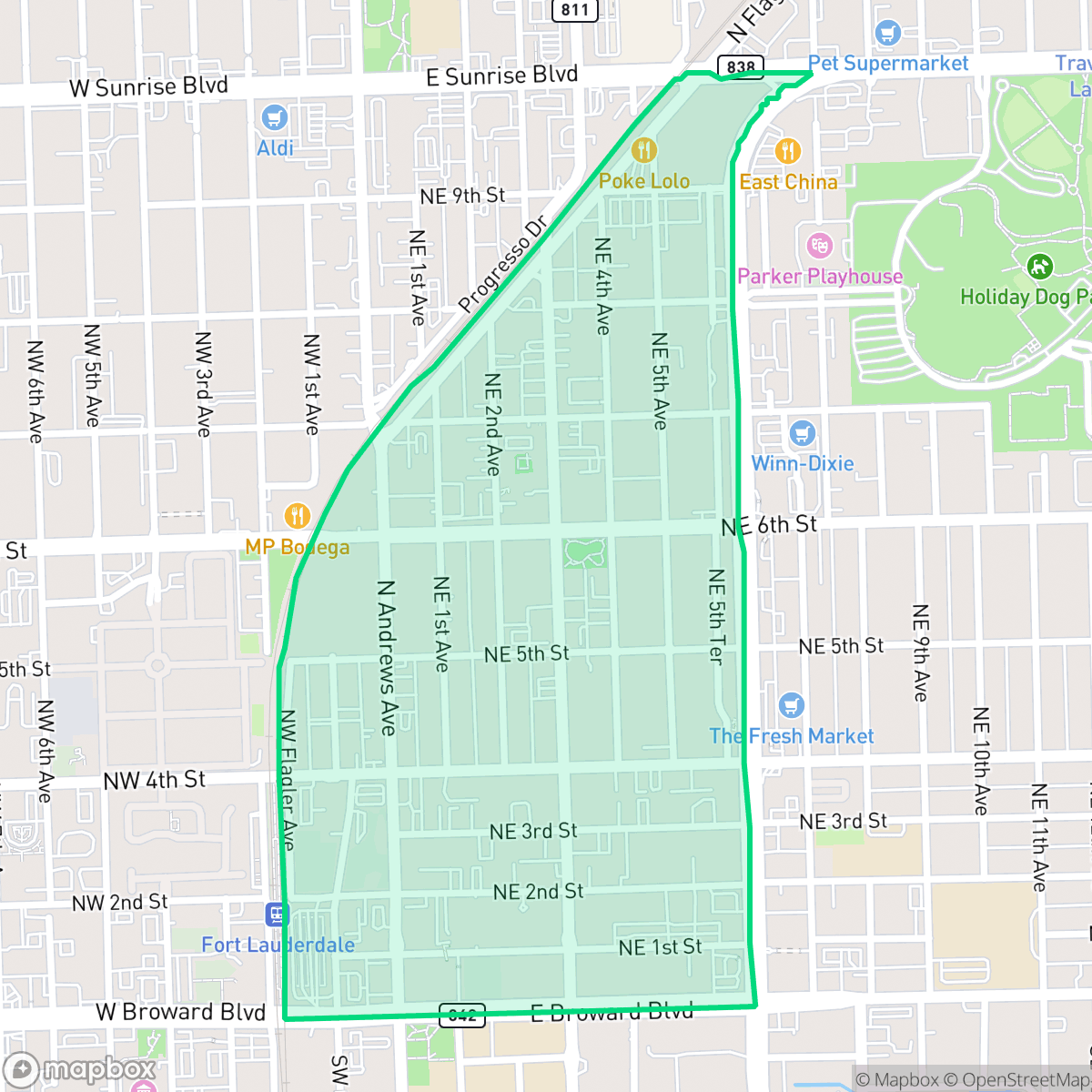
About Flagler Heights
Flagler Heights, widely known as Flagler Village, originated in the early 20th century as a commercial and industrial district defined by its proximity to the Florida East Coast Railway. For decades, the area served as a hub for warehouses, automotive repair shops, and small-scale businesses. By the late 20th century, much of the district faced neglect, but it began a significant urban renewal process in the early 2000s. This transformation repurposed industrial spaces into modern lofts, art studios, and residential complexes while preserving historical elements like 1920s brick facades. Today, the neighborhood is characterized by its walkable layout, vibrant mural-covered streets, and dedicated cultural hubs such as the Flagler Arts and Technology (FAT) Village and the Music & Arts South of Sunrise (MASS) District, which host monthly art walks and creative events.
The neighborhood functions as a dynamic cultural hub where repurposed industrial architecture meets modern residential convenience. Its grid-based layout promotes exceptional pedestrian access, allowing residents to navigate between local galleries, eateries, and social spaces with ease. The area maintains a balanced atmosphere that avoids the extreme density of the city center, offering a structured environment characterized by organized streetscapes and private residential features. Residents benefit from robust health insurance coverage and a community that leans toward liberal political perspectives.
Living here involves balancing the benefits of a bustling, high-energy environment with specific urban trade-offs. The proximity to transit corridors and flight paths results in frequent acoustic disturbances, and the limited availability of public green space means pet owners often rely on private yards. Those considering the area should also be aware of the elevated flood risk associated with the local topography. While the broader school district faces ongoing structural and budgetary challenges, the community remains a popular choice for those seeking a central, active lifestyle within Fort Lauderdale.
Neighborhood Scores Across 15 Qualities
Residential spacing is varied, with some neighbors sharing walls or living in close proximity. This level of density is slightly higher than the Fort Lauderdale average according to iHuus data.
Pedestrian connectivity is exceptional due to a dense grid system with wide, consistent sidewalks and frequent crossings. Most daily activities can be accomplished on foot, significantly exceeding the Fort Lauderdale average for ease of walking.
Well-defined landscaping, large homes, and spacious driveways create a visual environment that matches the city average. Residents can expect a consistent residential aesthetic characterized by private pools and organized street grids.
Dog owners rely primarily on private fenced backyards due to narrow street verges and limited public park access. While some riverfront areas offer green space, the neighborhood has fewer accessible public areas for pets than the Fort Lauderdale average.
Residential streets and green spaces are distributed in roughly equal measure, creating a setting that is less dense than the Fort Lauderdale average. According to iHuus data, this provides a suburban atmosphere without the heavy urban density found in the city center.
Dense clusters of dining, entertainment, and local institutions provide a level of activity significantly higher than the Fort Lauderdale average. Residents can access a diverse array of eateries and social venues within highly walkable, bustling pockets of the area.
Frequent sounds from nearby transit corridors and flight paths characterize the area. According to iHuus data, acoustic disturbance levels are slightly higher than the Fort Lauderdale average.
Air quality remains consistently clean with rare instances of elevated readings. This level of air purity is notably better than the Fort Lauderdale average, according to iHuus data.
Light industrial uses, such as warehouses and a nearby airport, exist alongside residential streets. According to iHuus data, this mix of commercial activity and transit traffic is slightly higher than the Fort Lauderdale average.
Health insurance accessibility for residents in this area is notably higher than the Fort Lauderdale average, according to iHuus data.
Political leanings in this area trend more liberal than the Fort Lauderdale average, according to iHuus data.
Residents live alongside a balanced spread of young adults, families, and older individuals. This age distribution is roughly in line with the broader Fort Lauderdale area according to iHuus data.
Property within the 100-year floodplain faces significant flood vulnerability; according to iHuus data, this risk level is slightly higher than the Fort Lauderdale average.
Address-Level Insights for Flagler Heights


iHuus Neighborhood Intelligence Insights
Get address-level neighborhood insights for Flagler Heights
- Street-level scores — see how individual blocks compare, not just neighborhood averages
- Micro-zone boundaries — identify quiet pockets, flood boundaries, and walkable clusters before you visit
- 15 dimensions in full — walkability, noise, air quality, school quality, insurance coverage, population age profile, urban/rural index, and more
- Boundary risk alerts — know if your address sits near a block boundary where scores drop, the kind of detail no listing will ever mention
- School insights — individual school ratings and insights, not just district-level data
- Compare before you commit — side-by-side data across neighborhoods, down to block precision
No credit card required
Compare with Any Neighborhood
| Dimension | Flagler Heights | Bal Harbour |
|---|---|---|
| 🚶 Walkabilityavg 6.6 | ||
| 🔊 Acoustic Comfortavg 3.24 | ||
| 🤫 Privacy Indexavg 5.33 | ||
| 🎨 Visual Appealavg 6.66 | ||
| 🐕 Dog Friendlinessavg 4.88 | ||
| 🗺️ Urban-Rural Indexavg 6.04 | ||
| ✨ Neighborhood Vibeavg 4.63 | ||
| 🏥 Health Insurance Coverageavg 6.16 | ||
| 🌿 Air Qualityavg 6.61 | ||
| 🏭 Industrial Proximityavg 6.49 | ||
| 🌊 Flood Safetyavg 3.54 | ||
| 🗳️ Ideological Leanavg 6.3 | ||
| 👥 Population Age Profileavg 5.2 | ||
| 🔥 Fire Safety | ||
| 🏫 School Quality |
Flagler Heights Rankings
School Districts Serving Flagler Heights
School Insights for Flagler Heights
Below average outcomes; significant attendance and academic challenges.
School Insights
See what's really behind every school rating near Flagler Heights
- Individual school ratings — each school's own score with outcome context, not just a district average
- Enrollment & class size data — student-to-teacher ratio and how it compares to the state average
- Full demographics breakdown — ethnicity and gender composition for every school in the enrollment zone
- Every school in the district — all schools within the enrollment boundary ranked by rating, not just the closest one
- Grade levels & benchmarks — elementary through high school, with below/above state-average flags
No credit card required