Edgewood, Fort Lauderdale
Updated · 2,684 residents
Edgewood is a quiet, mid-century residential enclave in Southwest Fort Lauderdale known for its classic ranch-style homes and active civic association. While the area offers a suburban feel, residents must navigate persistent aircraft noise and limited walkability due to nearby industrial and transit infrastructure.
Key Highlights
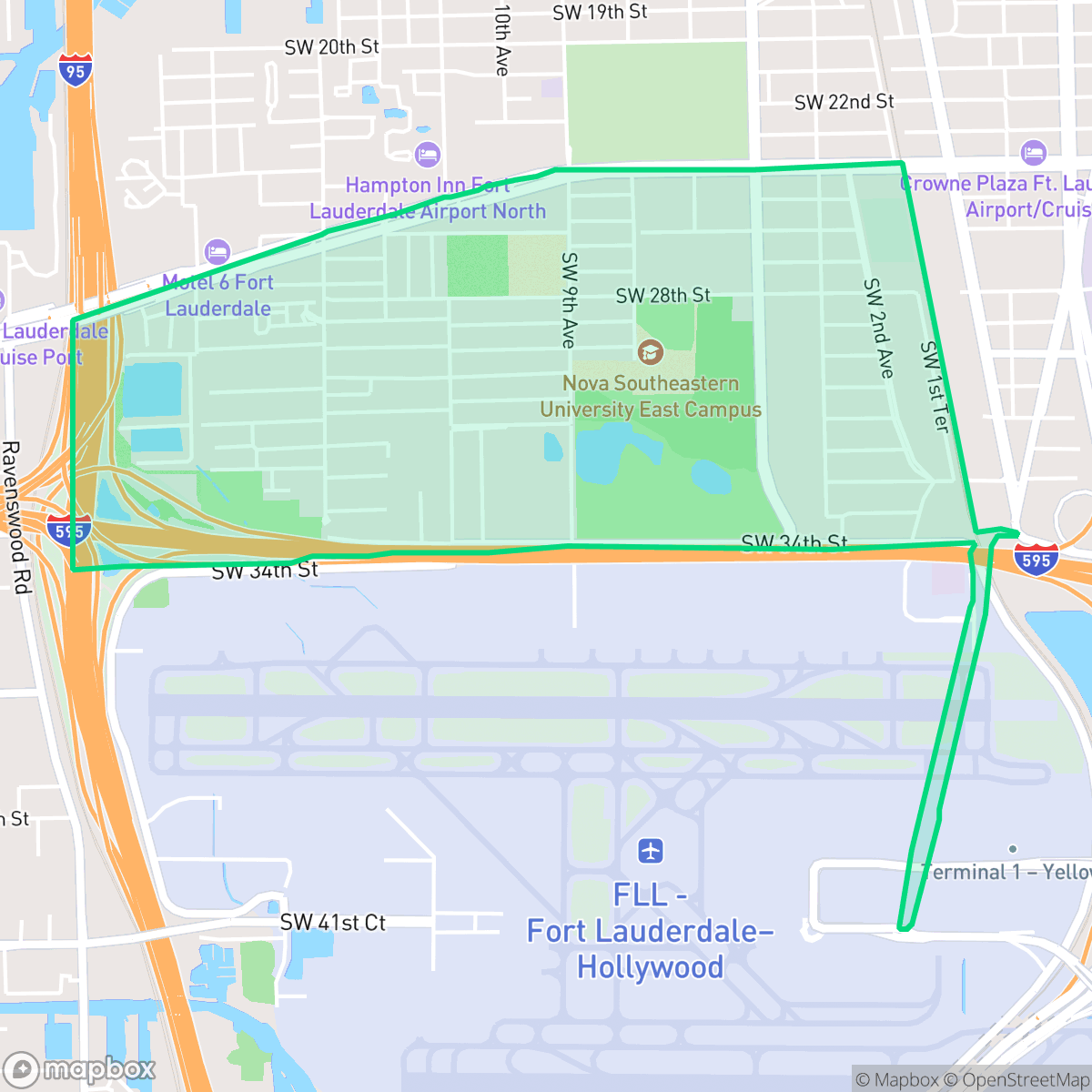
About Edgewood
Edgewood, located in Southwest Fort Lauderdale, emerged primarily during the mid-20th century as a post-war suburban development designed to provide quality housing near the city's growing employment centers. The neighborhood is defined by its classic mid-century ranch-style architecture, typically built between 1955 and 1970, and is characterized by mature tree-lined streets. Edgewood maintains a strong community identity through the Edgewood Civic Association and access to significant local public spaces, including Snyder Park and Passive Park. In recent years, the neighborhood has been shaped by its resilience efforts following historic 2023 flooding, which prompted major infrastructure investments, including a $14.5 million city-led stormwater improvement project to enhance flood mitigation and protect the area's established residential character.
The neighborhood presents a distinct suburban character defined by its grid-like residential streets and proximity to light industrial zones. It maintains a diverse demographic mix, ranging from young professionals and families to long-term senior residents. While the area is largely separated from heavy industrial activity, the presence of major transit corridors and the nearby airport contributes to a high level of ambient noise. Residents often rely on vehicles for daily errands, as the surrounding highway interchanges and industrial barriers make pedestrian travel challenging. According to iHuus data, the neighborhood balances this industrial-adjacent setting with a tight-knit community feel supported by local civic engagement.
Neighborhood Scores Across 15 Qualities
Residential spacing varies between dense apartment clusters and detached homes with moderate yard buffers. According to iHuus data, privacy levels in Edgewood are lower than the Fort Lauderdale average due to the presence of industrial zones and closer proximity between neighbors.
Large highway interchanges and arterial roads create significant pedestrian barriers, making walking much less convenient than in most other parts of Fort Lauderdale. While some residential pockets are navigable, industrial blocks often disrupt continuous sidewalk access.
Uniform housing layouts and small yards characterize the streetscapes, making the visual variety lower than the Fort Lauderdale average. While some waterfront areas feature luxury yachts and large estates, much of the neighborhood consists of standard residential grids.
Greenery in this area consists primarily of private residential yards and narrow verges along busy roads, which is below the city average. Residents can find better amenities near large nearby parks that offer trail and lake access for pets.
Residential streets and green spaces are balanced with significant industrial warehouses and transit infrastructure. This area presents a more suburban character than the typical Fort Lauderdale urban density, according to iHuus data.
Suburban streets and industrial pockets offer a subdued atmosphere with limited commercial activity. Most daily activities require a vehicle due to the sparse density of local dining and retail compared to the Fort Lauderdale average.
Persistent aircraft noise from the nearby airport runway significantly impacts acoustic comfort. According to iHuus data, this area experiences much higher levels of sound disruption than the rest of Fort Lauderdale.
Air quality fluctuates between acceptable and unhealthy levels, occasionally posing risks for sensitive groups. This area experiences slightly lower air quality than the Fort Lauderdale average, according to iHuus data.
Residential areas are largely separated from heavy industrial zones, though some light commercial activity and transit traffic are present. This level of industrial proximity is notably lower than the Fort Lauderdale average, according to iHuus data.
Health insurance coverage among residents is significantly lower than the Fort Lauderdale average, according to iHuus data. This indicates a much higher proportion of uninsured individuals compared to most other parts of the city.
Political views in Edgewood are evenly split between conservative and liberal leanings, representing a more balanced ideological landscape than the more liberal-leaning city average.
Edgewood features a varied demographic of young adults, families, and seniors. According to iHuus data, the population age distribution is more concentrated toward certain age groups than the broader Fort Lauderdale average.
Significant flood risk exists due to the area's location within a designated floodplain, which is notably higher than the Fort Lauderdale average. According to iHuus data, residents should anticipate that flood insurance will likely be a requirement for properties here.
Address-Level Insights for Edgewood


iHuus Neighborhood Intelligence Insights
Get address-level neighborhood insights for Edgewood
- Street-level scores — see how individual blocks compare, not just neighborhood averages
- Micro-zone boundaries — identify quiet pockets, flood boundaries, and walkable clusters before you visit
- 15 dimensions in full — walkability, noise, air quality, school quality, insurance coverage, population age profile, urban/rural index, and more
- Boundary risk alerts — know if your address sits near a block boundary where scores drop, the kind of detail no listing will ever mention
- School insights — individual school ratings and insights, not just district-level data
- Compare before you commit — side-by-side data across neighborhoods, down to block precision
No credit card required
Compare with Any Neighborhood
| Dimension | Edgewood | Bal Harbour |
|---|---|---|
| 🚶 Walkabilityavg 6.6 | ||
| 🔊 Acoustic Comfortavg 3.24 | ||
| 🤫 Privacy Indexavg 5.33 | ||
| 🎨 Visual Appealavg 6.66 | ||
| 🐕 Dog Friendlinessavg 4.88 | ||
| 🗺️ Urban-Rural Indexavg 6.04 | ||
| ✨ Neighborhood Vibeavg 4.63 | ||
| 🏥 Health Insurance Coverageavg 6.16 | ||
| 🌿 Air Qualityavg 6.61 | ||
| 🏭 Industrial Proximityavg 6.49 | ||
| 🌊 Flood Safetyavg 3.54 | ||
| 🗳️ Ideological Leanavg 6.3 | ||
| 👥 Population Age Profileavg 5.2 | ||
| 🔥 Fire Safety | ||
| 🏫 School Quality |
Edgewood Rankings
School Districts Serving Edgewood
School Insights for Edgewood
Below average outcomes; significant attendance and academic challenges.
School Insights
See what's really behind every school rating near Edgewood
- Individual school ratings — each school's own score with outcome context, not just a district average
- Enrollment & class size data — student-to-teacher ratio and how it compares to the state average
- Full demographics breakdown — ethnicity and gender composition for every school in the enrollment zone
- Every school in the district — all schools within the enrollment boundary ranked by rating, not just the closest one
- Grade levels & benchmarks — elementary through high school, with below/above state-average flags
No credit card required