Downtown, Fort Lauderdale
Updated · 3,504 residents
Downtown Fort Lauderdale serves as the city's vibrant urban core, defined by high-rise residential towers and a dense concentration of dining and entertainment venues. Residents benefit from exceptional walkability and direct access to the scenic New River, though the area experiences moderate traffic noise and an elevated risk of flooding.
Key Highlights
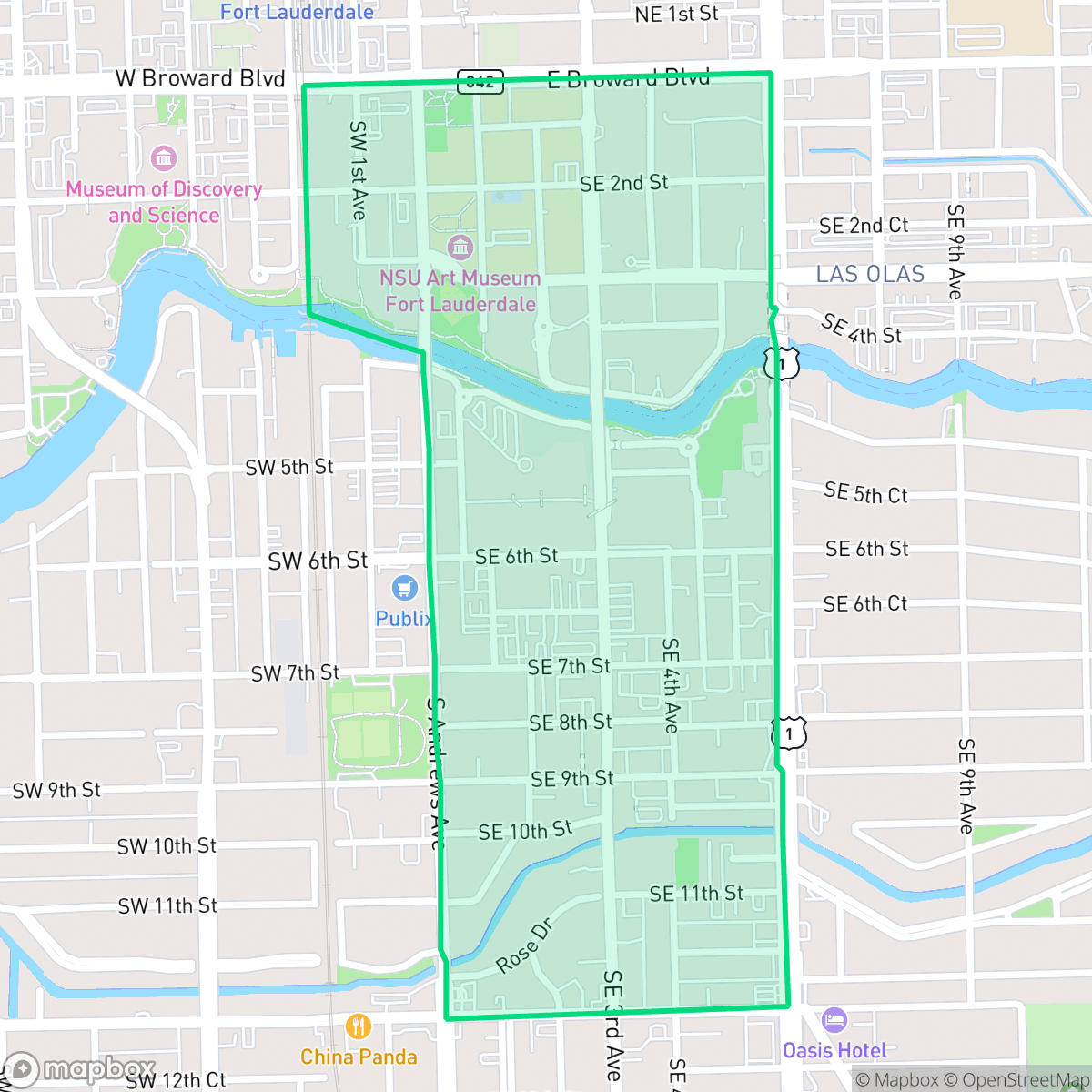
About Downtown
Downtown Fort Lauderdale's origins are rooted in the 1838 construction of a military fort on the New River during the Second Seminole War. Permanent civilian settlement began in the 1890s, catalyzed by the arrival of the Florida East Coast Railway. The neighborhood contains the Himmarshee Historic District, the city's oldest commercial section, which features early 20th-century architecture and the 1901 Stranahan House, the oldest surviving structure in Broward County. Once a quiet trading post, the area evolved into a civic and cultural hub, particularly following the 1980s and 1990s redevelopment efforts that established the Riverwalk—a linear park along the New River—and anchored the district with institutions like the NSU Art Museum. Today, Downtown balances its preserved historic landmarks with a dense urban landscape of high-rise residential and commercial development.
The neighborhood functions as a high-energy urban hub, characterized by a dense landscape of luxury high-rises and professional services. It offers a unique visual appeal with its manicured waterfront views and proximity to premium amenities, drawing a diverse population of young professionals and established residents. The area maintains a constant buzz of activity, making it a primary destination for those who prioritize immediate access to dining, culture, and social venues over a quiet, secluded environment. Living in this district involves specific trade-offs, particularly regarding environmental and infrastructure factors. While the area is highly pedestrian-friendly, residents should be aware of the persistent hum of local traffic and the increased risk of flooding associated with its location in a designated floodplain. Educational options fall under the Broward County School District, which is currently navigating significant structural and budgetary transitions. This neighborhood is best suited for individuals who value a dense, active urban lifestyle and wish to reside within walking distance of the city's most prominent cultural and commercial corridors.
Neighborhood Scores Across 15 Qualities
Residential spacing varies between high-rise towers with shared walls and more detached structures with moderate yard separation. This level of privacy is roughly in line with the Fort Lauderdale city average according to iHuus data.
Wide sidewalks, pedestrian-priority zones, and integrated riverwalks make navigating the area on foot easy. According to iHuus data, the connectivity and density of crossings are significantly higher than the city average.
Manicured waterfront views, luxury high-rises, and private docks characterize this area. The visual landscape sits slightly above the city average due to the frequent presence of premium amenities and well-maintained canal properties.
Riverfront parks and wide sidewalks offer decent walking opportunities, though the high density of urban pavement makes this area slightly more dog-friendly than the Fort Lauderdale average.
High-rise buildings and paved surfaces define this area, creating a more concentrated urban environment than the Fort Lauderdale average. According to iHuus data, the landscape features significant vertical density with relatively limited green space compared to suburban surroundings.
Intense activity and dense commercial development characterize this area, offering a level of movement and vibrancy that is significantly higher than the Fort Lauderdale average. Residents can expect a constant buzz from a high concentration of diverse dining, entertainment venues, and walkable urban corridors.
A steady hum of local traffic persists due to nearby busy streets, though this level of activity remains more tranquil than the city average according to iHuus data.
Air remains mostly clean with infrequent periods of elevated readings, representing a higher standard than the Fort Lauderdale average according to iHuus data.
Light commercial activity and transit-related services are present alongside residential areas. While there are no heavy industrial hazards, residents may encounter occasional utility odors or freight-related noise from nearby storage facilities and gas stations.
Health insurance accessibility is notably higher than the Fort Lauderdale average, according to iHuus data. Residents in this area have significantly greater access to coverage compared to the rest of the city.
Political leanings in this area are split nearly evenly between conservative and liberal residents. This level of ideological diversity is slightly lower than the average found across Fort Lauderdale, according to iHuus data.
A balanced mix of young professionals, families, and seniors resides here, representing a slightly more varied age distribution than the city average according to iHuus data.
Frequent flooding is a concern in this area because much of the neighborhood sits within a designated floodplain. According to iHuus data, this level of risk is slightly higher than the average for Fort Lauderdale.
Address-Level Insights for Downtown


iHuus Neighborhood Intelligence Insights
Get address-level neighborhood insights for Downtown
- Street-level scores — see how individual blocks compare, not just neighborhood averages
- Micro-zone boundaries — identify quiet pockets, flood boundaries, and walkable clusters before you visit
- 15 dimensions in full — walkability, noise, air quality, school quality, insurance coverage, population age profile, urban/rural index, and more
- Boundary risk alerts — know if your address sits near a block boundary where scores drop, the kind of detail no listing will ever mention
- School insights — individual school ratings and insights, not just district-level data
- Compare before you commit — side-by-side data across neighborhoods, down to block precision
No credit card required
Compare with Any Neighborhood
| Dimension | Downtown | Bal Harbour |
|---|---|---|
| 🚶 Walkabilityavg 6.6 | ||
| 🔊 Acoustic Comfortavg 3.24 | ||
| 🤫 Privacy Indexavg 5.33 | ||
| 🎨 Visual Appealavg 6.66 | ||
| 🐕 Dog Friendlinessavg 4.88 | ||
| 🗺️ Urban-Rural Indexavg 6.04 | ||
| ✨ Neighborhood Vibeavg 4.63 | ||
| 🏥 Health Insurance Coverageavg 6.16 | ||
| 🌿 Air Qualityavg 6.61 | ||
| 🏭 Industrial Proximityavg 6.49 | ||
| 🌊 Flood Safetyavg 3.54 | ||
| 🗳️ Ideological Leanavg 6.3 | ||
| 👥 Population Age Profileavg 5.2 | ||
| 🔥 Fire Safety | ||
| 🏫 School Quality |
Downtown Rankings
School Districts Serving Downtown
School Insights for Downtown
Below average outcomes; significant attendance and academic challenges.
School Insights
See what's really behind every school rating near Downtown
- Individual school ratings — each school's own score with outcome context, not just a district average
- Enrollment & class size data — student-to-teacher ratio and how it compares to the state average
- Full demographics breakdown — ethnicity and gender composition for every school in the enrollment zone
- Every school in the district — all schools within the enrollment boundary ranked by rating, not just the closest one
- Grade levels & benchmarks — elementary through high school, with below/above state-average flags
No credit card required