Croissant Park, Fort Lauderdale
Updated · 2,785 residents
Croissant Park is a historic residential enclave defined by its blend of mid-century architecture and lush, tree-lined streets near downtown Fort Lauderdale. The area offers high walkability and strong health insurance coverage, providing a balanced suburban lifestyle with convenient access to the New River.
Key Highlights
About Croissant Park
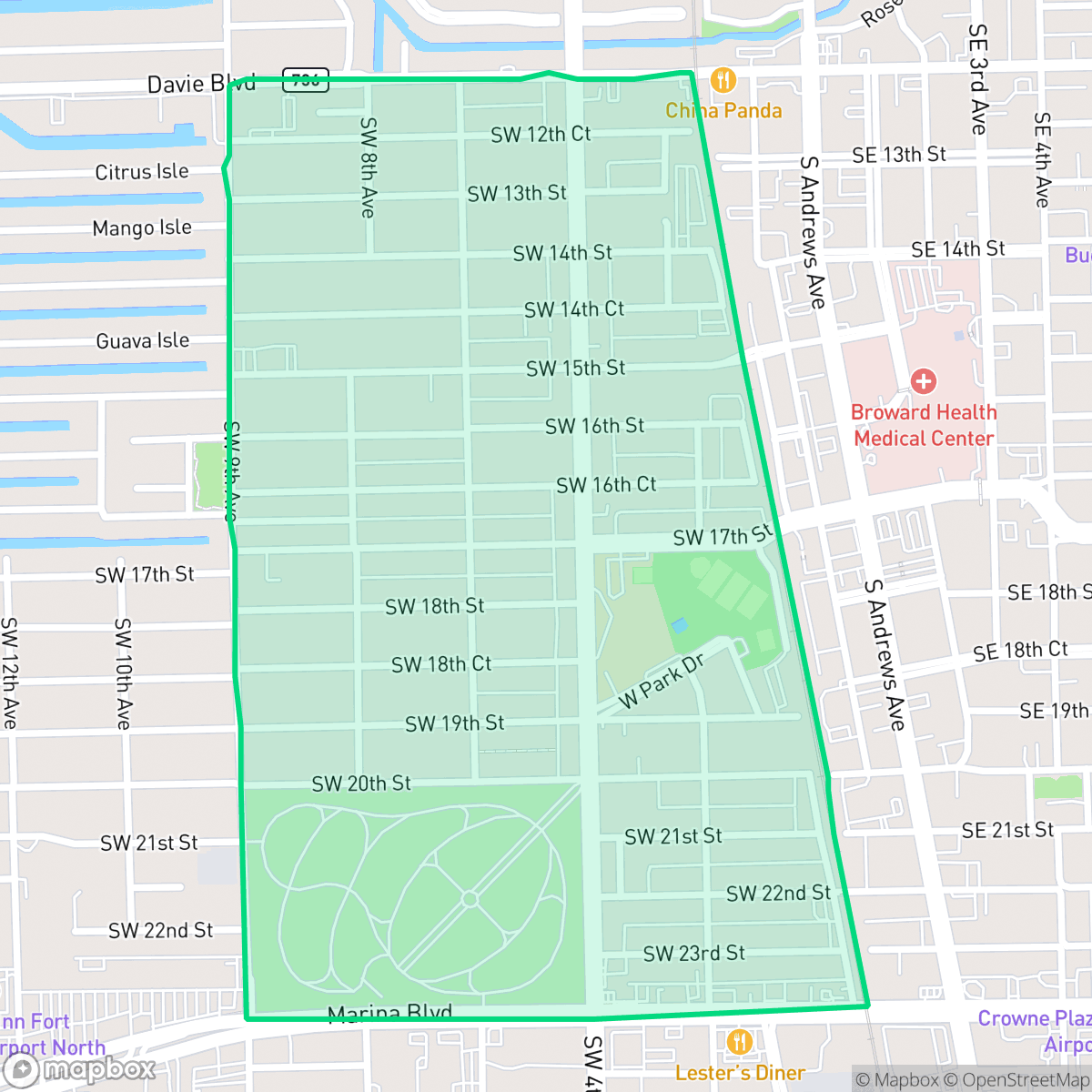
Croissant Park, established during the Florida land boom of the 1920s, is one of Fort Lauderdale's oldest subdivisions. It was developed by G. Frank Croissant, a colorful real estate entrepreneur who purchased 1,200 acres in 1924. The neighborhood's historic centerpiece is the Croissant Park Administration Building, a Mission Revival-style structure built in 1923 that served as the development's sales office and is now listed on the National Register of Historic Places. While the neighborhood saw significant growth in the 1950s and 1960s, featuring modest ranch-style homes alongside earlier bungalows, it retains a distinct character defined by its quiet, tree-lined residential streets. Today, the area is recognized for its blend of historic architecture and convenient proximity to downtown Fort Lauderdale and the New River.
The area maintains a distinct residential character that balances quiet, mature landscapes with the convenience of being near the city center. Residents enjoy a high level of air purity and a well-connected sidewalk network that encourages pedestrian activity throughout the neighborhood. The visual appeal is bolstered by well-maintained private properties, many of which feature swimming pools and waterfront access, creating a setting that feels both established and well-cared for. Prospective residents should be aware that the neighborhood is located within a floodplain, which necessitates careful consideration regarding insurance and property protection. While the environment is generally peaceful, the presence of nearby major thoroughfares creates a consistent background hum of traffic. The community attracts a diverse demographic, ranging from young professionals to long-term families, and benefits from a stable, balanced local atmosphere that avoids the extremes of industrial or high-density commercial development.
Neighborhood Scores Across 15 Qualities
Residential spacing provides a moderate level of separation between homes, consistent with the city average. While many properties feature yards and mature trees, some multi-family units and tighter street grids exist within the area according to iHuus data.
A consistent network of sidewalks and safe crossings makes much of the area highly navigable for pedestrians. Most residential streets offer walkable paths that are more accessible than the typical Fort Lauderdale neighborhood, though a major high-traffic artery does segment parts of the community.
Manicured lawns, private swimming pools, and waterfront properties with docks characterize much of the area. This visual landscape remains largely consistent with the broader Fort Lauderdale average.
Public parks and greenways in the southeast and southwest corners provide ample space for pet walking, making this area more dog friendly than much of Fort Lauderdale. While some sections feature narrow sidewalks, iHuus data shows significant accessible greenery available throughout the neighborhood.
Residential streets and green spaces are distributed in roughly equal measure, creating a suburban landscape that is slightly more developed than the Fort Lauderdale average. According to iHuus data, the area features a mix of single-family homes, tree-covered corridors, and low-rise apartment complexes.
Local activity levels are slightly higher than the Fort Lauderdale average, offering a balanced mix of transit hubs, diverse dining, and residential pockets. Residents can expect a consistent but moderate level of energy ranging from quiet tree-lined streets to more bustling commercial intersections.
Local traffic from nearby thoroughfares creates a consistent background noise level. This acoustic environment is notably more active than the average for Fort Lauderdale.
Air quality remains consistently clear with infrequent periods of poor visibility. This level of air purity is notably higher than the Fort Lauderdale average, according to iHuus data.
Largely residential in character, this area features significantly less heavy industry than the Fort Lauderdale average. While some light commercial activity and utility-related traffic exist near main roads, residents can expect minimal exposure to industrial hazards.
Health insurance enrollment among residents is notably higher than the Fort Lauderdale average, according to iHuus data.
Political leanings in Croissant Park are evenly split between conservative and liberal residents, representing a more moderate landscape than the broader Fort Lauderdale area according to iHuus data.
Residents live alongside a balanced spread of young adults, families, and older individuals. According to iHuus data, the age distribution in Croissant Park is consistent with the broader Fort Lauderdale area.
Properties within the 100-year floodplain are subject to significant inundation risks, and flood insurance is typically required. According to iHuus data, this level of vulnerability is consistent with the city average.
Address-Level Insights for Croissant Park


iHuus Neighborhood Intelligence Insights
Get address-level neighborhood insights for Croissant Park
- Street-level scores — see how individual blocks compare, not just neighborhood averages
- Micro-zone boundaries — identify quiet pockets, flood boundaries, and walkable clusters before you visit
- 15 dimensions in full — walkability, noise, air quality, school quality, insurance coverage, population age profile, urban/rural index, and more
- Boundary risk alerts — know if your address sits near a block boundary where scores drop, the kind of detail no listing will ever mention
- School insights — individual school ratings and insights, not just district-level data
- Compare before you commit — side-by-side data across neighborhoods, down to block precision
No credit card required
Compare with Any Neighborhood
| Dimension | Croissant Park | Bal Harbour |
|---|---|---|
| 🚶 Walkabilityavg 6.6 | ||
| 🔊 Acoustic Comfortavg 3.24 | ||
| 🤫 Privacy Indexavg 5.33 | ||
| 🎨 Visual Appealavg 6.66 | ||
| 🐕 Dog Friendlinessavg 4.88 | ||
| 🗺️ Urban-Rural Indexavg 6.04 | ||
| ✨ Neighborhood Vibeavg 4.63 | ||
| 🏥 Health Insurance Coverageavg 6.16 | ||
| 🌿 Air Qualityavg 6.61 | ||
| 🏭 Industrial Proximityavg 6.49 | ||
| 🌊 Flood Safetyavg 3.54 | ||
| 🗳️ Ideological Leanavg 6.3 | ||
| 👥 Population Age Profileavg 5.2 | ||
| 🔥 Fire Safety | ||
| 🏫 School Quality |
Croissant Park Rankings
School Districts Serving Croissant Park
School Insights for Croissant Park
Below average outcomes; significant attendance and academic challenges.
School Insights
See what's really behind every school rating near Croissant Park
- Individual school ratings — each school's own score with outcome context, not just a district average
- Enrollment & class size data — student-to-teacher ratio and how it compares to the state average
- Full demographics breakdown — ethnicity and gender composition for every school in the enrollment zone
- Every school in the district — all schools within the enrollment boundary ranked by rating, not just the closest one
- Grade levels & benchmarks — elementary through high school, with below/above state-average flags
No credit card required