Coral Shores, Fort Lauderdale
Updated · 357 residents
Coral Shores is a quintessential canal-front enclave defined by its upscale waterfront estates and a vibrant, socially active atmosphere. While the area offers a semi-rural feel with frequent greenery, residents should be prepared for higher noise levels from nearby transit and aircraft, as well as a significant risk of flooding.
Key Highlights
About Coral Shores
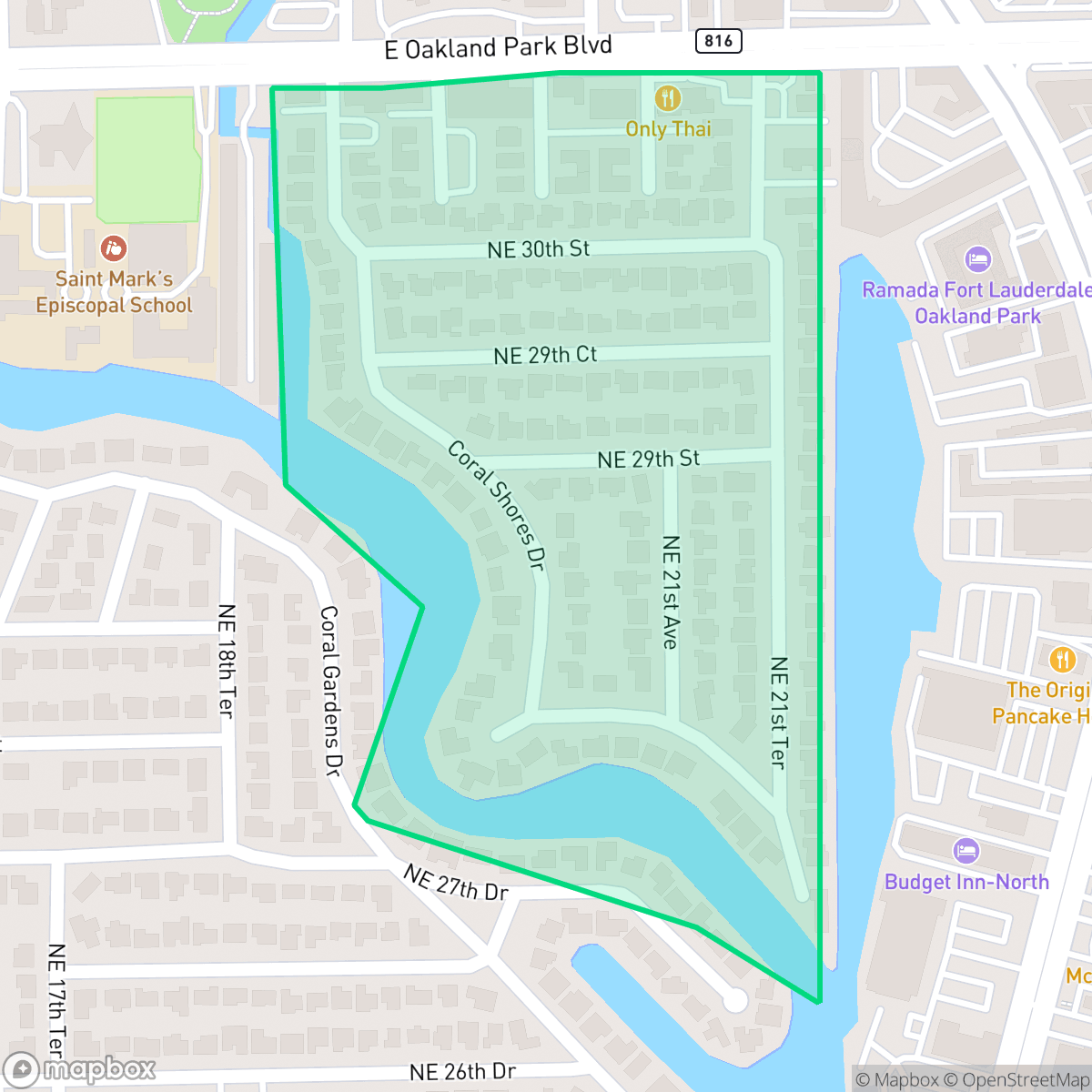
Coral Shores is an established residential neighborhood in Northeast Fort Lauderdale, characterized by its classic canal-front living. Developed primarily between the 1940s and 1960s, the community was designed to provide accessible waterfront access, with its canal systems connecting directly to the Intracoastal Waterway and the Atlantic Ocean via Port Everglades. The neighborhood features a mix of mid-century single-family homes and low-rise residential buildings. Its identity is defined by its nautical lifestyle, with many properties offering private dockage. The area is represented by the Coral Shores Civic Association, which helps maintain the community’s character as a quiet, family-oriented enclave positioned between Federal Highway and the waterfront.
The area serves as a hub for those seeking a polished, nautical lifestyle, characterized by well-maintained properties and a strong sense of social connectivity. Its layout provides a semi-rural aesthetic that stands out against the denser urban sprawl of the surrounding city, offering residents a peaceful visual environment despite the presence of nearby commercial activity. The community maintains a largely liberal ideological leaning and boasts high rates of health insurance coverage among its mature population.
Prospective residents should weigh the benefits of the neighborhood's lively social scene and walkability against specific environmental trade-offs. The area experiences notable noise disturbances from transit corridors and flight paths, and the limited availability of public parks can make pet ownership more challenging. Additionally, the neighborhood is situated within a high-risk flood zone, which is a common consideration for waterfront living in this region. Families should also note the current state of the Broward County School District, which is navigating a period of significant structural and budgetary transition.
Neighborhood Scores Across 15 Qualities
Residential spacing is consistent with the Fort Lauderdale average, offering a mix of yard buffers and closely situated homes along shared canals. According to iHuus data, some properties feature dense layouts where neighbors are positioned near one another.
Sidewalks and safe crossings are available along residential loops, though high speed traffic is common on larger arterial roads. According to iHuus data, the neighborhood offers slightly better pedestrian connectivity than the Fort Lauderdale average.
Luxury waterfront properties and well-maintained estates with private pools define the local landscape. According to iHuus data, the visual environment is notably more polished than the Fort Lauderdale average.
Access to public areas for pet exercise is somewhat restricted, as narrow sidewalk verges and private waterfront yards are more common than expansive public parks. According to iHuus data, the availability of accessible green space for dogs is slightly below the Fort Lauderdale average.
Open land and scattered vegetation provide a more spacious, semi-rural atmosphere compared to the denser urban landscape of Fort Lauderdale. According to iHuus data, this area features frequent pockets of greenery and woodland interspersed with residential clusters.
Social activity and business density are significantly higher than the Fort Lauderdale average. Residents have easy access to a concentrated variety of dining, fitness, and coffee shops within a walkable, high-energy environment.
Frequent noise from nearby major transit corridors and flight paths makes this area louder than the typical Fort Lauderdale neighborhood. According to iHuus data, residents may experience significant disturbances from traffic or aircraft activity.
Air quality levels in Coral Shores fluctuate between acceptable and unhealthy, staying slightly below the Fort Lauderdale average. Sensitive individuals may experience occasional concern during periods of poor air quality according to iHuus data.
Residential life remains undisturbed by heavy industry, as the area contains only light commercial use and local retail. According to iHuus data, this lack of industrial activity makes the neighborhood significantly cleaner than the Fort Lauderdale average.
Health insurance enrollment among residents is notably higher than the Fort Lauderdale average, according to iHuus data.
Political leanings in this area trend more liberal than the Fort Lauderdale average. According to iHuus data, the community maintains a liberal majority with a modest presence of opposing viewpoints.
Older adults comprise the majority of the population, representing a more mature demographic than the Fort Lauderdale average. According to iHuus data, there is also a modest presence of younger residents in the area.
Properties in this area are situated within a designated flood zone, meaning residents should expect a higher likelihood of flooding and potential requirements for flood insurance. This level of risk is consistent with the city average for Fort Lauderdale.
Address-Level Insights for Coral Shores


iHuus Neighborhood Intelligence Insights
Get address-level neighborhood insights for Coral Shores
- Street-level scores — see how individual blocks compare, not just neighborhood averages
- Micro-zone boundaries — identify quiet pockets, flood boundaries, and walkable clusters before you visit
- 15 dimensions in full — walkability, noise, air quality, school quality, insurance coverage, population age profile, urban/rural index, and more
- Boundary risk alerts — know if your address sits near a block boundary where scores drop, the kind of detail no listing will ever mention
- School insights — individual school ratings and insights, not just district-level data
- Compare before you commit — side-by-side data across neighborhoods, down to block precision
No credit card required
Compare with Any Neighborhood
| Dimension | Coral Shores | Bal Harbour |
|---|---|---|
| 🚶 Walkabilityavg 6.6 | ||
| 🔊 Acoustic Comfortavg 3.24 | ||
| 🤫 Privacy Indexavg 5.33 | ||
| 🎨 Visual Appealavg 6.66 | ||
| 🐕 Dog Friendlinessavg 4.88 | ||
| 🗺️ Urban-Rural Indexavg 6.04 | ||
| ✨ Neighborhood Vibeavg 4.63 | ||
| 🏥 Health Insurance Coverageavg 6.16 | ||
| 🌿 Air Qualityavg 6.61 | ||
| 🏭 Industrial Proximityavg 6.49 | ||
| 🌊 Flood Safetyavg 3.54 | ||
| 🗳️ Ideological Leanavg 6.3 | ||
| 👥 Population Age Profileavg 5.2 | ||
| 🔥 Fire Safety | ||
| 🏫 School Quality |
Coral Shores Rankings
School Districts Serving Coral Shores
School Insights for Coral Shores
Below average outcomes; significant attendance and academic challenges.
School Insights
See what's really behind every school rating near Coral Shores
- Individual school ratings — each school's own score with outcome context, not just a district average
- Enrollment & class size data — student-to-teacher ratio and how it compares to the state average
- Full demographics breakdown — ethnicity and gender composition for every school in the enrollment zone
- Every school in the district — all schools within the enrollment boundary ranked by rating, not just the closest one
- Grade levels & benchmarks — elementary through high school, with below/above state-average flags
No credit card required