Coral Ridge, Fort Lauderdale
Updated · 5,301 residents
Coral Ridge is a visually striking waterfront community defined by its collection of luxury estates and canal-side living. While the area offers high walkability and a diverse demographic, residents should be prepared for significant noise from nearby thoroughfares and a high risk of flooding.
Key Highlights
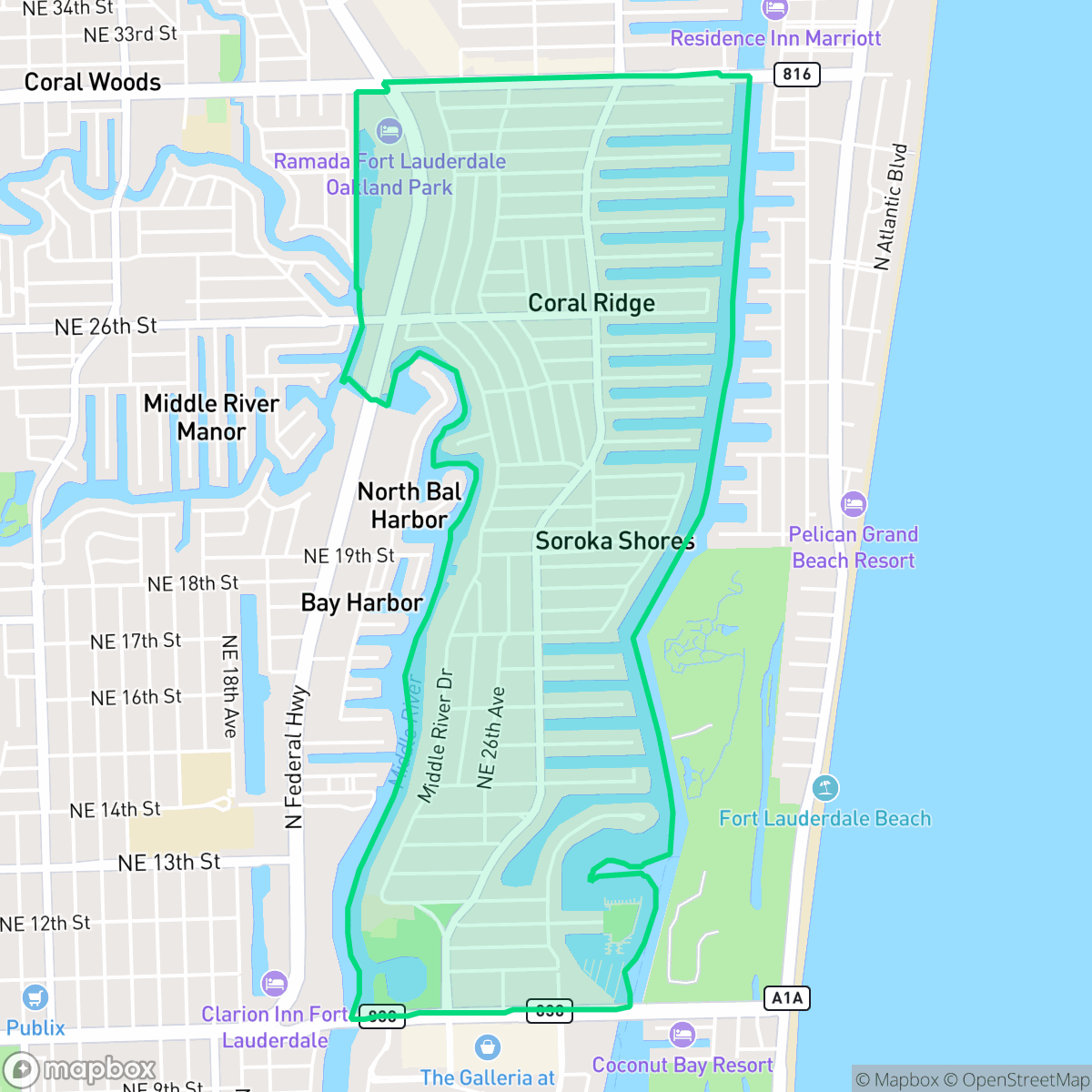
About Coral Ridge
Coral Ridge was primarily developed in the 1950s by Coral Ridge Properties, a company founded by James S. Hunt and Stephen A. Calder. Following their 1953 purchase of a massive tract of land from Arthur T. Galt, the developers transformed the area into a premier residential community characterized by extensive canal-front homes and mid-century modern architecture. The neighborhood gained further prominence with the 1962 opening of the Coral Ridge Shopping Plaza, which was among the first enclosed, air-conditioned malls in Florida. Today, the community remains defined by its waterfront lifestyle and its historical role in shifting Fort Lauderdale's residential growth northward during the post-World War II real estate boom.
The neighborhood offers a distinctively manicured aesthetic, characterized by large custom homes, private pools, and extensive boat docks that line the canal systems. This environment fosters a spacious suburban atmosphere, providing a clean, residential setting free from industrial activity. Residents benefit from a vibrant local scene, with numerous dining options and fitness studios integrated into walkable pockets throughout the area.
Living here involves specific considerations, particularly regarding environmental and infrastructure factors. The area is situated within a designated floodplain, necessitating careful attention to insurance requirements. While the neighborhood is generally pedestrian-friendly, the proximity to major arterial roads results in higher noise levels than in more secluded parts of the city. Families navigating the local public school system will find a district currently undergoing significant structural and budgetary transitions, though the community maintains a balanced demographic mix of young adults, families, and seniors.
Neighborhood Scores Across 15 Qualities
Residential spacing offers a moderate level of separation, though homes located along the canal corridors are often closely packed. This density provides slightly more privacy than the Fort Lauderdale average due to the varied mix of single-family homes and larger complexes.
Pedestrian infrastructure is well-developed with consistent sidewalks and canal bridges that make the area more walkable than the Fort Lauderdale average. While residential loops are safe for walking, some larger arterial roads feature higher traffic speeds.
Large custom homes, private pools, and extensive boat docks characterize the landscape, offering a much more manicured aesthetic than the Fort Lauderdale average. According to iHuus data, the area features a high density of luxury waterfront estates and coastal high-rises.
Public green space for pets is sparse due to narrow street verges and a lack of visible public parks. Most available greenery consists of private waterfront yards, making the area slightly less dog-friendly than the Fort Lauderdale average according to iHuus data.
A mix of waterfront single-family homes and canal systems provides a slightly more open, semi-rural atmosphere than the typical Fort Lauderdale urban density. This landscape features frequent open spaces and scattered residential pockets, according to iHuus data.
Active dining, fitness studios, and waterfront amenities provide a more energetic atmosphere than the city average. Residents can access a diverse collection of restaurants and transit hubs within various walkable pockets of the neighborhood.
Frequent noise from nearby major thoroughfares and transit paths makes this area noisier than the Fort Lauderdale average. Residents may experience regular auditory disturbances due to proximity to busy roadways.
Air quality in this area fluctuates between acceptable and unhealthy levels, falling slightly below the Fort Lauderdale average. Sensitive groups may experience occasional concern during certain periods according to iHuus data.
Industrial presence is virtually nonexistent in this area, providing a clean environment far cleaner than the Fort Lauderdale average. According to iHuus data, the neighborhood consists strictly of residential, recreational, and light commercial spaces without any heavy industry or hazardous facilities.
Health insurance accessibility among residents is significantly higher than the Fort Lauderdale average, according to iHuus data.
Political perspectives in this area are distributed fairly evenly between conservative and liberal leanings. This reflects a more moderate ideological split than the broader Fort Lauderdale average, according to iHuus data.
Residents will find a varied demographic mix of young adults, families, and seniors. According to iHuus data, this age distribution is more balanced than the average seen across Fort Lauderdale.
Property within this area sits inside a designated floodplain, which typically necessitates flood insurance. According to iHuus data, the level of flood risk in Coral Ridge is consistent with the city average.
Address-Level Insights for Coral Ridge


iHuus Neighborhood Intelligence Insights
Get address-level neighborhood insights for Coral Ridge
- Street-level scores — see how individual blocks compare, not just neighborhood averages
- Micro-zone boundaries — identify quiet pockets, flood boundaries, and walkable clusters before you visit
- 15 dimensions in full — walkability, noise, air quality, school quality, insurance coverage, population age profile, urban/rural index, and more
- Boundary risk alerts — know if your address sits near a block boundary where scores drop, the kind of detail no listing will ever mention
- School insights — individual school ratings and insights, not just district-level data
- Compare before you commit — side-by-side data across neighborhoods, down to block precision
No credit card required
Compare with Any Neighborhood
| Dimension | Coral Ridge | Bal Harbour |
|---|---|---|
| 🚶 Walkabilityavg 6.6 | ||
| 🔊 Acoustic Comfortavg 3.24 | ||
| 🤫 Privacy Indexavg 5.33 | ||
| 🎨 Visual Appealavg 6.66 | ||
| 🐕 Dog Friendlinessavg 4.88 | ||
| 🗺️ Urban-Rural Indexavg 6.04 | ||
| ✨ Neighborhood Vibeavg 4.63 | ||
| 🏥 Health Insurance Coverageavg 6.16 | ||
| 🌿 Air Qualityavg 6.61 | ||
| 🏭 Industrial Proximityavg 6.49 | ||
| 🌊 Flood Safetyavg 3.54 | ||
| 🗳️ Ideological Leanavg 6.3 | ||
| 👥 Population Age Profileavg 5.2 | ||
| 🔥 Fire Safety | ||
| 🏫 School Quality |
Coral Ridge Rankings
School Districts Serving Coral Ridge
School Insights for Coral Ridge
Below average outcomes; significant attendance and academic challenges.
School Insights
See what's really behind every school rating near Coral Ridge
- Individual school ratings — each school's own score with outcome context, not just a district average
- Enrollment & class size data — student-to-teacher ratio and how it compares to the state average
- Full demographics breakdown — ethnicity and gender composition for every school in the enrollment zone
- Every school in the district — all schools within the enrollment boundary ranked by rating, not just the closest one
- Grade levels & benchmarks — elementary through high school, with below/above state-average flags
No credit card required