Central Beach Alliance, Fort Lauderdale
Updated · 3,546 residents
Central Beach Alliance is a premier coastal district defined by its exceptional walkability and upscale aesthetic, featuring a mix of luxury high-rises and canal-front residences. The area serves as a vibrant hub for recreation and dining, offering residents immediate access to the Atlantic shoreline and well-maintained pedestrian promenades.
Key Highlights
About Central Beach Alliance
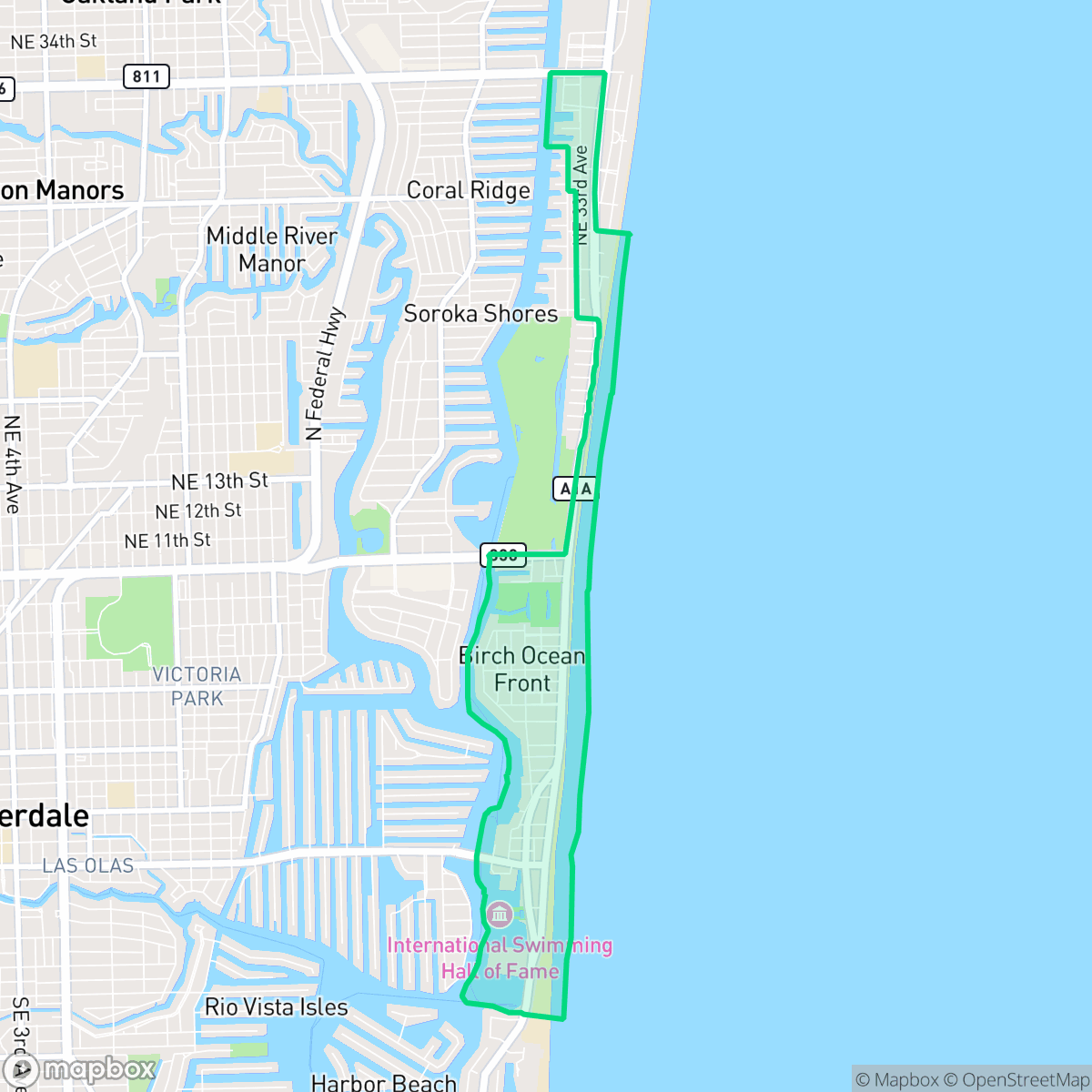
The Central Beach neighborhood in Fort Lauderdale, represented by the Central Beach Alliance, is a vibrant coastal district that evolved from an uninhabited barrier island into a premier resort destination following the 1920s Florida land boom. Its development was significantly influenced by conservationist Hugh Taylor Birch, whose legacy is preserved in the neighboring Hugh Taylor Birch State Park and the historic 1920s-era Bonnet House Museum and Gardens. Architecturally, the neighborhood features a distinct blend of mid-century modern landmarks, such as the 1960 Birch Tower, alongside contemporary luxury high-rises. Stretching along A1A, the area serves as a signature tourism and entertainment corridor, defined by its grid-pattern streets, proximity to the Atlantic Ocean, and a lively mix of beachfront dining, nightlife, and resort-style residential living.
The neighborhood functions as a highly active coastal hub characterized by a polished visual identity and a dense, walkable layout. Its infrastructure supports a lifestyle where residents can easily navigate between beachfront amenities, local transit hubs, and social venues. Unlike many other parts of the city, the area is entirely free of industrial facilities, which helps maintain a clean and residential-focused environment that feels more suburban than the typical urban landscape of Fort Lauderdale.
Living in this area involves certain trade-offs, particularly regarding environmental factors. Properties are located within a designated floodplain, and the area experiences occasional traffic noise from surrounding busy streets. It is best suited for individuals who prioritize proximity to the water and a social, active lifestyle. While the population demographic trends toward older adults, the community maintains high levels of health insurance coverage and offers a balanced political environment, according to iHuus data.
Neighborhood Scores Across 15 Qualities
Residential spacing varies between closely packed canal homes and high-rise towers, offering slightly more separation than the Fort Lauderdale average. According to iHuus data, this mix of multi-unit structures and single-family homes provides a moderate level of privacy.
Pedestrian infrastructure is exceptional here, featuring a dense grid of sidewalks and beachside promenades that are significantly more navigable than the Fort Lauderdale average. Residents can easily traverse the area using well-defined crossings and pedestrian bridges over the local canals.
Premium waterfront estates, private docks, and luxury high-rises create a highly polished landscape that is significantly more visually impressive than the Fort Lauderdale average. According to iHuus data, the area features frequent high-end amenities such as rooftop pools and large private boats.
Access to the beach and nearby forested park areas provides reliable walking opportunities for pets. According to iHuus data, this area offers more accessible greenery for dogs than the Fort Lauderdale average.
A blend of dense coastal high-rises and suburban canal-front homes defines this area. According to iHuus data, the neighborhood feels more suburban than the typical Fort Lauderdale urban landscape.
High concentrations of dining, transit hubs, and coastal parks create a significantly more active atmosphere than the Fort Lauderdale average. This dense area offers a bustling environment with many social venues and walkable access to waterfront amenities.
Steady traffic sounds from nearby busy streets are present, though levels are noticeably more tranquil than the Fort Lauderdale city average according to iHuus data.
Air quality fluctuates between acceptable and unhealthy levels, presenting occasional concerns for sensitive groups. This area experiences slightly lower air quality than the Fort Lauderdale average, according to iHuus data.
This area is entirely composed of residential, recreational, and light commercial spaces with no presence of heavy industry or warehouses. According to iHuus data, the neighborhood lacks the industrial facilities and hazard sites found more commonly across Fort Lauderdale.
Health insurance coverage among residents is significantly higher than the Fort Lauderdale average, according to iHuus data.
Political leanings in this area are split nearly evenly between conservative and liberal perspectives, making it more politically diverse than the Fort Lauderdale average.
Older adults represent the majority of the population here, while younger residents maintain a more modest presence. This age demographic trends higher than the Fort Lauderdale city average according to iHuus data.
Living within a designated floodplain means properties are subject to periodic inundation risks. According to iHuus data, flood vulnerability in this area is slightly higher than the Fort Lauderdale average.
Address-Level Insights for Central Beach Alliance


iHuus Neighborhood Intelligence Insights
Get address-level neighborhood insights for Central Beach Alliance
- Street-level scores — see how individual blocks compare, not just neighborhood averages
- Micro-zone boundaries — identify quiet pockets, flood boundaries, and walkable clusters before you visit
- 15 dimensions in full — walkability, noise, air quality, school quality, insurance coverage, population age profile, urban/rural index, and more
- Boundary risk alerts — know if your address sits near a block boundary where scores drop, the kind of detail no listing will ever mention
- School insights — individual school ratings and insights, not just district-level data
- Compare before you commit — side-by-side data across neighborhoods, down to block precision
No credit card required
Compare with Any Neighborhood
| Dimension | Central Beach Alliance | Bal Harbour |
|---|---|---|
| 🚶 Walkabilityavg 6.6 | ||
| 🔊 Acoustic Comfortavg 3.24 | ||
| 🤫 Privacy Indexavg 5.33 | ||
| 🎨 Visual Appealavg 6.66 | ||
| 🐕 Dog Friendlinessavg 4.88 | ||
| 🗺️ Urban-Rural Indexavg 6.04 | ||
| ✨ Neighborhood Vibeavg 4.63 | ||
| 🏥 Health Insurance Coverageavg 6.16 | ||
| 🌿 Air Qualityavg 6.61 | ||
| 🏭 Industrial Proximityavg 6.49 | ||
| 🌊 Flood Safetyavg 3.54 | ||
| 🗳️ Ideological Leanavg 6.3 | ||
| 👥 Population Age Profileavg 5.2 | ||
| 🔥 Fire Safety | ||
| 🏫 School Quality |
Central Beach Alliance Rankings
School Districts Serving Central Beach Alliance
School Insights for Central Beach Alliance
Below average outcomes; significant attendance and academic challenges.
School Insights
See what's really behind every school rating near Central Beach Alliance
- Individual school ratings — each school's own score with outcome context, not just a district average
- Enrollment & class size data — student-to-teacher ratio and how it compares to the state average
- Full demographics breakdown — ethnicity and gender composition for every school in the enrollment zone
- Every school in the district — all schools within the enrollment boundary ranked by rating, not just the closest one
- Grade levels & benchmarks — elementary through high school, with below/above state-average flags
No credit card required