Clearwater Beach Association, Clearwater
Updated · 1,551 residents
The Clearwater Beach Association area offers a highly walkable coastal environment defined by its upscale residential properties and vibrant, resort-style atmosphere. Residents enjoy excellent access to local amenities and pedestrian-friendly streets, though the neighborhood faces challenges related to flood vulnerability and consistent traffic noise.
Key Highlights
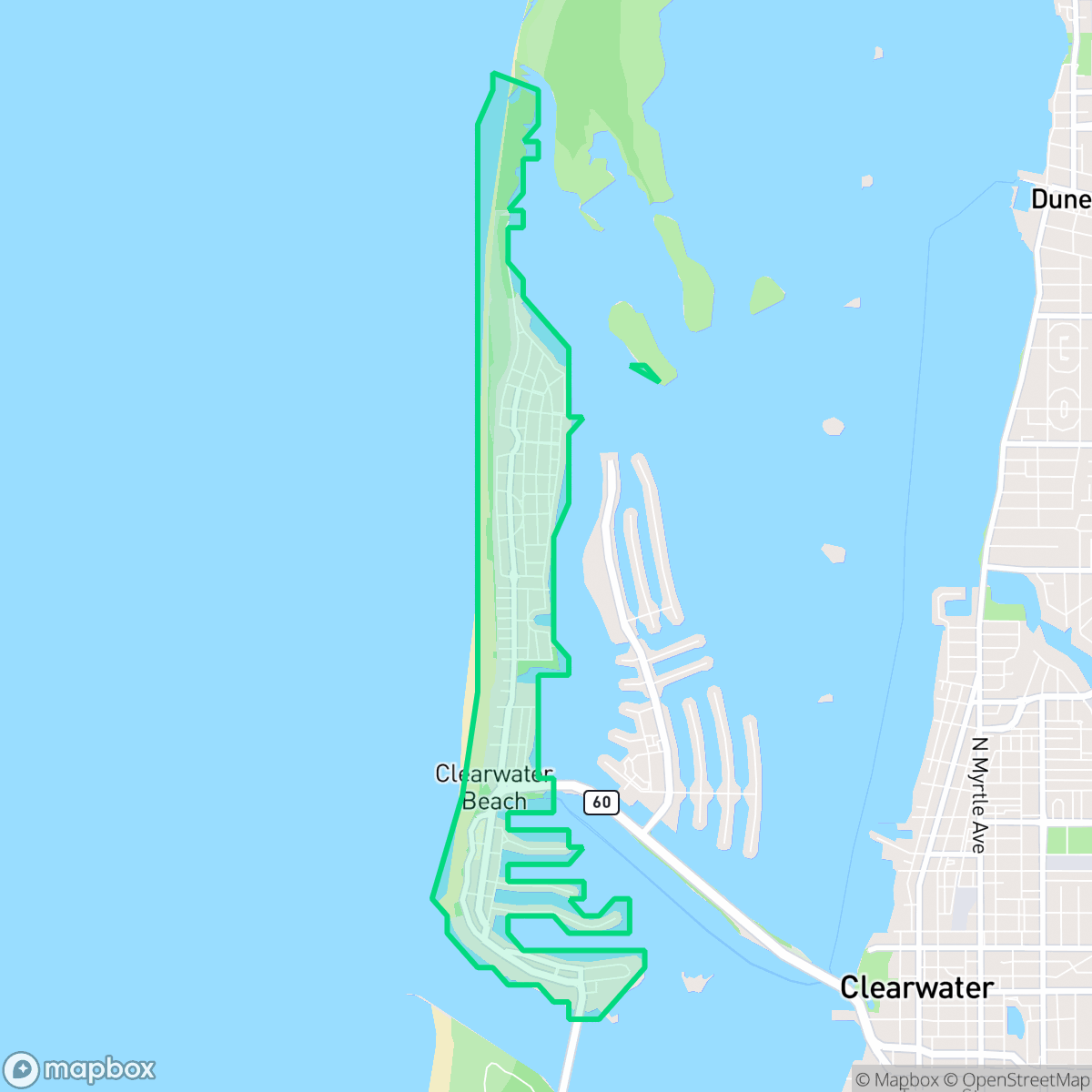
About Clearwater Beach Association
The Clearwater Beach Association (CBA), established in 1944, is Clearwater's oldest civic association, formed by permanent residents to manage neighborhood affairs when the island was sparsely settled with waterfront homes and scattered tourist courts. Historically known as Tate's Island after early homesteader Ernest Tate, the area transitioned from an isolated wilderness reachable only by boat to a tourist destination following the 1917 opening of a wooden bridge. The CBA played a pivotal role in the island's development, notably advocating for community interests against high-rise encroachment and spearheading the 1952 establishment of the Chapel-by-the-Sea. Over decades, the association has influenced local planning, including the creation of Sunsets at Pier 60 and ongoing coastal resilience initiatives, helping define the character of this barrier island community as it evolved from modest seasonal cottages to a major resort destination.
The neighborhood is characterized by its manicured landscape and a complete absence of industrial activity, fostering a clean and visually appealing environment. It maintains a semi-rural feel through its open spaces and scattered residences, balancing quiet, private pockets with the lively energy of a major coastal destination. The community benefits from high levels of health insurance coverage and a well-supported school district, contributing to a stable and mature social environment that values local civic engagement.
Prospective residents should note that the area sits within a designated floodplain, which creates a high risk for water-related issues. Additionally, the neighborhood experiences frequent traffic noise and air quality concerns that are common in the broader region. Given the predominantly older demographic and conservative social climate, the neighborhood is well-suited for those seeking a settled, pedestrian-oriented lifestyle in a scenic barrier island setting.
Neighborhood Scores Across 15 Qualities
Residential spacing is mixed with some buffers between properties, offering a level of privacy that is roughly comparable to the Clearwater average.
Pedestrian access is well-supported by sidewalks and safe crossings, making it easier to navigate the area on foot than in most parts of Clearwater. According to iHuus data, this accessibility is notably higher than the city average.
Large residential properties and premium amenities define the area's landscape, which appears significantly more manicured than the Clearwater average according to iHuus data.
Connected green spaces and wide, low-traffic paths provide reliable areas for walking pets. This level of accessibility is slightly above the Clearwater average according to iHuus data.
Open land and scattered residences provide a sense of space that is slightly more suburban than the Clearwater average. According to iHuus data, the area features pockets of greenery and woodland interspersed with residential structures.
A varied rhythm of activity defines this area, where bustling coastal hubs with diverse dining and transit options exist alongside quieter, more subdued residential pockets. This balance of lively social spots and calm streets results in a level of liveliness that is higher than the Clearwater average.
Steady sound from nearby busy streets creates a consistent hum, though levels are slightly higher than the Clearwater average according to iHuus data.
Frequent unhealthy air quality levels pose a significant risk to sensitive groups. This condition remains consistent with the broader Clearwater average, according to iHuus data.
Industrial activity is virtually non-existent here, as the area consists entirely of residential pockets and light commercial uses like cafes and hotels. This lack of warehouses or hazardous sites makes the neighborhood significantly cleaner than the Clearwater average, according to iHuus data.
Health insurance access is exceptionally high among residents, significantly surpassing the Clearwater average according to iHuus data.
Voting patterns and census indicators reflect a predominantly conservative leaning that is notably more pronounced than the Clearwater city average, according to iHuus data.
Residents primarily consist of older adults with a smaller population of younger individuals, representing a more mature demographic than the Clearwater average.
Frequent flooding is a significant concern in this area because it sits within a designated floodplain. According to iHuus data, the vulnerability to rising waters is much higher than the average for Clearwater.
Address-Level Insights for Clearwater Beach Association


iHuus Neighborhood Intelligence Insights
Get address-level neighborhood insights for Clearwater Beach Association
- Street-level scores — see how individual blocks compare, not just neighborhood averages
- Micro-zone boundaries — identify quiet pockets, flood boundaries, and walkable clusters before you visit
- 15 dimensions in full — walkability, noise, air quality, school quality, insurance coverage, population age profile, urban/rural index, and more
- Boundary risk alerts — know if your address sits near a block boundary where scores drop, the kind of detail no listing will ever mention
- School insights — individual school ratings and insights, not just district-level data
- Compare before you commit — side-by-side data across neighborhoods, down to block precision
No credit card required
Compare with Any Neighborhood
| Dimension | Clearwater Beach Association | Alcove Homeowners Association, Inc |
|---|---|---|
| 🚶 Walkabilityavg 7.25 | ||
| 🔊 Acoustic Comfortavg 4.07 | ||
| 🤫 Privacy Indexavg 5.66 | ||
| 🎨 Visual Appealavg 6.72 | ||
| 🐕 Dog Friendlinessavg 6.21 | ||
| 🗺️ Urban-Rural Indexavg 6.51 | ||
| ✨ Neighborhood Vibeavg 4.03 | ||
| 🏥 Health Insurance Coverageavg 6.32 | ||
| 🌿 Air Qualityavg 1.98 | ||
| 🏭 Industrial Proximityavg 7.82 | ||
| 🌊 Flood Safetyavg 5.71 | ||
| 🗳️ Ideological Leanavg 3.22 | ||
| 👥 Population Age Profileavg 5.73 | ||
| 🔥 Fire Safety | ||
| 🏫 School Quality |
Clearwater Beach Association Rankings
School Districts Serving Clearwater Beach Association
School Insights for Clearwater Beach Association
Below average outcomes; significant attendance and academic challenges.
School Insights
See what's really behind every school rating near Clearwater Beach Association
- Individual school ratings — each school's own score with outcome context, not just a district average
- Enrollment & class size data — student-to-teacher ratio and how it compares to the state average
- Full demographics breakdown — ethnicity and gender composition for every school in the enrollment zone
- Every school in the district — all schools within the enrollment boundary ranked by rating, not just the closest one
- Grade levels & benchmarks — elementary through high school, with below/above state-average flags
No credit card required