Broderrick/Bryte, West Sacramento
Updated · 11,292 residents
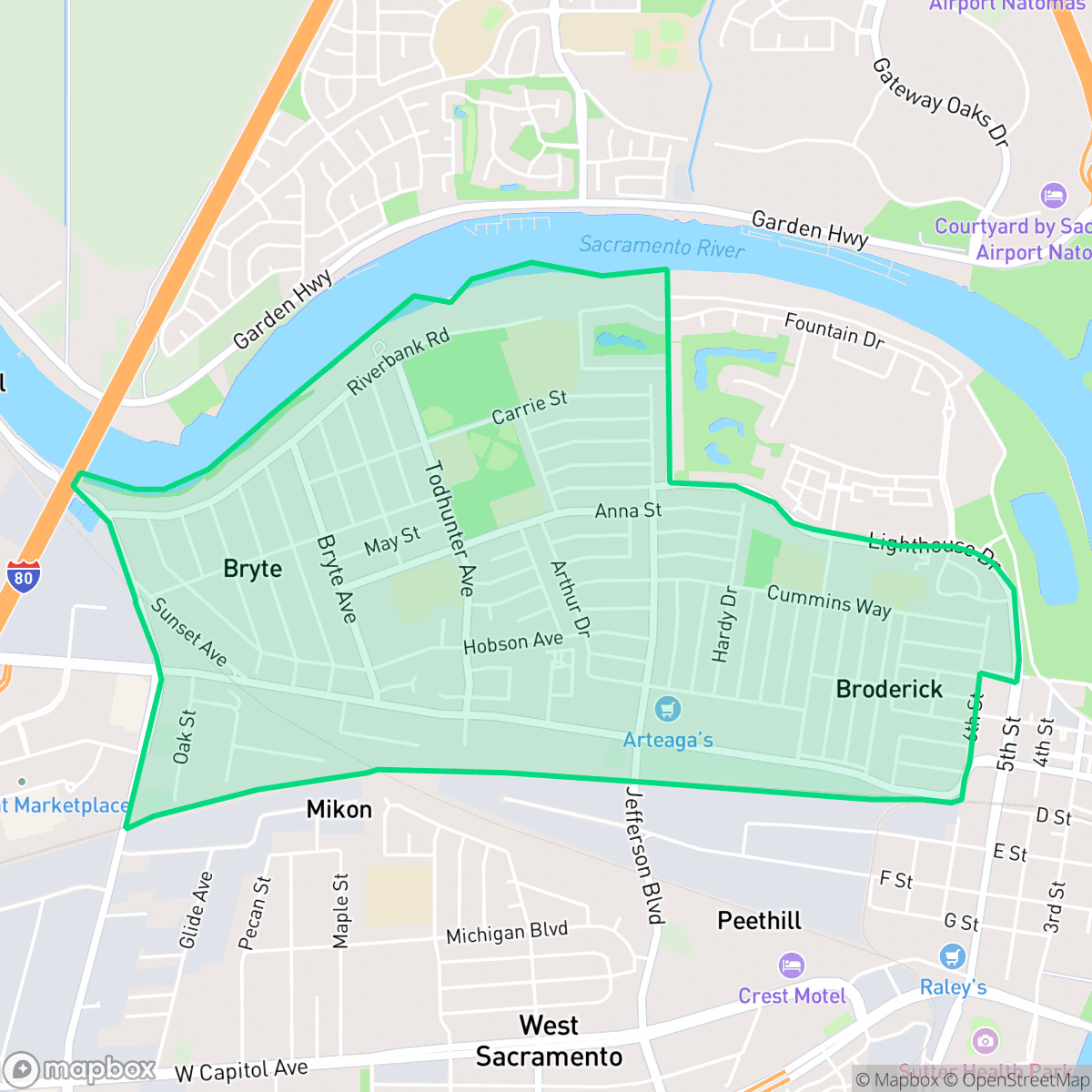
Broderick and Bryte offer a highly walkable residential environment defined by a blend of historic charm and functional suburban living. Residents benefit from excellent access to riverside green spaces for outdoor recreation, though the area experiences moderate noise from nearby traffic and industrial activity.
Key Highlights
About Broderrick/Bryte
Broderick and Bryte are historic communities that formed the foundation of modern West Sacramento. Broderick, originally settled in 1846 and named after U.S. Senator David C. Broderick, began as the 'Town of Washington,' a bustling Gold Rush-era shipping and transit hub along the Sacramento River. Adjacent to it, Bryte developed in the 20th century from the subdivision of large dairy farms established by early settler Mike Bryte. Historically, these areas were defined by diverse immigrant enclaves, including Italian, Japanese, and Russian populations. A notable cultural landmark is the Bryte VFW Memorial Hall, designated as California Historical Landmark #1057; it served as the first All-Indian Veterans of Foreign Wars chapter in California and became a vital center for the revival of traditional Maidu and Miwok dances and community networking.
The neighborhood provides a highly walkable environment where residents can easily navigate local streets and reach nearby parks. Its semi-rural atmosphere, characterized by open land and scattered residential pockets, creates a quiet, functional setting for daily life. The area maintains good air quality and offers significant opportunities for outdoor recreation, particularly for dog owners who utilize the expansive riverside fields. According to iHuus data, the neighborhood provides a balanced demographic mix that supports a steady, community-oriented rhythm.
Prospective residents should consider the trade-offs of living in a mixed industrial and residential zone, as logistics hubs in the southern portion contribute to localized traffic noise. While the area is generally quiet, it remains within a floodplain, necessitating awareness of seasonal environmental risks. The neighborhood is well-suited for those who value pedestrian-friendly streets and a strong community identity, though it is best for individuals who are comfortable with a functional, suburban pace and the occasional presence of heavy transit nearby.
Neighborhood Scores Across 15 Qualities
Residential spacing is varied, with some areas featuring closely positioned houses and shared apartment courtyards. According to iHuus data, the level of separation between neighbors is slightly lower than the West Sacramento average.
Continuous sidewalks and clear crosswalks are available on most residential streets, making this area slightly more walkable than the West Sacramento average. The dense sidewalk network and presence of local schools and parks support easy pedestrian movement throughout the neighborhood.
Standardized tract housing and mid-range apartment complexes define the area's visual character. According to iHuus data, the neighborhood's aesthetic appeal is slightly lower than the West Sacramento average due to repetitive rooflines and limited private greenery.
Expansive riverside parks and large grass fields offer ample space for pets. While sidewalk verges are occasionally narrow, the area provides significant access to open green spaces and safe walking areas similar to the rest of West Sacramento.
Open land and scattered residential pockets provide a semi-rural feel, though this area is slightly less open than the West Sacramento average. The landscape features a blend of residential grids and larger industrial or commercial clusters.
Suburban streets and green spaces offer a calm environment, though the area relies on car travel for most commercial needs. According to iHuus data, the local rhythm of services and social hubs is slightly more active than the West Sacramento average.
Steady traffic noise from a nearby busy street is common in this area. This level of acoustic activity is roughly comparable to the average found throughout West Sacramento.
Air quality remains generally good with rare instances of elevated readings. According to iHuus data, the air quality in this area is slightly better than the West Sacramento average.
Residential areas remain largely quiet, though significant logistics hubs and warehouse operations in the southern portion and near the riverfront introduce localized noise and truck traffic. This level of industrial proximity is slightly higher than the West Sacramento average according to iHuus data.
Health insurance access among residents is relatively high, though slightly lower than the West Sacramento average according to iHuus data.
Voting patterns and census indicators reflect a very liberal political leaning, which is slightly more pronounced than the West Sacramento average according to iHuus data.
Residents live alongside a diverse range of age groups, including young adults, families, and seniors. This demographic spread is consistent with the broader West Sacramento area, according to iHuus data.
Residual flood risk exists within this area as it sits within a 500-year floodplain, which is slightly higher than the West Sacramento average. Residents should be aware of these seasonal vulnerabilities according to iHuus data.
Address-Level Insights for Broderrick/Bryte


iHuus Neighborhood Intelligence Insights
Get address-level neighborhood insights for Broderrick/Bryte
- Street-level scores — see how individual blocks compare, not just neighborhood averages
- Micro-zone boundaries — identify quiet pockets, flood boundaries, and walkable clusters before you visit
- 15 dimensions in full — walkability, noise, air quality, school quality, insurance coverage, population age profile, urban/rural index, and more
- Boundary risk alerts — know if your address sits near a block boundary where scores drop, the kind of detail no listing will ever mention
- School insights — individual school ratings and insights, not just district-level data
- Compare before you commit — side-by-side data across neighborhoods, down to block precision
No credit card required
Compare with Any Neighborhood
| Dimension | Broderrick/Bryte | Broderrick/Bryte |
|---|---|---|
| 🚶 Walkabilityavg 8.33 | ||
| 🔊 Acoustic Comfortavg 4.31 | ||
| 🤫 Privacy Indexavg 5.47 | ||
| 🎨 Visual Appealavg 6.52 | ||
| 🐕 Dog Friendlinessavg 7.26 | ||
| 🗺️ Urban-Rural Indexavg 6.86 | ||
| ✨ Neighborhood Vibeavg 3.48 | ||
| 🏥 Health Insurance Coverageavg 7.88 | ||
| 🌿 Air Qualityavg 6.1 | ||
| 🏭 Industrial Proximityavg 7.34 | ||
| 🌊 Flood Safetyavg 7.06 | ||
| 🗳️ Ideological Leanavg 8.96 | ||
| 👥 Population Age Profileavg 4.78 | ||
| 🔥 Fire Safety | ||
| 🏫 School Quality |
Broderrick/Bryte Rankings
School Districts Serving Broderrick/Bryte
School Insights for Broderrick/Bryte
Below average outcomes; significant attendance and academic challenges.
School Insights
See what's really behind every school rating near Broderrick/Bryte
- Individual school ratings — each school's own score with outcome context, not just a district average
- Enrollment & class size data — student-to-teacher ratio and how it compares to the state average
- Full demographics breakdown — ethnicity and gender composition for every school in the enrollment zone
- Every school in the district — all schools within the enrollment boundary ranked by rating, not just the closest one
- Grade levels & benchmarks — elementary through high school, with below/above state-average flags
No credit card required