Broderrick/Bryte, West Sacramento
Updated · 11,292 residents
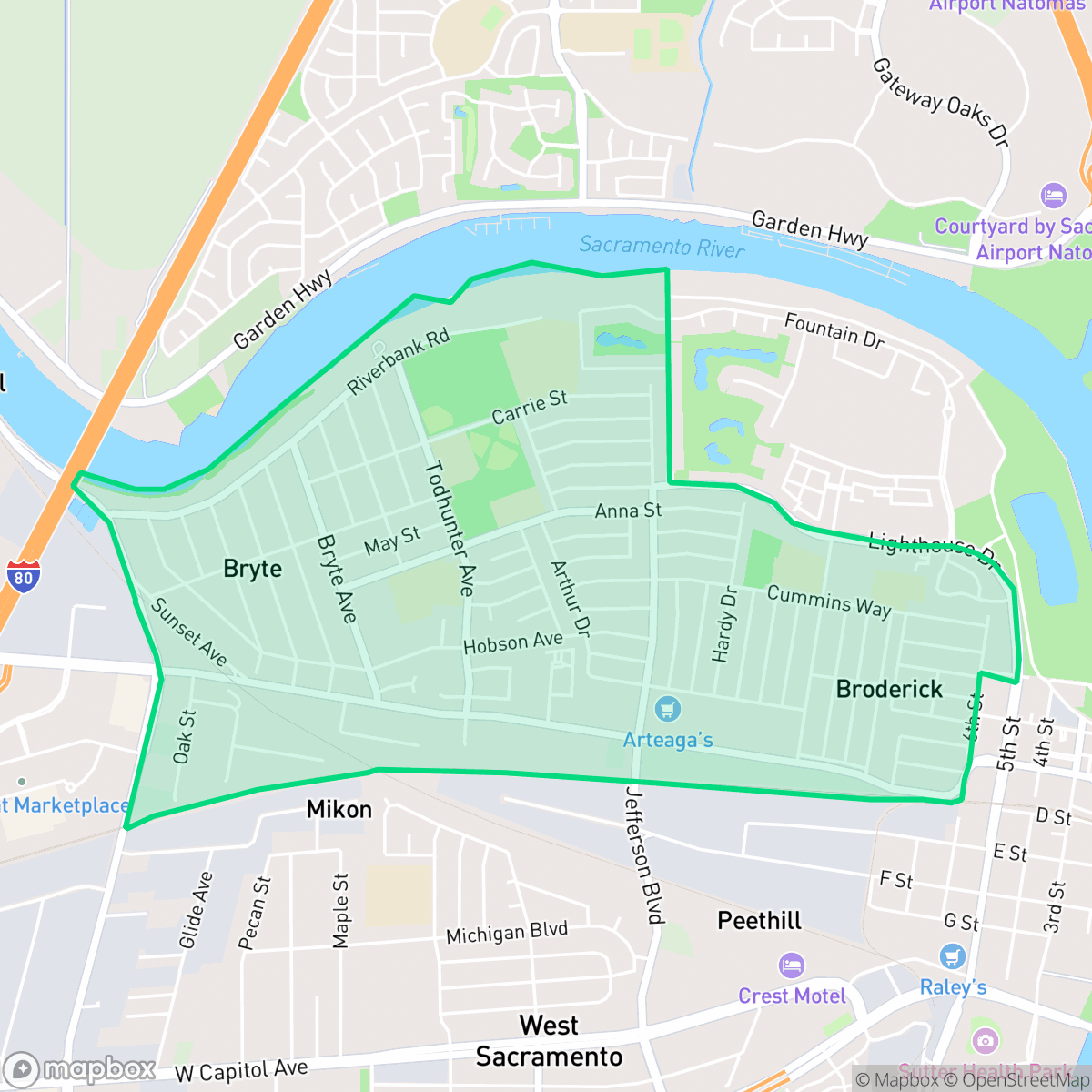
Broderick and Bryte is a historic, high-density neighborhood in West Sacramento known for its exceptional walkability and grid-based street layout. The area offers a quiet, suburban atmosphere with proximity to riverside parks and local community hubs.
Key Highlights
About Broderrick/Bryte
The historic northern West Sacramento neighborhoods of Broderick and Bryte began as distinct 19th-century settlements. Broderick was founded in 1849 as the "Town of Washington" by Margaret McDowell, a widow who subdivided 160 acres to support her family; it was later renamed for anti-slavery Senator David C. Broderick. Bryte, originally known as "Riverbank," developed from a dairy farm established in 1853 by Gold Rush pioneer Mike Bryte. Renamed in 1915, Bryte evolved into a diverse mosaic of ethnic "colonies" during the early 20th century, featuring a Japanese village, Mexican families along Mikon Street, an Italian center, and Russian refugees. Facing persistent flooding due to low-lying topography, these working-class communities maintained a resilient, distinct identity before officially incorporating into the City of West Sacramento in 1987.
The neighborhood maintains a distinct identity characterized by a dense, traditional grid layout that supports high walkability for residents. The landscape consists primarily of suburban-style single-family homes and multi-family complexes, interspersed with light industrial facilities and logistics centers. Community life centers around local parks and neighborhood institutions, providing a functional, steady pace of life that balances residential needs with nearby commercial activity.
Living in this area involves navigating a trade-off between its convenient, walkable design and its industrial proximity. While the consistent sidewalk network and access to green spaces like Bryte Park appeal to those who prefer active, outdoor-oriented lifestyles, residents should be aware of the compact housing density and moderate noise levels from local road traffic. It is best suited for individuals or families who value a well-connected, established community over expansive private yards or total seclusion.
Neighborhood Scores Across 15 Qualities
Residential spacing is moderate, featuring a mix of closely positioned houses and shared apartment courtyards. This density is slightly higher than the West Sacramento average, resulting in less buffer between neighbors in certain grid layouts.
A dense sidewalk network and clear crosswalks make most residential streets easy to navigate on foot. According to iHuus data, the connectivity in this area is slightly above the West Sacramento average.
Standard tract housing and mid-range apartment complexes define the area, which features relatively consistent landscaping and small yards. This visual landscape is slightly below the West Sacramento average according to iHuus data.
Expansive riverside parks and large grass fields offer ample space for pets. While sidewalk verges are occasionally narrow, the area provides significant access to open green spaces and safe walking areas similar to the rest of West Sacramento.
Open land and scattered greenery provide a semi-rural atmosphere that is slightly less dense than the West Sacramento average. Residents will find a mix of residential grids and larger industrial or warehouse clusters alongside more open riverfront areas.
A steady but low-key rhythm characterizes this area, offering a slightly more active atmosphere than the West Sacramento average. While pockets of lively dining and riverside parks exist, much of the landscape is defined by quiet suburban streets, light industrial units, and a reliance on vehicles for errands.
Ongoing noise from nearby busy streets is a common feature of this area. According to iHuus data, acoustic comfort levels are slightly below the West Sacramento average.
Air quality remains generally good with rare instances of elevated readings. According to iHuus data, the air quality in this area is slightly better than the West Sacramento average.
Residential areas are interspersed with logistics hubs and warehouses, particularly near the southern and riverfront edges. While the neighborhood lacks heavy toxic industry, the presence of large truck yards and utility infrastructure results in more industrial activity than the West Sacramento average.
Health insurance coverage among residents is lower than the West Sacramento average, according to iHuus data.
Voting patterns and census indicators reflect a very liberal political leaning, which is slightly more pronounced than the West Sacramento average according to iHuus data.
Residents live alongside a balanced mix of young adults, families, and older individuals. This demographic spread aligns closely with the average found throughout West Sacramento.
Residual flood risk exists within this area as it sits within a 500-year floodplain, which is slightly higher than the West Sacramento average. Residents should be aware of these seasonal vulnerabilities according to iHuus data.
Address-Level Insights for Broderrick/Bryte


iHuus Neighborhood Intelligence Insights
Get address-level neighborhood insights for Broderrick/Bryte
- Street-level scores — see how individual blocks compare, not just neighborhood averages
- Micro-zone boundaries — identify quiet pockets, flood boundaries, and walkable clusters before you visit
- 15 dimensions in full — walkability, noise, air quality, school quality, insurance coverage, population age profile, urban/rural index, and more
- Boundary risk alerts — know if your address sits near a block boundary where scores drop, the kind of detail no listing will ever mention
- School insights — individual school ratings and insights, not just district-level data
- Compare before you commit — side-by-side data across neighborhoods, down to block precision
No credit card required
Compare with Any Neighborhood
| Dimension | Broderrick/Bryte | Broderrick/Bryte |
|---|---|---|
| 🚶 Walkabilityavg 8.33 | ||
| 🔊 Acoustic Comfortavg 4.31 | ||
| 🤫 Privacy Indexavg 5.47 | ||
| 🎨 Visual Appealavg 6.52 | ||
| 🐕 Dog Friendlinessavg 7.26 | ||
| 🗺️ Urban-Rural Indexavg 6.86 | ||
| ✨ Neighborhood Vibeavg 3.48 | ||
| 🏥 Health Insurance Coverageavg 7.88 | ||
| 🌿 Air Qualityavg 6.1 | ||
| 🏭 Industrial Proximityavg 7.34 | ||
| 🌊 Flood Safetyavg 7.06 | ||
| 🗳️ Ideological Leanavg 8.96 | ||
| 👥 Population Age Profileavg 4.78 | ||
| 🔥 Fire Safety | ||
| 🏫 School Quality |
Broderrick/Bryte Rankings
School Districts Serving Broderrick/Bryte
School Insights for Broderrick/Bryte
Below average outcomes; significant attendance and academic challenges.
School Insights
See what's really behind every school rating near Broderrick/Bryte
- Individual school ratings — each school's own score with outcome context, not just a district average
- Enrollment & class size data — student-to-teacher ratio and how it compares to the state average
- Full demographics breakdown — ethnicity and gender composition for every school in the enrollment zone
- Every school in the district — all schools within the enrollment boundary ranked by rating, not just the closest one
- Grade levels & benchmarks — elementary through high school, with below/above state-average flags
No credit card required