West Hollywood West, West Hollywood
Updated · 1,976 residents
West Hollywood West is a highly walkable urban enclave characterized by its dense grid and immediate proximity to the West Hollywood Design District. While the area offers exceptional pedestrian connectivity, residents should expect significant road traffic noise and limited privacy due to closely spaced homes.
Key Highlights
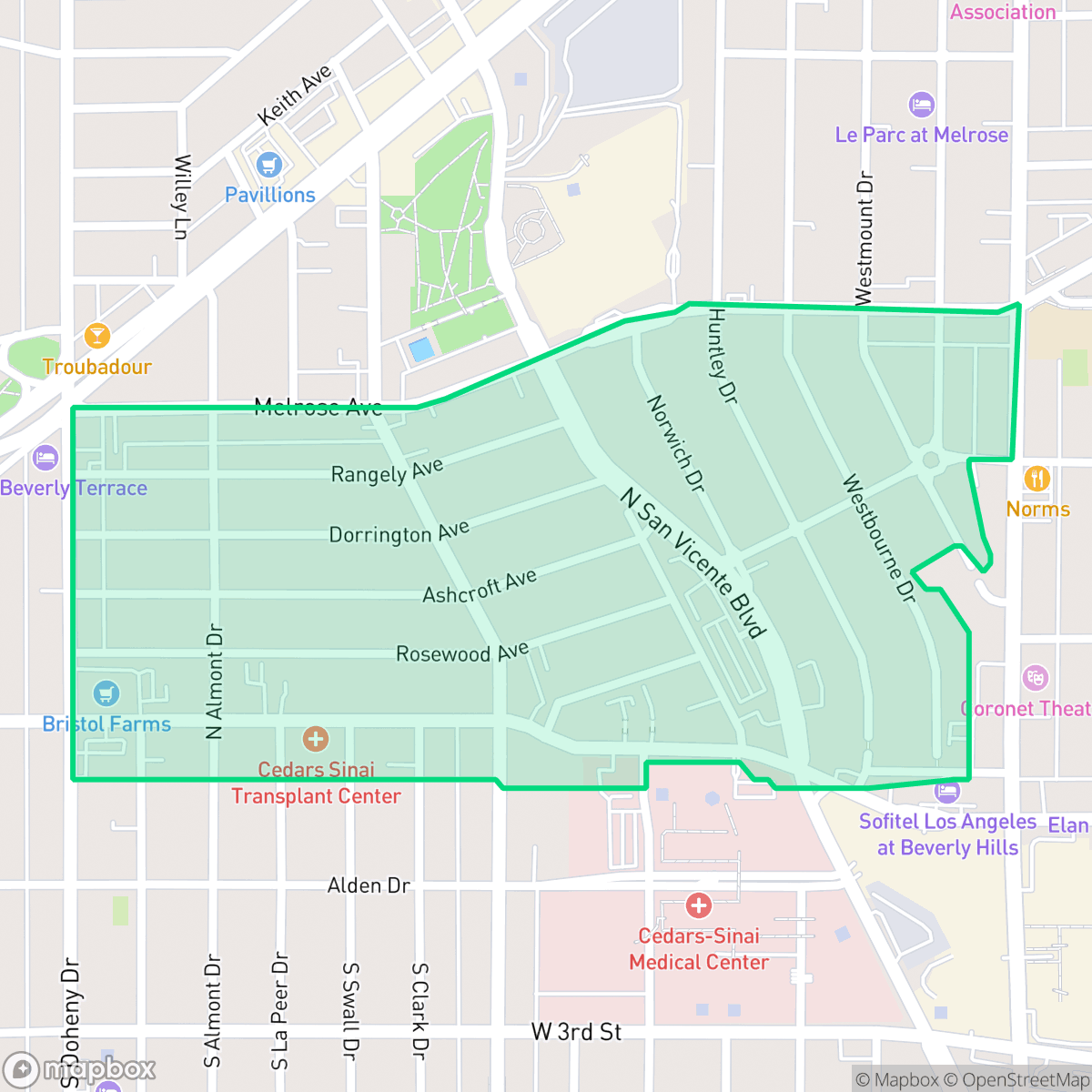
About West Hollywood West
Laid out in the early 20th century as a streetcar suburb, West Hollywood West is a highly walkable residential neighborhood in West Hollywood, California, bounded by Doheny Drive, Melrose Avenue, La Cienega Boulevard, and Beverly Boulevard. Developed in tandem with the Pacific Electric Railway and the nearby Sherman rail yard, the neighborhood historically featured a dense collection of single-family homes, Craftsman bungalows, Spanish-style duplexes, and Mid-Century Modern designs. To protect this distinct architectural character from rapid redevelopment, the city established the West Hollywood West Neighborhood Overlay District. The neighborhood is championed by the West Hollywood West Residents Association (WHWRA), one of the city's oldest and most organized civic groups, founded by local activist Joyce Hundal. Today, it sits adjacent to the bustling West Hollywood Design District and the iconic Pacific Design Center.
The neighborhood functions as a dense, high-energy residential pocket that integrates seamlessly with the surrounding commercial landscape. According to iHuus data, the area maintains a perfect walkability score, allowing residents to access local dining and social hubs like Alana's Coffee Roasters without a vehicle. The architecture remains a defining feature, with a mix of historic bungalows and modern structures that contribute to a visually appealing streetscape throughout the grid.
Prospective residents should weigh the benefits of this central location against the realities of urban living. The area experiences high levels of ambient road traffic noise, and the dense configuration of residential lots results in reduced personal privacy compared to suburban alternatives. This neighborhood is well-suited for individuals who prioritize immediate access to city amenities and a vibrant, walkable lifestyle over quiet, secluded living.
Neighborhood Scores Across 15 Qualities
Residential spacing provides more separation between neighbors than the city average. Building density varies from compact multi-family structures near commercial corridors to larger estates with significant vegetation buffers.
Pedestrians benefit from a dense grid of wide sidewalks and frequent crosswalks that connect residential and commercial zones. This level of connectivity and infrastructure is even more robust than the average for West Hollywood.
Landscaped estates and private amenities like pools and tennis courts are frequently visible, making the visual landscape more polished than the city average. This area features a mix of high-density luxury housing and large custom homes with extensive greenery.
Access to grassy areas and public parks varies by street, though the area offers more green verges than the city average according to iHuus data.
A mix of mid-rise commercial buildings and low-density residential estates defines this area. According to iHuus data, the environment is less dense than the city average, offering a balance of street life and green space.
Dense urban landscapes and a high concentration of diverse dining and social destinations provide a level of activity that is notably higher than the West Hollywood average. Frequent movement and a rich variety of local amenities define this area according to iHuus data.
Frequent loud disturbances from nearby transportation infrastructure characterize this area. According to iHuus data, acoustic comfort is significantly lower than the city average due to the immediate proximity of heavy transit routes.
Air quality remains consistently high with minimal health concerns for residents. This level of cleanliness is nearly on par with the broader city average according to iHuus data.
Industrial facilities, warehouses, and hazardous sites are absent from this area. According to iHuus data, the neighborhood consists entirely of residential, commercial, and institutional buildings, which is slightly cleaner than the city average.
Health insurance accessibility is notably higher here than the city average, according to iHuus data. Most residents in this area have access to medical coverage.
Voting patterns and census indicators reflect a highly progressive political landscape, though this lean is slightly less pronounced than the broader West Hollywood average according to iHuus data.
Residents live alongside a diverse demographic of young professionals, families, and seniors. This distribution is largely in line with the broader West Hollywood area, according to iHuus data.
Flood risk levels are comparable to the city average, though official FEMA studies for this specific area remain incomplete. Residents should remain aware that detailed flood hazard assessments are currently unavailable for this neighborhood.
Fire risk in this area is significantly higher than the West Hollywood average. Residents should be aware of extreme fire hazards that require maximum protection measures, according to iHuus data.
Address-Level Insights for West Hollywood West


iHuus Neighborhood Intelligence Insights
Get address-level neighborhood insights for West Hollywood West
- Street-level scores — see how individual blocks compare, not just neighborhood averages
- Micro-zone boundaries — identify quiet pockets, flood boundaries, and walkable clusters before you visit
- 15 dimensions in full — walkability, noise, air quality, school quality, insurance coverage, population age profile, urban/rural index, and more
- Boundary risk alerts — know if your address sits near a block boundary where scores drop, the kind of detail no listing will ever mention
- School insights — individual school ratings and insights, not just district-level data
- Compare before you commit — side-by-side data across neighborhoods, down to block precision
No credit card required
Compare with Any Neighborhood
| Dimension | West Hollywood West | Center City |
|---|---|---|
| 🚶 Walkabilityavg 9.57 | ||
| 🔊 Acoustic Comfortavg 2.56 | ||
| 🤫 Privacy Indexavg 3.91 | ||
| 🎨 Visual Appealavg 7.39 | ||
| 🐕 Dog Friendlinessavg 4.89 | ||
| 🗺️ Urban-Rural Indexavg 5.47 | ||
| ✨ Neighborhood Vibeavg 7.19 | ||
| 🏥 Health Insurance Coverageavg 7.45 | ||
| 🌿 Air Qualityavg 9.89 | ||
| 🏭 Industrial Proximityavg 9.88 | ||
| 🌊 Flood Safetyavg 5.66 | ||
| 🗳️ Ideological Leanavg 9.65 | ||
| 👥 Population Age Profileavg 5.43 | ||
| 🔥 Fire Safetyavg 0.24 | ||
| 🏫 School Quality |
West Hollywood West Rankings
School Districts Serving West Hollywood West
School Insights for West Hollywood West
Below average outcomes; significant attendance and academic challenges.
School Insights
See what's really behind every school rating near West Hollywood West
- Individual school ratings — each school's own score with outcome context, not just a district average
- Enrollment & class size data — student-to-teacher ratio and how it compares to the state average
- Full demographics breakdown — ethnicity and gender composition for every school in the enrollment zone
- Every school in the district — all schools within the enrollment boundary ranked by rating, not just the closest one
- Grade levels & benchmarks — elementary through high school, with below/above state-average flags
No credit card required