Westlake Hills, Thousand Oaks
Updated · 1,118 residents
Westlake Hills is a highly walkable neighborhood in Thousand Oaks that balances suburban tranquility with convenient access to local shopping and parks. Residents benefit from excellent air quality and top-rated local schools, though the area experiences moderate noise levels due to nearby road traffic.
Key Highlights
About Westlake Hills
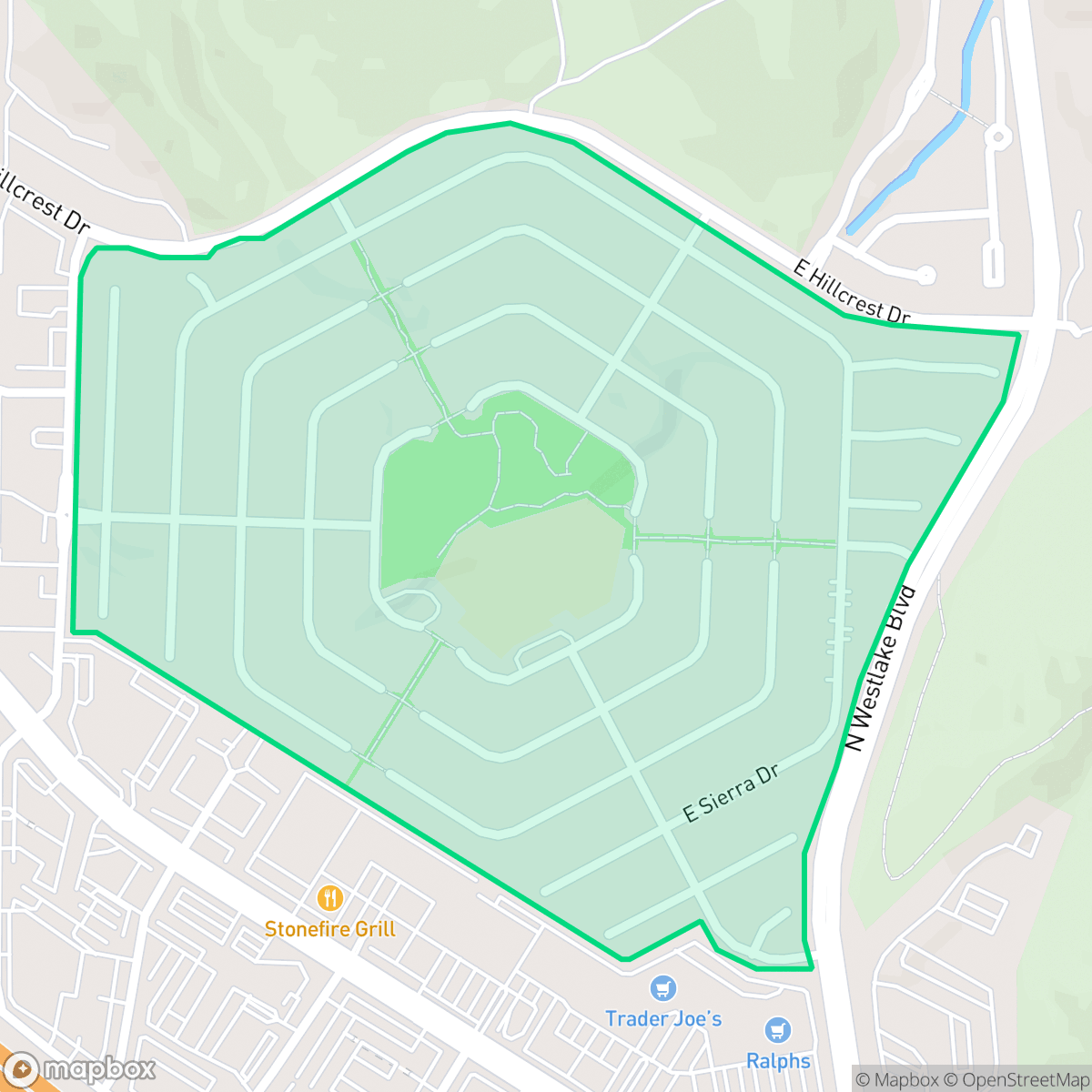
Westlake Hills is a classic suburban neighborhood in the Thousand Oaks portion of the Westlake Village master-planned community, which was built on the former Albertson movie ranch. Following the annexation of this Ventura County section by Thousand Oaks in 1972, Westlake Hills was developed primarily during the 1970s. Designed with a distinct layout of concentric residential streets, the neighborhood centers around its own public park and the award-winning Westlake Hills Elementary School, which opened in September 1974. Characterized by its family-oriented design, tree-lined streets, and close proximity to the Promenade at Westlake shopping center, the neighborhood represents the mid-to-late 20th-century Southern California vision of a planned "city in the country".
The area functions as a central hub within Thousand Oaks, offering exceptional walkability that is rare for the region. Residents frequently gather at local spots like Russell Park, which anchors the community and provides a social focal point for families. According to iHuus data, the neighborhood maintains superior air quality and high levels of health insurance coverage, contributing to a stable and health-conscious environment for its residents. The presence of high-performing educational institutions further supports the community's reputation as a desirable location for families.
While the neighborhood offers significant lifestyle benefits, prospective residents should consider specific environmental trade-offs. The area faces challenges regarding fire safety, and acoustic comfort is impacted by road traffic, resulting in a moderate noise profile. Despite these factors, the combination of high-performing schools and a well-connected street layout makes the community an attractive choice for those seeking a balance between suburban comfort and accessible amenities.
Neighborhood Scores Across 15 Qualities
Residential spacing offers a moderate amount of separation between neighbors. This level of seclusion is consistent with the average found throughout Thousand Oaks.
Pedestrian travel is convenient due to the presence of sidewalks on one side of streets and safe crossings. According to iHuus data, this level of walkability is slightly above the Thousand Oaks average.
Large homes and frequent upscale amenities provide a pleasant environment, though the visual variety is slightly below the Thousand Oaks average according to iHuus data.
Connected green spaces and wide, traffic-safe paths provide reliable walking routes for pets. However, overall accessibility to dog-friendly amenities is slightly below the Thousand Oaks average according to iHuus data.
Vast, undeveloped hilly open space and scattered homes provide a more rural feel than most of Thousand Oaks. Residential clusters here transition directly into significant tracts of woodland and open land, according to iHuus data.
Local dining options and social hubs like Russell Park provide a much more active atmosphere than the typical Thousand Oaks suburb. While much of the area consists of quiet, low-density streets, there is a notable concentration of lively eateries and parks accessible to residents.
Frequent acoustic disturbances from nearby freeway and rail corridors are common here. This level of noise is slightly higher than the average for Thousand Oaks, according to iHuus data.
Air quality remains consistently high and presents little to no health concern for residents. This level of cleanliness is on par with the rest of Thousand Oaks.
Industrial activity is nonexistent in this area, providing a landscape free from warehouses or heavy manufacturing hazards. According to iHuus data, the neighborhood remains strictly residential with only minor municipal utility structures present.
Health insurance accessibility is high in this area, sitting slightly above the Thousand Oaks average according to iHuus data.
Political leanings in this area are split fairly evenly between conservative and liberal perspectives, mirroring the broader political landscape of Thousand Oaks.
Residents experience a balanced demographic spread of young adults, families, and seniors. According to iHuus data, this age distribution is largely consistent with the broader Thousand Oaks area.
Flood risk in this area is slightly below the Thousand Oaks average. According to iHuus data, the lack of a detailed FEMA study means the specific level of danger remains undetermined.
Elevated wildfire hazards exist throughout this area, which is slightly higher than the average for Thousand Oaks. Residents should prioritize enhanced mitigation measures and fire preparedness according to iHuus data.
Address-Level Insights for Westlake Hills


iHuus Neighborhood Intelligence Insights
Get address-level neighborhood insights for Westlake Hills
- Street-level scores — see how individual blocks compare, not just neighborhood averages
- Micro-zone boundaries — identify quiet pockets, flood boundaries, and walkable clusters before you visit
- 15 dimensions in full — walkability, noise, air quality, school quality, insurance coverage, population age profile, urban/rural index, and more
- Boundary risk alerts — know if your address sits near a block boundary where scores drop, the kind of detail no listing will ever mention
- School insights — individual school ratings and insights, not just district-level data
- Compare before you commit — side-by-side data across neighborhoods, down to block precision
No credit card required
Compare with Any Neighborhood
| Dimension | Westlake Hills | Lynnmere |
|---|---|---|
| 🚶 Walkabilityavg 8.4 | ||
| 🔊 Acoustic Comfortavg 3.04 | ||
| 🤫 Privacy Indexavg 6.02 | ||
| 🎨 Visual Appealavg 8.05 | ||
| 🐕 Dog Friendlinessavg 8.29 | ||
| 🗺️ Urban-Rural Indexavg 7.67 | ||
| ✨ Neighborhood Vibeavg 4.5 | ||
| 🏥 Health Insurance Coverageavg 8.34 | ||
| 🌿 Air Qualityavg 10 | ||
| 🏭 Industrial Proximityavg 9.8 | ||
| 🌊 Flood Safetyavg 4.81 | ||
| 🗳️ Ideological Leanavg 6 | ||
| 👥 Population Age Profileavg 5.28 | ||
| 🔥 Fire Safetyavg 1.88 | ||
| 🏫 School Quality |
Westlake Hills Rankings
School Districts Serving Westlake Hills
School Insights for Westlake Hills
Below average outcomes; significant attendance and academic challenges.
School Insights
See what's really behind every school rating near Westlake Hills
- Individual school ratings — each school's own score with outcome context, not just a district average
- Enrollment & class size data — student-to-teacher ratio and how it compares to the state average
- Full demographics breakdown — ethnicity and gender composition for every school in the enrollment zone
- Every school in the district — all schools within the enrollment boundary ranked by rating, not just the closest one
- Grade levels & benchmarks — elementary through high school, with below/above state-average flags
No credit card required