Newbury Park, Thousand Oaks
Updated · 45,601 residents
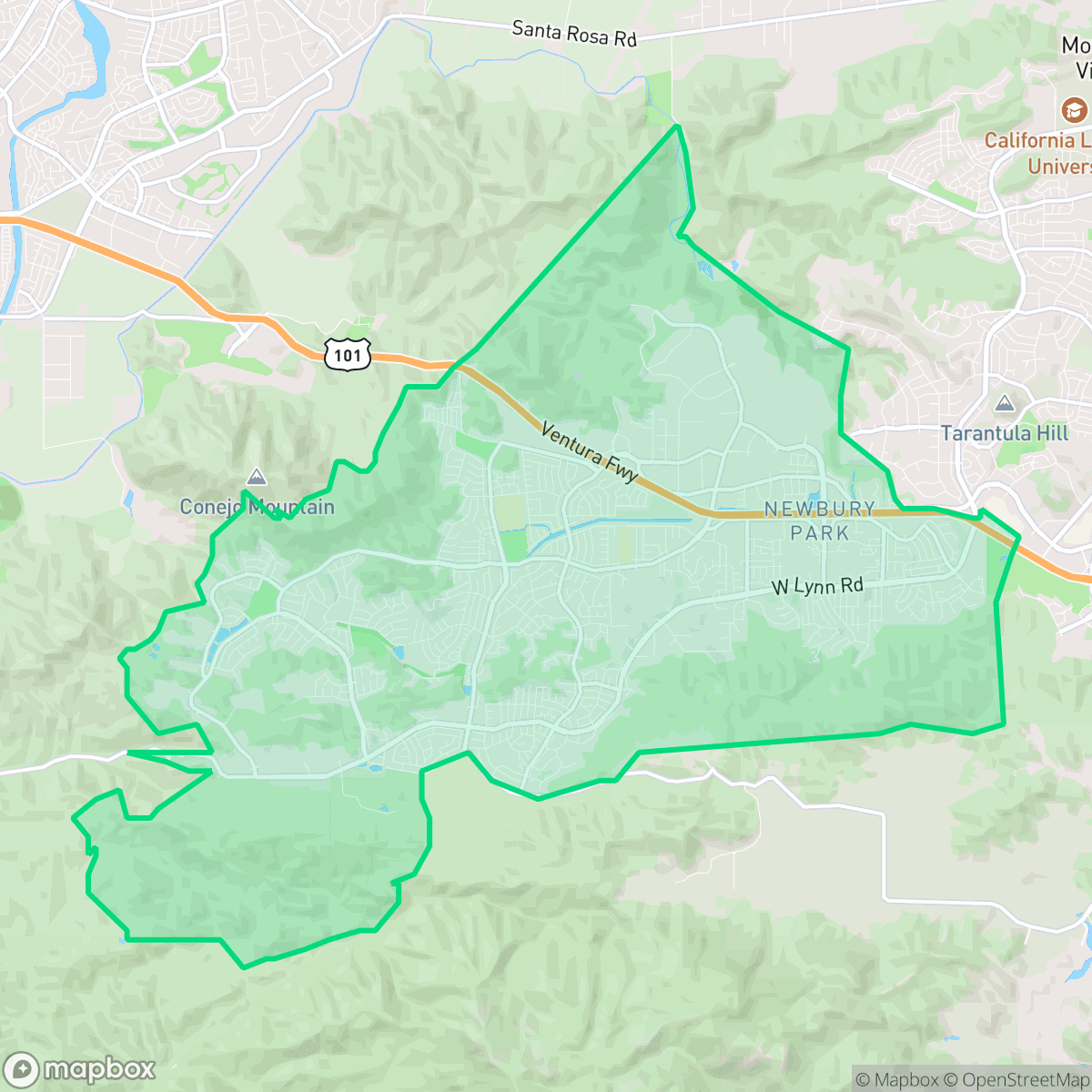
Newbury Park is a suburban community in Thousand Oaks defined by its proximity to expansive open wildlands and a distinct equestrian character. Residents benefit from excellent air quality and a well-connected sidewalk network, though the area remains largely car-dependent with moderate noise levels from nearby highway traffic.
Key Highlights
About Newbury Park
Named after its first postmaster, Egbert Starr Newbury, who established a post office here in 1875, Newbury Park has a rich history transitioning from Chumash territory to a pioneering agricultural hub. The area's deep indigenous roots are preserved at the Satwiwa Native American Indian Culture Center near the sacred Boney Mountain. A cornerstone of the neighborhood's early American era is the 1876 Stagecoach Inn (originally the Grand Union Hotel), a Monterey-style landmark that served as a vital rest stop along the route from Los Angeles to San Francisco. In the 1940s, the Ventu Park subdivision emerged as a rustic retreat for Hollywood movie stars, while the 1960s brought Casa Conejo, the area's first master-planned community. Though annexed by Thousand Oaks in the late 20th century, Newbury Park retains its distinct equestrian character.
The neighborhood offers a blend of suburban residential life and access to significant natural landscapes, including the nearby Santa Monica Mountains. The housing landscape consists primarily of detached single-family homes with private backyards, interspersed with occasional multi-family units and mobile home parks. While the area provides a consistent sidewalk network that facilitates local walking, most daily errands and commutes require a vehicle due to the suburban layout and the central freeway corridor that bisects the community. Education is a primary draw for families, with several highly-rated elementary schools and a solid high school serving the area under the Conejo Valley Unified School District. According to data, the area maintains a high standard for air quality and community health insurance coverage. The neighborhood is best suited for those seeking a quiet, suburban environment with strong access to outdoor recreation. Prospective residents should note that while the community is generally peaceful, traffic noise from the highway is a consistent factor. Additionally, while the area is well-served by public services and schools, the fire safety profile necessitates awareness for those living near the wildland-urban interface.
Neighborhood Scores Across 15 Qualities
Residential spacing varies from high-density apartments to detached houses with private backyards, matching the general level of privacy found across Thousand Oaks. According to iHuus data, some areas feature limited distance between neighbors while others offer more significant buffers.
Pedestrian safety is high due to a comprehensive network of sidewalks and signalized crossings. This area offers superior walkability compared to the Thousand Oaks average, although a large central freeway corridor does divide the neighborhood.
Large homes with private pools and well-maintained landscaping define the local landscape. This level of visual quality is largely consistent with the broader Thousand Oaks area.
Extensive sidewalks and nearby green buffers provide safe, connected routes for walking dogs. This area offers a similar level of accessibility for pets as the rest of Thousand Oaks.
Significant portions of the area consist of open natural canyons and rolling hills. This landscape provides a transition zone of low density housing and wildland that is consistent with the broader Thousand Oaks area.
A steady rhythm of residential life and scattered local services defines this area, which offers a slightly more tranquil atmosphere than the average for Thousand Oaks. While some pockets feature accessible dining and social hubs, much of the landscape consists of low-density, serene spaces that often require a car for errands.
Frequent noise from nearby freeway and rail infrastructure is present; according to iHuus data, acoustic levels are slightly higher than the Thousand Oaks average.
Air quality remains consistently high with minimal health concerns, matching the city average for Thousand Oaks. According to iHuus data, the area experiences very clean air with little to no pollution detected.
Industrial presence is nearly non-existent here, as the area is composed almost entirely of residential and natural spaces. Aside from a few isolated municipal utility structures, there are no warehouses or heavy industrial facilities detected in the neighborhood, which is slightly more residential than the Thousand Oaks average.
Health insurance access remains strong among residents, performing slightly above the Thousand Oaks average according to iHuus data.
Political views in this area are divided, showing a more even split between conservative and liberal leanings than the city average according to iHuus data.
A diverse range of age groups resides here, including young adults, families, and seniors. According to iHuus data, this age distribution is roughly in line with the average found throughout Thousand Oaks.
Flood risk levels in this area are difficult to determine because FEMA has not completed a detailed study for this specific location. According to iHuus data, the lack of verified mapping results in a slightly higher level of uncertainty compared to the Thousand Oaks average.
Wildfire danger is exceptionally high in this area, representing a significantly greater hazard than the average for Thousand Oaks. Residents should prioritize maximum fire protection measures and maintain strict emergency preparedness plans according to iHuus data.
Address-Level Insights for Newbury Park


iHuus Neighborhood Intelligence Insights
Get address-level neighborhood insights for Newbury Park
- Street-level scores — see how individual blocks compare, not just neighborhood averages
- Micro-zone boundaries — identify quiet pockets, flood boundaries, and walkable clusters before you visit
- 15 dimensions in full — walkability, noise, air quality, school quality, insurance coverage, population age profile, urban/rural index, and more
- Boundary risk alerts — know if your address sits near a block boundary where scores drop, the kind of detail no listing will ever mention
- School insights — individual school ratings and insights, not just district-level data
- Compare before you commit — side-by-side data across neighborhoods, down to block precision
No credit card required
Compare with Any Neighborhood
| Dimension | Newbury Park | Lynnmere |
|---|---|---|
| 🚶 Walkabilityavg 8.4 | ||
| 🔊 Acoustic Comfortavg 3.04 | ||
| 🤫 Privacy Indexavg 6.02 | ||
| 🎨 Visual Appealavg 8.05 | ||
| 🐕 Dog Friendlinessavg 8.29 | ||
| 🗺️ Urban-Rural Indexavg 7.67 | ||
| ✨ Neighborhood Vibeavg 4.5 | ||
| 🏥 Health Insurance Coverageavg 8.34 | ||
| 🌿 Air Qualityavg 10 | ||
| 🏭 Industrial Proximityavg 9.8 | ||
| 🌊 Flood Safetyavg 4.81 | ||
| 🗳️ Ideological Leanavg 6 | ||
| 👥 Population Age Profileavg 5.28 | ||
| 🔥 Fire Safetyavg 1.88 | ||
| 🏫 School Quality |
Newbury Park Rankings
School Districts Serving Newbury Park
School Insights for Newbury Park
Below average outcomes; significant attendance and academic challenges.
School Insights
See what's really behind every school rating near Newbury Park
- Individual school ratings — each school's own score with outcome context, not just a district average
- Enrollment & class size data — student-to-teacher ratio and how it compares to the state average
- Full demographics breakdown — ethnicity and gender composition for every school in the enrollment zone
- Every school in the district — all schools within the enrollment boundary ranked by rating, not just the closest one
- Grade levels & benchmarks — elementary through high school, with below/above state-average flags
No credit card required