Horsethief Canyon Ranch, Temescal Valley
Updated · 4,916 residents
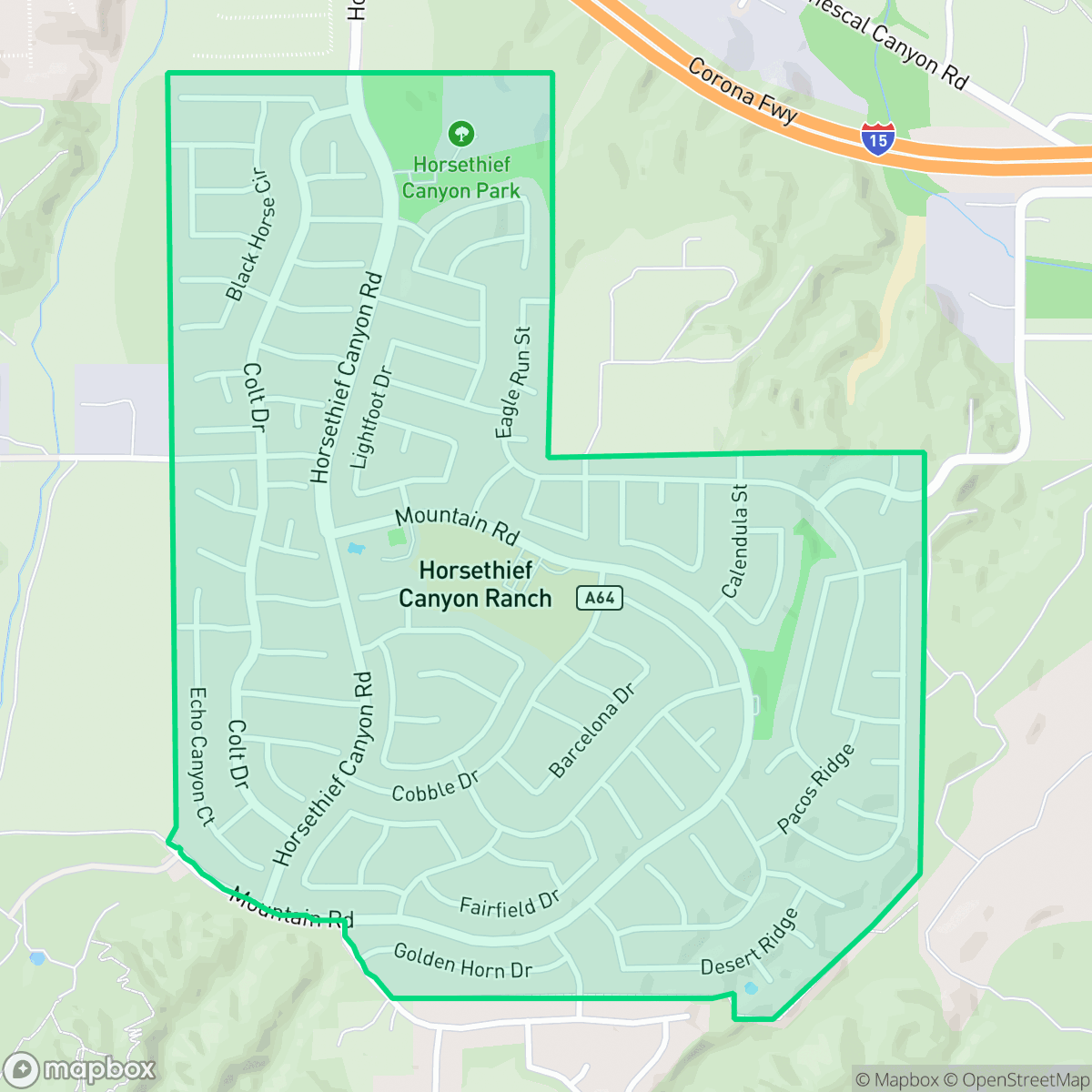
Horsethief Canyon Ranch is a master-planned community in Temescal Valley defined by its Spanish Revival architecture and extensive sidewalk network. While the area offers exceptional air quality and high walkability, residents experience significant noise levels from nearby highway traffic.
Key Highlights
About Horsethief Canyon Ranch
Nestled in the Temescal Valley against the Cleveland National Forest, the Horsethief Canyon Ranch neighborhood is steeped in local lore. According to legend, the rugged canyon earned its name in the 1860s when outlaws used its secluded mountain trails to hide stolen horses. The area first saw settlement between 1858 and 1861 with the arrival of the Butterfield Overland Mail Company. In 1989, developer Presley Homes began transforming the canyon into a master-planned community. Built primarily between the late 1980s and 2000s, the neighborhood’s single-family homes largely feature Spanish Revival architecture. Today, the tight-knit community centers around local landmarks like the Horsethief Canyon Ranch Clubhouse, Luiseno School, and extensive hiking trails leading directly into the adjacent national forest.
The neighborhood features a consistent suburban layout with uniform density and large, well-maintained single-family homes. A comprehensive sidewalk system connects the residential blocks, providing an environment that is highly walkable for a suburban tract. Residents benefit from superior air quality, which contributes to a clean living environment nestled against the arid hills of the Cleveland National Forest. The area maintains a calm atmosphere, although it lacks a dense commercial core within immediate walking distance.
Prospective residents should consider the significant acoustic impact from nearby road traffic, which is a notable trade-off for the otherwise quiet suburban setting. The community faces higher risks regarding fire and flood safety compared to regional averages, and prospective families should review the performance metrics for the local Luiseno school within the Lake Elsinore Unified School District. This area is best suited for those prioritizing a structured, suburban lifestyle with access to outdoor recreation, provided they are comfortable with the noise profile and regional environmental risks.
Neighborhood Scores Across 15 Qualities
Homes are positioned with a moderate amount of space between neighbors, offering slightly more separation than the typical Temescal Valley density. According to iHuus data, the layout provides a balanced buffer between adjacent properties.
Pedestrian movement is well-supported by a comprehensive sidewalk network on both sides of low-traffic residential streets. According to iHuus data, the connectivity and safety of crossings in this area are notably higher than the Temescal Valley average.
Large residences, private swimming pools, and spacious driveways characterize the landscape. According to iHuus data, the visual environment is slightly more polished than the surrounding Temescal Valley area.
Private fenced yards are common here, though access to public green spaces and continuous walking paths is below the city average according to iHuus data.
Scattered homes sit among undeveloped arid hills and woodland, offering a landscape that is slightly less dense than the Temescal Valley average according to iHuus data.
Largely a tranquil and low-density landscape, this area offers more pockets of activity and amenities than the city average. Most sections consist of quiet, rural, or industrial spaces with limited local business access near residential blocks.
Frequent loud disturbances from nearby heavy rail or airport activity define the acoustic environment. According to iHuus data, these noise levels are significantly higher than the city average.
Air quality remains consistently high with minimal health concerns, surpassing the average levels found throughout Temescal Valley. According to iHuus data, the area benefits from very low levels of pollutants.
Residential life remains largely undisturbed by heavy industry, though a wastewater treatment facility and a nearby active quarry introduce localized dust and machinery noise. This level of industrial proximity is slightly lower than the city average due to these specific utility and earthworks operations.
Health insurance access is widespread among residents, appearing slightly above the city average according to iHuus data.
Political leanings in this area trend conservative, showing a slightly stronger conservative majority than the Temescal Valley average according to iHuus data.
A varied mix of young adults, families, and seniors resides here, reflecting a demographic spread that is slightly lower than the Temescal Valley average according to iHuus data.
Flood risk in this area is significantly higher than the city average, as portions of the ranch sit within a designated 100-year floodplain. According to iHuus data, residents may find that flood insurance is a typical requirement for properties in this location.
Wildfire hazards are significantly higher than the city average due to the surrounding terrain; residents should prioritize enhanced mitigation and emergency preparedness. According to iHuus data, the area requires heightened vigilance regarding fire safety protocols.
Address-Level Insights for Horsethief Canyon Ranch


iHuus Neighborhood Intelligence Insights
Get address-level neighborhood insights for Horsethief Canyon Ranch
- Street-level scores — see how individual blocks compare, not just neighborhood averages
- Micro-zone boundaries — identify quiet pockets, flood boundaries, and walkable clusters before you visit
- 15 dimensions in full — walkability, noise, air quality, school quality, insurance coverage, population age profile, urban/rural index, and more
- Boundary risk alerts — know if your address sits near a block boundary where scores drop, the kind of detail no listing will ever mention
- School insights — individual school ratings and insights, not just district-level data
- Compare before you commit — side-by-side data across neighborhoods, down to block precision
No credit card required
Compare with Any Neighborhood
| Dimension | Horsethief Canyon Ranch | Sycamore Creek |
|---|---|---|
| 🚶 Walkabilityavg 8.74 | ||
| 🔊 Acoustic Comfortavg 2.04 | ||
| 🤫 Privacy Indexavg 5.62 | ||
| 🎨 Visual Appealavg 7.83 | ||
| 🐕 Dog Friendlinessavg 7.57 | ||
| 🗺️ Urban-Rural Indexavg 7.64 | ||
| ✨ Neighborhood Vibeavg 4.1 | ||
| 🏥 Health Insurance Coverageavg 8.24 | ||
| 🌿 Air Qualityavg 8.96 | ||
| 🏭 Industrial Proximityavg 8.07 | ||
| 🌊 Flood Safetyavg 5.06 | ||
| 🗳️ Ideological Leanavg 3.68 | ||
| 👥 Population Age Profileavg 5.09 | ||
| 🔥 Fire Safetyavg 1.55 | ||
| 🏫 School Quality |
Horsethief Canyon Ranch Rankings
School Districts Serving Horsethief Canyon Ranch
School Insights for Horsethief Canyon Ranch
Below average outcomes; significant attendance and academic challenges.
School Insights
See what's really behind every school rating near Horsethief Canyon Ranch
- Individual school ratings — each school's own score with outcome context, not just a district average
- Enrollment & class size data — student-to-teacher ratio and how it compares to the state average
- Full demographics breakdown — ethnicity and gender composition for every school in the enrollment zone
- Every school in the district — all schools within the enrollment boundary ranked by rating, not just the closest one
- Grade levels & benchmarks — elementary through high school, with below/above state-average flags
No credit card required