Tamalpais Valley, Tamalpais-Homestead Valley
Updated · 4,844 residents
Tamalpais Valley is a quiet, nature-oriented community defined by its rural landscape and proximity to the Golden Gate National Recreation Area. Residents benefit from excellent air quality and access to top-rated schools, though the area remains largely car-dependent with limited local amenities.
Key Highlights
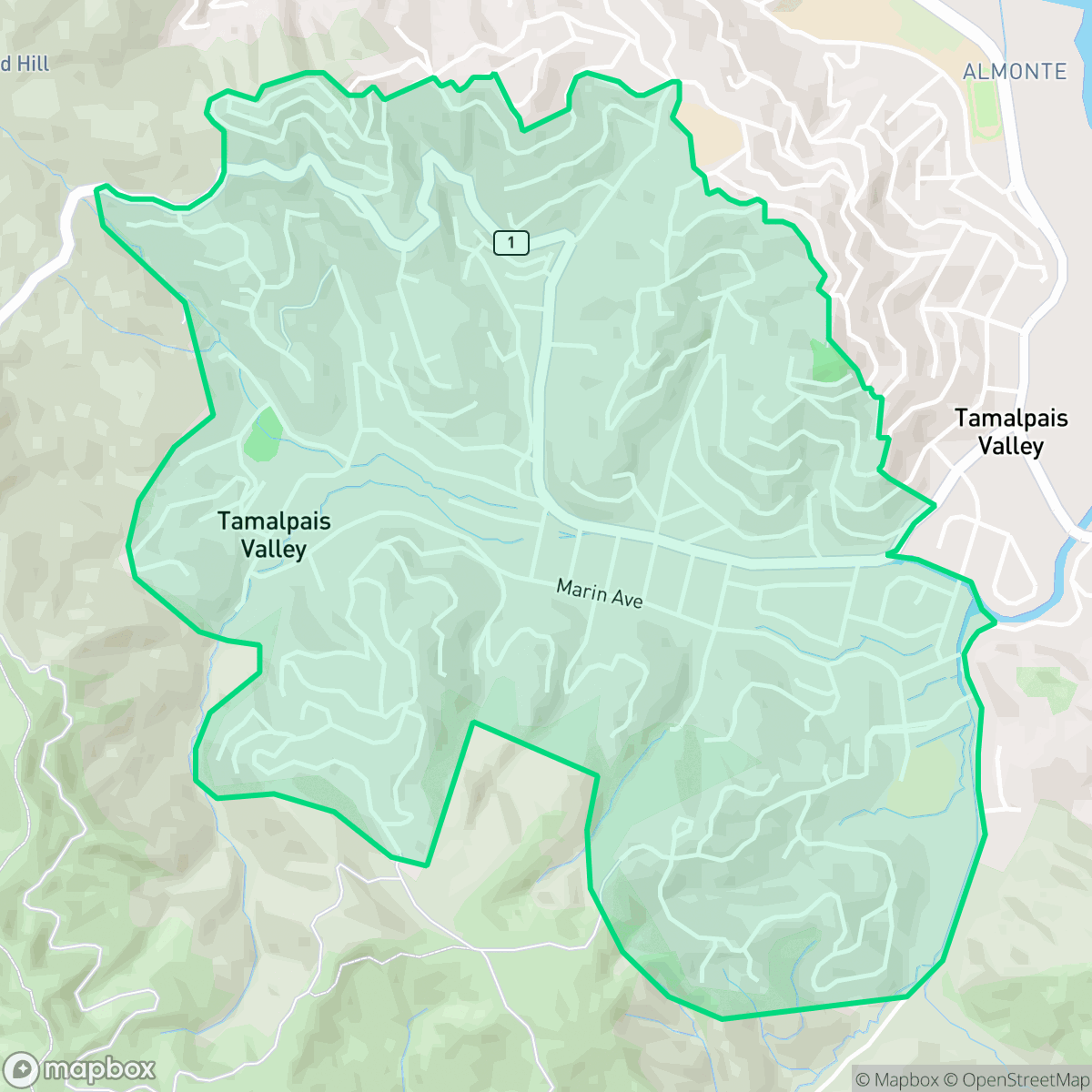
About Tamalpais Valley
Originally known as Coyote Hollow, Tamalpais Valley was once part of Rancho Saucelito and was farmed by Portuguese Azorean dairy ranchers in the 19th century. In 1908, developer S.A. Moss purchased the land and renamed it Tamalpais Valley, subdividing it for residential sales. Historically referred to as "the other side of the tracks" compared to neighboring Mill Valley, this unincorporated community developed a distinct, working-class character. Early commercial activity centered on Shoreline Highway at Dolan’s Corners (now Tam Junction), where marshland was filled to accommodate travelers. Post-World War II suburban growth brought developments like Kay Park and Crest Marin. Today, the valley’s expansion is bounded by the surrounding Golden Gate National Recreation Area, preserving its close-knit, nature-oriented identity.
The area offers a serene, low-density environment characterized by its integration with open green spaces and natural beauty. It serves as a tranquil retreat for those prioritizing a connection to the outdoors, with a high degree of ideological alignment among residents and exceptional health insurance coverage. The community maintains a distinct, peaceful atmosphere that remains largely insulated from the bustle of nearby urban centers, supported by high-performing educational institutions in the surrounding districts.
Potential residents should consider the trade-offs inherent to this rural-leaning landscape, including a reliance on vehicles for daily errands and a lack of vibrant commercial activity. While the neighborhood provides a high quality of life, it faces specific environmental challenges, such as a notable risk of wildfire and noise levels primarily influenced by road traffic. It is best suited for individuals or families who value a quiet, nature-adjacent lifestyle and prioritize access to elite public schools over walkability or immediate proximity to dining and social venues.
Neighborhood Scores Across 15 Qualities
Residential spacing provides a balanced level of separation between neighbors. According to iHuus data, this level of privacy is roughly in line with the city average.
Low traffic volumes and peaceful streets make for pleasant strolls, though the lack of sidewalks makes this area slightly less walkable than the surrounding city average according to iHuus data.
Large homes and upscale amenities characterize the area, though the overall visual appeal is slightly below the city average. According to iHuus data, the landscape features spacious driveways and well-maintained properties.
Connected green spaces and wide, low-traffic paths provide ample space for walking dogs. This level of accessibility is nearly comparable to the city average, according to iHuus data.
Dense forests and minimal building density characterize this area, offering a more secluded environment than the surrounding city average. According to iHuus data, the landscape is dominated by natural vegetation and sparse development.
Low density housing and significant open space create a tranquil environment with very few local commercial destinations. This area offers much less social activity and fewer daily essential services than the city average, according to iHuus data.
Frequent noise from nearby rail lines and major roadways characterizes the area. According to iHuus data, acoustic comfort is significantly lower than the city average.
Air quality remains consistently high and clear, matching the average levels found across the city. According to iHuus data, residents can expect mostly clean air with only rare instances of elevated readings.
Industrial presence is virtually non-existent here, offering a cleaner environment than the surrounding city average. According to iHuus data, the area is free from warehouses, manufacturing facilities, or hazardous industrial sites.
Nearly all residents possess health insurance, which represents a higher rate of coverage than the city average according to iHuus data.
Voting patterns and census indicators reflect a deeply liberal political leaning that is slightly more pronounced than the local city average, according to iHuus data.
Residents live alongside a balanced mix of young adults, families, and older individuals. This demographic distribution is consistent with the broader Tamalpais-Homestead Valley area, according to iHuus data.
Flood risk in this area is notably higher than the city average; however, current FEMA records indicate an undetermined risk level because a detailed flood study has not yet been completed for this specific location.
Significant fire hazards exist in this area, presenting a higher risk than the surrounding Tamalpais-Homestead Valley average. Residents should prioritize enhanced wildfire mitigation and emergency preparedness according to iHuus data.
Address-Level Insights for Tamalpais Valley


iHuus Neighborhood Intelligence Insights
Get address-level neighborhood insights for Tamalpais Valley
- Street-level scores — see how individual blocks compare, not just neighborhood averages
- Micro-zone boundaries — identify quiet pockets, flood boundaries, and walkable clusters before you visit
- 15 dimensions in full — walkability, noise, air quality, school quality, insurance coverage, population age profile, urban/rural index, and more
- Boundary risk alerts — know if your address sits near a block boundary where scores drop, the kind of detail no listing will ever mention
- School insights — individual school ratings and insights, not just district-level data
- Compare before you commit — side-by-side data across neighborhoods, down to block precision
No credit card required
Compare with Any Neighborhood
| Dimension | Tamalpais Valley | Almonte |
|---|---|---|
| 🚶 Walkabilityavg 6.73 | ||
| 🔊 Acoustic Comfortavg 3.92 | ||
| 🤫 Privacy Indexavg 6.22 | ||
| 🎨 Visual Appealavg 8.52 | ||
| 🐕 Dog Friendlinessavg 8.69 | ||
| 🗺️ Urban-Rural Indexavg 8.69 | ||
| ✨ Neighborhood Vibeavg 3.26 | ||
| 🏥 Health Insurance Coverageavg 9.1 | ||
| 🌿 Air Qualityavg 8 | ||
| 🏭 Industrial Proximityavg 9.26 | ||
| 🌊 Flood Safetyavg 3.41 | ||
| 🗳️ Ideological Leanavg 9.95 | ||
| 👥 Population Age Profileavg 5.3 | ||
| 🔥 Fire Safetyavg 2.51 | ||
| 🏫 School Quality |
Tamalpais Valley Rankings
School Districts Serving Tamalpais Valley
School Insights for Tamalpais Valley
Below average outcomes; significant attendance and academic challenges.
School Insights
See what's really behind every school rating near Tamalpais Valley
- Individual school ratings — each school's own score with outcome context, not just a district average
- Enrollment & class size data — student-to-teacher ratio and how it compares to the state average
- Full demographics breakdown — ethnicity and gender composition for every school in the enrollment zone
- Every school in the district — all schools within the enrollment boundary ranked by rating, not just the closest one
- Grade levels & benchmarks — elementary through high school, with below/above state-average flags
No credit card required