Washington, Sunnyvale
Updated · 16,599 residents
Washington is a highly walkable neighborhood defined by its dense suburban landscape and proximity to diverse dining options. While residents benefit from excellent access to healthcare and a vibrant local culture, the area experiences significant noise from nearby rail lines and freeway traffic.
Key Highlights
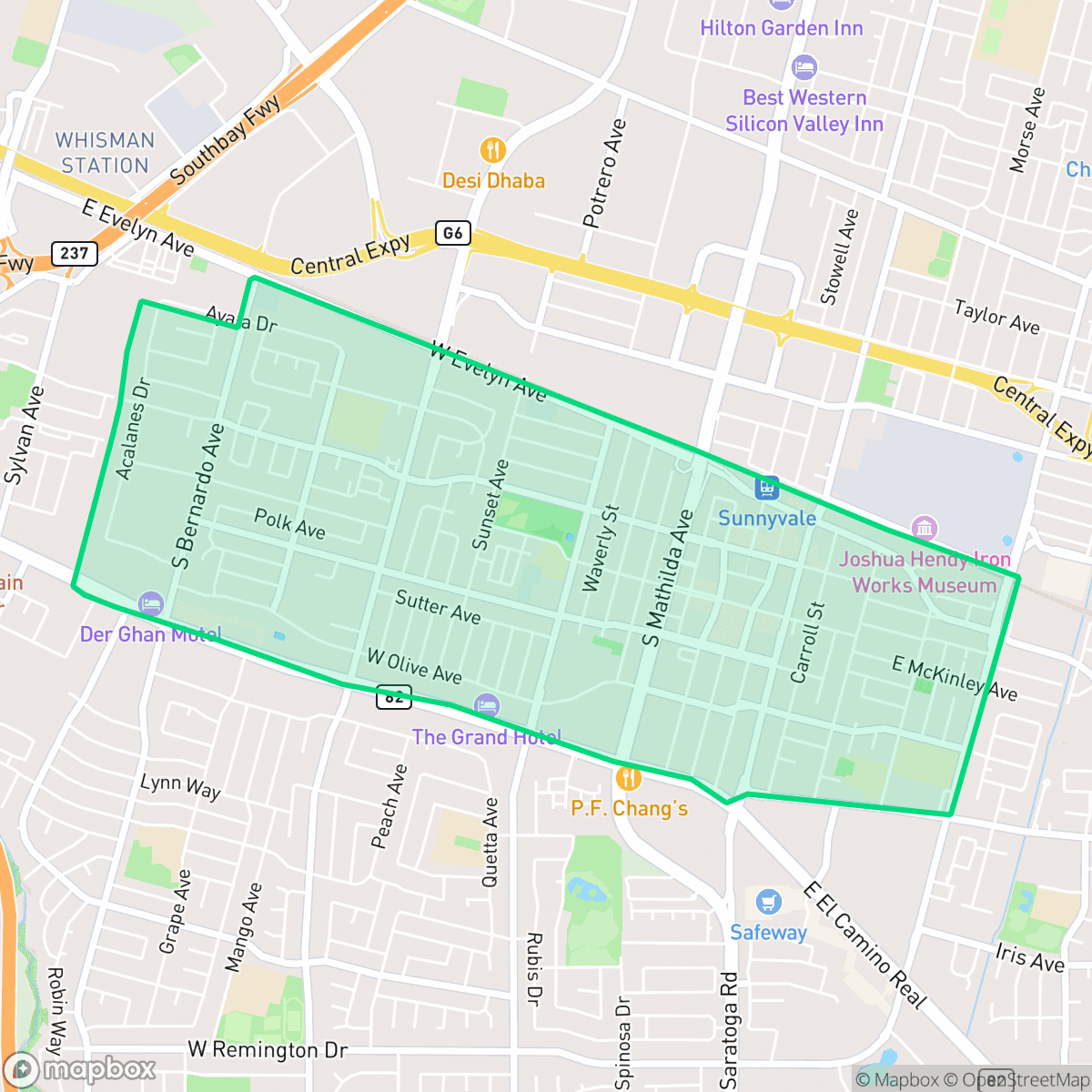
About Washington
The Washington neighborhood in Sunnyvale is centered around Washington Park, which serves as a historical focal point for the community. In the 1920s, the site featured a small village of worker cottages built for seasonal employees of a local fruit cannery. During World War II, the area was repurposed as the Sunnyvale Ordnance Depot, serving as an Army training and bivouac site where soldiers drilled and interacted with the local community. Following the war, the city reclaimed the land and dedicated it as Sunnyvale’s first public park in the late 1940s. Today, the park remains a significant landmark, housing a World War II memorial that includes a 57 mm anti-tank artillery gun, standing as a testament to the neighborhood's transition from agricultural and wartime roots to its modern residential character.
The neighborhood offers a dense suburban environment characterized by a mix of single-family homes and apartment complexes. Its layout supports high levels of pedestrian connectivity, allowing residents to easily reach local commercial corridors and dining clusters. The population is demographically diverse, attracting a mix of young professionals, families, and long-term residents who value the strong sense of community and the area's progressive political leanings.
Prospective residents should consider the trade-offs associated with the location, including elevated noise levels from regional transportation infrastructure. While the area is largely residential, some sections are situated near sites with potential environmental considerations. The neighborhood is served by highly regarded school districts, making it a viable option for families, though it is important to verify specific school assignments due to the varied performance levels across the local educational landscape.
Neighborhood Scores Across 15 Qualities
Residential spacing varies between tightly packed multi-family units and detached homes with moderate buffers. This level of density is roughly in line with the rest of Sunnyvale.
Extensive sidewalk networks and frequent pedestrian crossings connect residential streets to commercial corridors. This level of connectivity is consistent with the city average.
Uniform tract housing and apartment complexes dominate the landscape, featuring consistent rooflines and modest yards. This area offers slightly less visual variety than the Sunnyvale average, though some well-landscaped properties and private pools are present according to iHuus data.
Accessible green spaces and central parks provide decent walking routes for dogs, though the area sits slightly below the Sunnyvale average for dog friendliness. Residents can utilize continuous sidewalk verges and various neighborhood parks, but some denser residential blocks lack large open public grounds.
Residential and commercial areas feature a dense suburban landscape consisting of single-family homes, apartment complexes, and office parks. This level of development is consistent with the average found throughout Sunnyvale.
Vibrant dining clusters and social spots provide more activity than the typical Sunnyvale suburb. While some blocks feature diverse restaurants and walkable paths, other areas remain quiet and more car-dependent near industrial zones and highways.
Frequent noise from nearby rail lines and freeway traffic defines the acoustic environment. According to iHuus data, these disturbances are more prevalent here than in most parts of Sunnyvale.
Air quality in this area is comparable to the Sunnyvale average, though it may experience occasional days that are unhealthy for sensitive groups. Residents should monitor local conditions during periods of stagnant air or high pollution.
Industrial activity is minimal and limited to occasional light commercial or utility use, which is slightly lower than the Sunnyvale average. While most areas are purely residential or retail, some parts of the neighborhood sit near a Superfund site with potential groundwater and soil considerations according to iHuus data.
Health insurance access is exceptionally high among residents, slightly surpassing the Sunnyvale city average according to iHuus data.
Voting patterns and census indicators in Washington align with a very liberal political landscape, consistent with the broader Sunnyvale area according to iHuus data.
A diverse range of age groups resides here, including young professionals, families, and seniors. This demographic spread is largely in line with the broader Sunnyvale area, according to iHuus data.
Flood risk levels in this area remain undetermined because detailed federal studies have not yet been completed. According to iHuus data, the level of precaution required here is higher than the typical risk found throughout Sunnyvale.
Address-Level Insights for Washington


iHuus Neighborhood Intelligence Insights
Get address-level neighborhood insights for Washington
- Street-level scores — see how individual blocks compare, not just neighborhood averages
- Micro-zone boundaries — identify quiet pockets, flood boundaries, and walkable clusters before you visit
- 15 dimensions in full — walkability, noise, air quality, school quality, insurance coverage, population age profile, urban/rural index, and more
- Boundary risk alerts — know if your address sits near a block boundary where scores drop, the kind of detail no listing will ever mention
- School insights — individual school ratings and insights, not just district-level data
- Compare before you commit — side-by-side data across neighborhoods, down to block precision
No credit card required
Compare with Any Neighborhood
| Dimension | Washington | Birdland |
|---|---|---|
| 🚶 Walkabilityavg 9.5 | ||
| 🔊 Acoustic Comfortavg 2.69 | ||
| 🤫 Privacy Indexavg 4.94 | ||
| 🎨 Visual Appealavg 6.66 | ||
| 🐕 Dog Friendlinessavg 6.76 | ||
| 🗺️ Urban-Rural Indexavg 6.55 | ||
| ✨ Neighborhood Vibeavg 4.49 | ||
| 🏥 Health Insurance Coverageavg 9.05 | ||
| 🌿 Air Qualityavg 6 | ||
| 🏭 Industrial Proximityavg 7.42 | ||
| 🌊 Flood Safetyavg 3.58 | ||
| 🗳️ Ideological Leanavg 9.69 | ||
| 👥 Population Age Profileavg 4.85 | ||
| 🔥 Fire Safety | ||
| 🏫 School Quality |
Washington Rankings
School Districts Serving Washington
School Insights for Washington
Below average outcomes; significant attendance and academic challenges.
School Insights
See what's really behind every school rating near Washington
- Individual school ratings — each school's own score with outcome context, not just a district average
- Enrollment & class size data — student-to-teacher ratio and how it compares to the state average
- Full demographics breakdown — ethnicity and gender composition for every school in the enrollment zone
- Every school in the district — all schools within the enrollment boundary ranked by rating, not just the closest one
- Grade levels & benchmarks — elementary through high school, with below/above state-average flags
No credit card required