Raynor, Sunnyvale
Updated · 6,112 residents
Raynor is a dense, suburban neighborhood in Sunnyvale known for its bird-themed streets and the dinosaur-inspired Raynor Park. The area offers high walkability and excellent access to local parks, making it a popular choice for pet owners and families. Residents benefit from a quiet, residential atmosphere that remains well-connected to nearby commercial dining and retail options.
Key Highlights
About Raynor
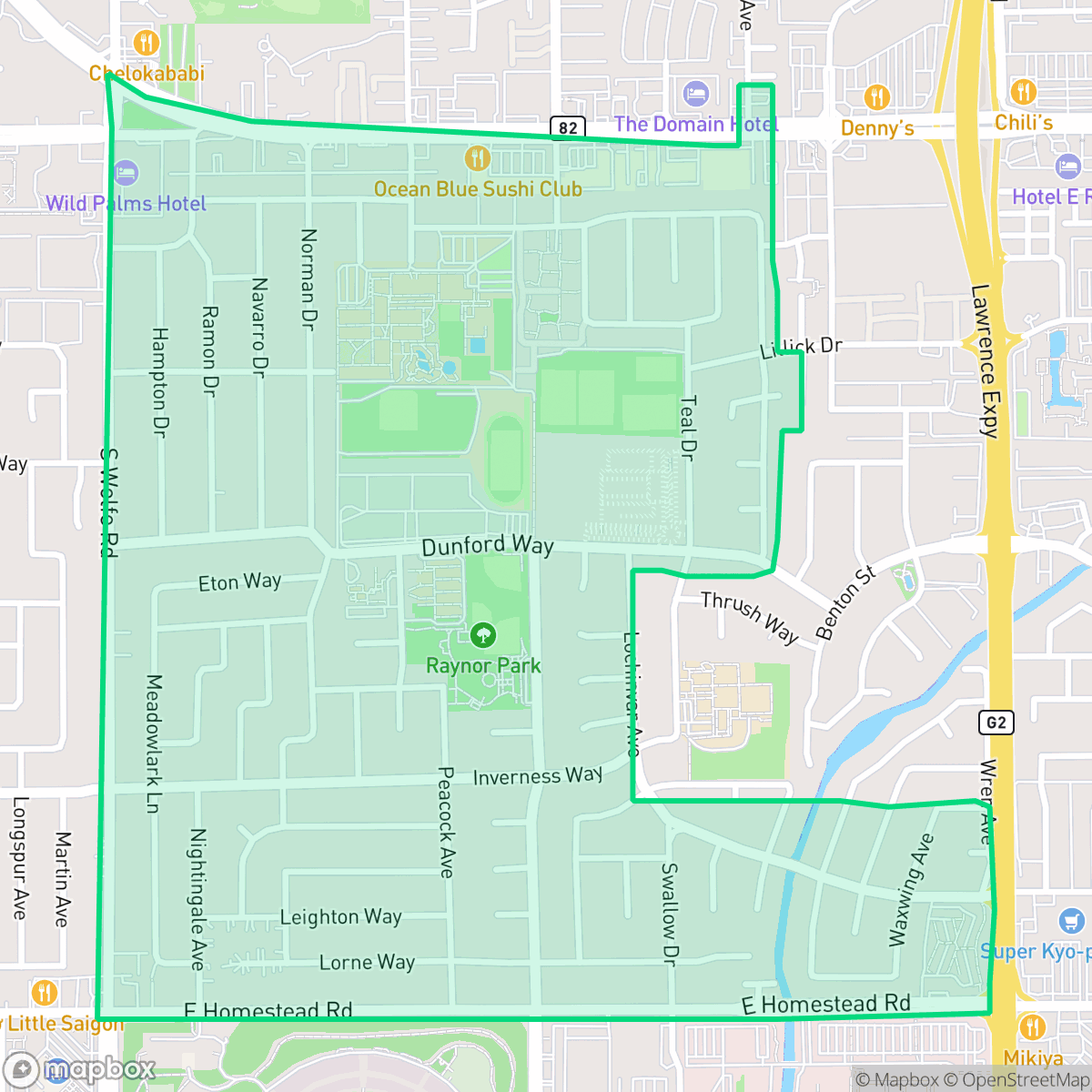
Located in southeastern Sunnyvale, California, the Raynor neighborhood (often associated with the adjacent Birdland area) developed primarily during the mid-20th century, with most homes built between 1940 and 1969. The neighborhood is widely recognized for its signature bird-themed street names, including Quail Avenue, Swallow Drive, Peacock Avenue, and Oriole Way. At the heart of the community is Raynor Park, a 12.7-acre public green space. The park is a local landmark celebrated for its whimsical dinosaur-themed playgrounds, secret dinosaur art, and mature, prehistoric-looking "dinosaur trees" (Araucaria bidwillii). Raynor also borders the Santa Clara Unified School District Farm, preserving a tangible connection to the Santa Clara Valley's rich agricultural heritage.
The neighborhood features a dense layout characterized by a mix of mid-century single-family homes and shared-wall apartment complexes. Its high walkability allows residents to reach local amenities, including diverse dining options and coffee shops, through a well-maintained network of sidewalks. The area is particularly well-suited for dog owners due to the proximity of public green spaces and wide sidewalk verges. While the environment is largely serene, the proximity to major roadways results in moderate ambient traffic noise. Prospective residents should note the balance between suburban comfort and the realities of a high-density area, which can limit personal privacy in some residential pockets. The community is served by several top-tier school districts, making it a stable environment for families. According to iHuus data, the neighborhood maintains strong health insurance coverage and a consistent social vibe, providing a reliable, if somewhat quiet, living experience for those prioritizing accessibility and educational quality over expansive private lots.
Neighborhood Scores Across 15 Qualities
Residential spacing is somewhat varied, featuring both closely packed apartment complexes and suburban homes with standard setbacks. According to iHuus data, the level of separation between neighbors is slightly lower than the Sunnyvale average.
Extensive sidewalk networks and signalized crossings provide safe, continuous pedestrian paths throughout both residential and commercial zones. According to iHuus data, the infrastructure for walking and strollers is slightly superior to the Sunnyvale average.
Residential aesthetics range from affluent estates with private pools to standard high-density apartment complexes. This visual diversity is roughly in line with the average across Sunnyvale.
Extensive green spaces and continuous sidewalk verges provide ample area for pet exercise. This accessibility to parks and connected paths is slightly above the Sunnyvale average, according to iHuus data.
A dense suburban layout characterizes this area, featuring a blend of single-family homes, multi-unit complexes, and large commercial retail zones. This level of density is consistent with the average across Sunnyvale.
Suburban streets offer a blend of quiet residential pockets and accessible dining, providing a more active atmosphere than much of Sunnyvale. While some areas are car-oriented, several blocks feature walkable access to diverse international cuisine and coffee shops according to iHuus data.
Frequent sounds from nearby transit corridors and flight paths characterize this area. According to iHuus data, acoustic comfort is notably lower than the Sunnyvale average.
Air quality in Raynor is consistent with the Sunnyvale average. Residents may encounter a mix of acceptable and unhealthy days, which can cause occasional concern for sensitive groups according to iHuus data.
Heavy industrial activity and large warehouses are absent from this area. According to iHuus data, the neighborhood is significantly more free of industrial hazards and manufacturing plants than the Sunnyvale average.
Health insurance coverage among residents is high, though slightly lower than the Sunnyvale average according to iHuus data.
Voting patterns and census indicators reflect a deeply liberal political leaning, which is consistent with the broader Sunnyvale area according to iHuus data.
Residents live alongside a balanced mix of young professionals, families, and seniors. This age distribution is largely consistent with the broader Sunnyvale area, according to iHuus data.
Properties in this area are situated within a designated floodplain, which means residents may need to carry flood insurance. According to iHuus data, the level of flood risk in Raynor is slightly higher than the average for Sunnyvale.
Address-Level Insights for Raynor


iHuus Neighborhood Intelligence Insights
Get address-level neighborhood insights for Raynor
- Street-level scores — see how individual blocks compare, not just neighborhood averages
- Micro-zone boundaries — identify quiet pockets, flood boundaries, and walkable clusters before you visit
- 15 dimensions in full — walkability, noise, air quality, school quality, insurance coverage, population age profile, urban/rural index, and more
- Boundary risk alerts — know if your address sits near a block boundary where scores drop, the kind of detail no listing will ever mention
- School insights — individual school ratings and insights, not just district-level data
- Compare before you commit — side-by-side data across neighborhoods, down to block precision
No credit card required
Compare with Any Neighborhood
| Dimension | Raynor | Birdland |
|---|---|---|
| 🚶 Walkabilityavg 9.5 | ||
| 🔊 Acoustic Comfortavg 2.69 | ||
| 🤫 Privacy Indexavg 4.94 | ||
| 🎨 Visual Appealavg 6.66 | ||
| 🐕 Dog Friendlinessavg 6.76 | ||
| 🗺️ Urban-Rural Indexavg 6.55 | ||
| ✨ Neighborhood Vibeavg 4.49 | ||
| 🏥 Health Insurance Coverageavg 9.05 | ||
| 🌿 Air Qualityavg 6 | ||
| 🏭 Industrial Proximityavg 7.42 | ||
| 🌊 Flood Safetyavg 3.58 | ||
| 🗳️ Ideological Leanavg 9.69 | ||
| 👥 Population Age Profileavg 4.85 | ||
| 🔥 Fire Safety | ||
| 🏫 School Quality |
Raynor Rankings
School Districts Serving Raynor
School Insights for Raynor
Below average outcomes; significant attendance and academic challenges.
School Insights
See what's really behind every school rating near Raynor
- Individual school ratings — each school's own score with outcome context, not just a district average
- Enrollment & class size data — student-to-teacher ratio and how it compares to the state average
- Full demographics breakdown — ethnicity and gender composition for every school in the enrollment zone
- Every school in the district — all schools within the enrollment boundary ranked by rating, not just the closest one
- Grade levels & benchmarks — elementary through high school, with below/above state-average flags
No credit card required