University, Stockton
Updated · 14,904 residents
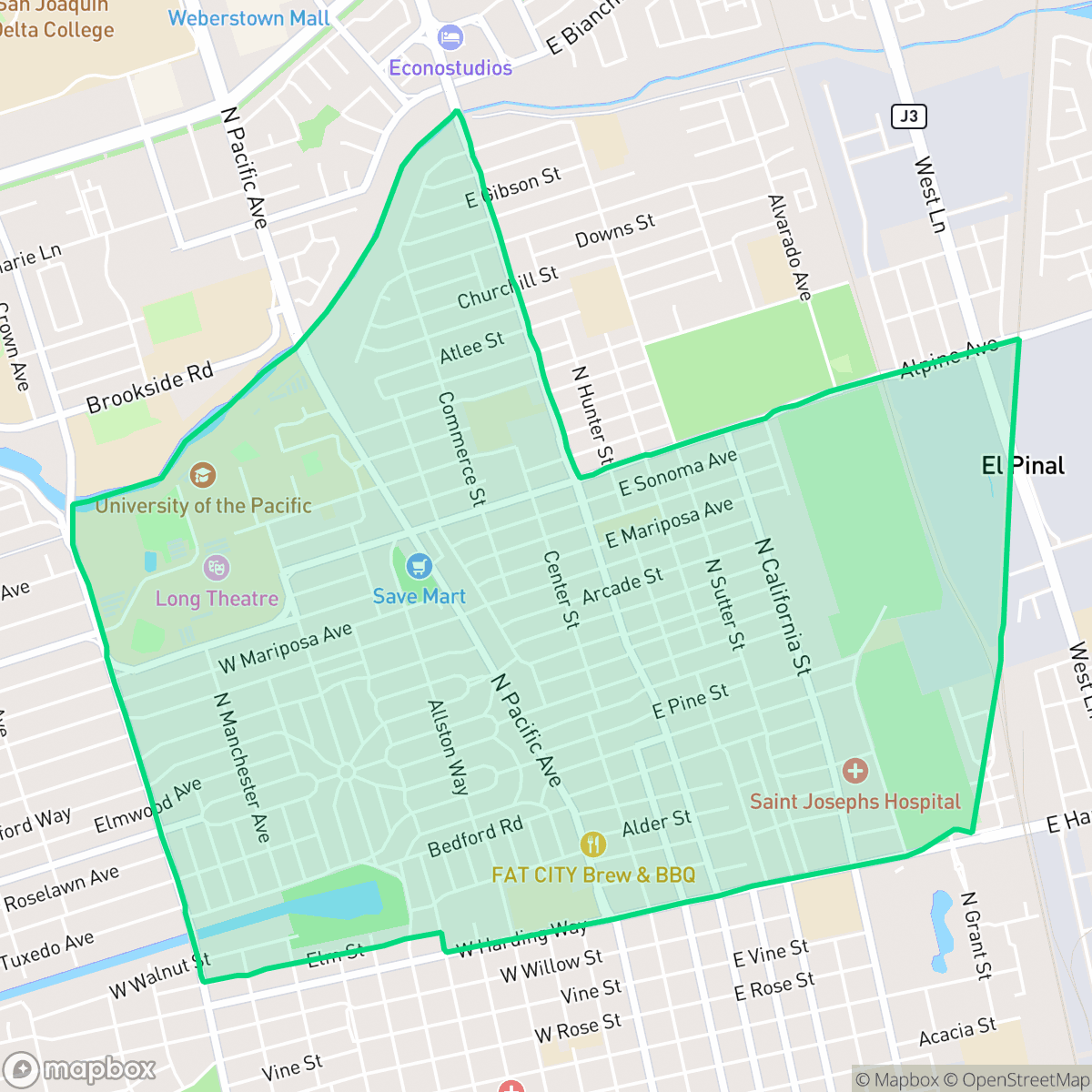
Defined by the historic University of the Pacific campus, this neighborhood offers high walkability and a vibrant academic atmosphere. Residents enjoy a mix of suburban housing styles and convenient access to local amenities, though the area experiences notable noise from nearby rail and freeway traffic.
Key Highlights
About University
The University neighborhood in Stockton is defined by the presence of the University of the Pacific, which relocated to the city in 1923. The campus is renowned for its distinctive Collegiate Gothic architecture, characterized by brick-and-ivy buildings that are unique on the West Coast. A central landmark is the 1963 Burns Tower, which served as Stockton's tallest building for three decades and remains an iconic symbol of the area. The neighborhood’s cultural identity is deeply intertwined with the university’s history as California’s first chartered university and its role as a repository for significant cultural artifacts, including the papers of environmentalist John Muir. The surrounding area has long been a hub for academic and civic life, with the university's presence fostering a scholarly atmosphere and a legacy of notable alumni, including jazz legend Dave Brubeck and actress Janet Leigh.
The area functions as a central academic and residential hub, characterized by a highly walkable street grid that encourages pedestrian activity. A diverse mix of young adults, families, and retirees contributes to a balanced social energy, supported by a predominantly liberal community. The neighborhood maintains a suburban feel with varied housing, ranging from modest tract homes to larger properties, providing a distinct contrast to the institutional architecture of the university grounds.
Prospective residents should consider the trade-offs of living in this central location, which include persistent noise levels from regional rail and freeway traffic. While health insurance coverage rates are relatively high, the local school district faces significant academic challenges and governance instability. Additionally, while the neighborhood is largely free from heavy industrial activity, potential environmental concerns regarding soil and groundwater quality exist, and residents should be aware of the moderate flood risk associated with the area.
Neighborhood Scores Across 15 Qualities
Residential spacing provides a moderate level of separation between homes, which is slightly higher than the Stockton average. According to iHuus data, structures range from closely packed houses with narrow side yards to larger setbacks near school and apartment zones.
Pedestrian access is excellent due to a dense street grid, consistent sidewalks on both sides of the road, and numerous safe crossings. This area offers superior walkability compared to the rest of Stockton, featuring connected residential blocks and easy access to nearby commercial hubs.
Varying housing styles define the area, ranging from larger properties with private pools to dense, uniform tract housing. This visual variety is largely in line with the overall Stockton average.
Abundant parks, river-adjacent trails, and continuous sidewalks provide ample space for pets. This area offers more accessible green space for dogs than the Stockton average, according to iHuus data.
Residential layouts range from dense single-family housing to multi-story institutional buildings and light industrial warehouses. This area is slightly less rural than the Stockton average, featuring a variety of suburban and medium-density developments.
Diverse dining and local social hubs provide more activity than the typical Stockton neighborhood. Residents can find a mix of lively street life and quiet, green spaces near the water, though some areas remain more car-oriented and low-density.
Persistent noise from nearby railroad tracks and major freeway traffic is a notable feature of this area. This level of acoustic disturbance is consistent with the average found across Stockton.
Air quality levels in this area are consistent with the Stockton average, presenting a mix of acceptable and unhealthy days for sensitive groups. According to iHuus data, residents may experience occasional periods of concern regarding air pollutants.
Primarily residential and institutional, this area lacks heavy industry or large warehouses. While the neighborhood is largely free of industrial activity, nearby environmental concerns regarding a Superfund site may affect groundwater and soil quality according to iHuus data.
Health insurance access is more prevalent here than in the rest of Stockton, according to iHuus data. Residents benefit from a higher rate of coverage compared to the city average.
Voting patterns and census indicators in this area show a strong liberal leaning, which is more pronounced than the average seen throughout Stockton.
Residents live alongside a diverse mix of young adults, families, and older individuals. This age distribution is largely consistent with the broader Stockton area, according to iHuus data.
Flood risk in this area is slightly above the Stockton average, though the specific level of danger remains undetermined because detailed federal studies have not been completed for this location.
Address-Level Insights for University


iHuus Neighborhood Intelligence Insights
Get address-level neighborhood insights for University
- Street-level scores — see how individual blocks compare, not just neighborhood averages
- Micro-zone boundaries — identify quiet pockets, flood boundaries, and walkable clusters before you visit
- 15 dimensions in full — walkability, noise, air quality, school quality, insurance coverage, population age profile, urban/rural index, and more
- Boundary risk alerts — know if your address sits near a block boundary where scores drop, the kind of detail no listing will ever mention
- School insights — individual school ratings and insights, not just district-level data
- Compare before you commit — side-by-side data across neighborhoods, down to block precision
No credit card required
Compare with Any Neighborhood
| Dimension | University | Anderson |
|---|---|---|
| 🚶 Walkabilityavg 8.33 | ||
| 🔊 Acoustic Comfortavg 3.04 | ||
| 🤫 Privacy Indexavg 5.32 | ||
| 🎨 Visual Appealavg 6.38 | ||
| 🐕 Dog Friendlinessavg 6.44 | ||
| 🗺️ Urban-Rural Indexavg 6.82 | ||
| ✨ Neighborhood Vibeavg 4.6 | ||
| 🏥 Health Insurance Coverageavg 6.72 | ||
| 🌿 Air Qualityavg 6 | ||
| 🏭 Industrial Proximityavg 7.71 | ||
| 🌊 Flood Safetyavg 5.9 | ||
| 🗳️ Ideological Leanavg 8.5 | ||
| 👥 Population Age Profileavg 4.59 | ||
| 🔥 Fire Safety | ||
| 🏫 School Quality |
University Rankings
School Districts Serving University
School Insights for University
Below average outcomes; significant attendance and academic challenges.
School Insights
See what's really behind every school rating near University
- Individual school ratings — each school's own score with outcome context, not just a district average
- Enrollment & class size data — student-to-teacher ratio and how it compares to the state average
- Full demographics breakdown — ethnicity and gender composition for every school in the enrollment zone
- Every school in the district — all schools within the enrollment boundary ranked by rating, not just the closest one
- Grade levels & benchmarks — elementary through high school, with below/above state-average flags
No credit card required