Spanos Park East, Stockton
Updated · 12,280 residents
Spanos Park East is a quiet, affluent suburban community in northern Stockton characterized by its well-maintained modern homes and extensive sidewalk network. Residents benefit from a highly walkable environment with easy access to local parks, though the area remains primarily residential with limited local commercial activity.
Key Highlights
About Spanos Park East
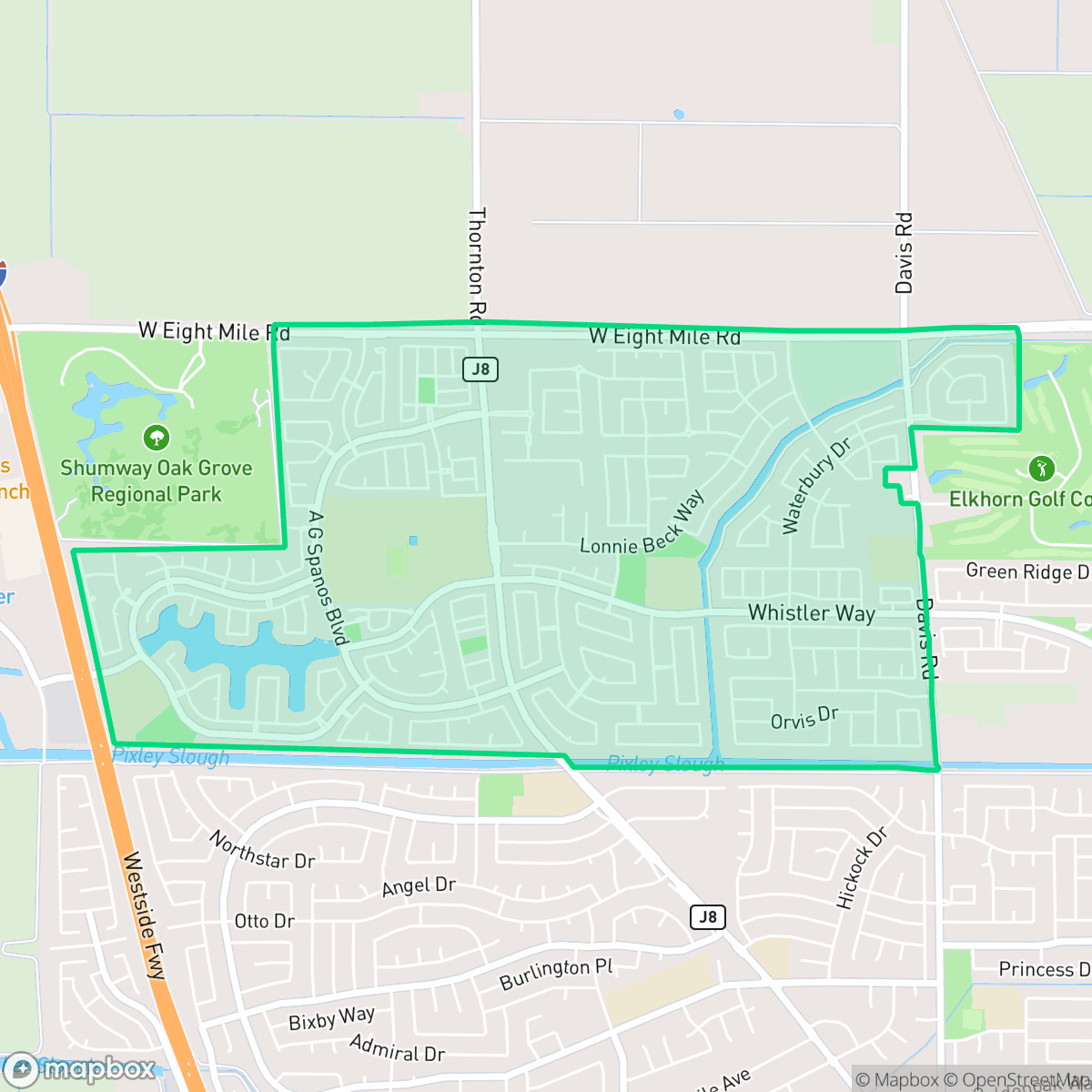
Spanos Park East is an established master-planned community located at the northernmost boundary of Stockton, California. Developed starting in the late 1990s by the prominent real-estate firm A.G. Spanos Companies, the neighborhood represents the older, eastern half of the broader Spanos Park development, separated from its western counterpart by Interstate 5. The neighborhood's expansion pushed Stockton's boundaries northward into former agricultural land. Characterized by distinct residential subdevelopments, many of which are governed by homeowners' associations, the area features suburban architectural styles, community clubhouses, and local parks such as Whistler Park and Baxter Park. It is also home to Bear Creek High School and Julia Morgan Elementary School, which serve the local community under the Lodi Unified School District.
The neighborhood is defined by its clean, suburban aesthetic, featuring large modern homes, private pools, and manicured landscaping. It offers a high level of walkability, with continuous sidewalks throughout the area that connect residents to community spaces like Whistler Park and Baxter Park. The atmosphere is largely tranquil, with no significant industrial activity, making it a stable environment for families and professionals.
While the area is highly walkable, it lacks a dense commercial core, meaning most daily errands require a short drive. Prospective residents should note that the homes are situated on relatively compact lots, which limits backyard privacy. Additionally, while the neighborhood is generally peaceful, proximity to major roadways contributes to a moderate level of ambient traffic noise. The area is served by the Lodi Unified School District, which offers a range of educational options, including high-performing elementary schools and local secondary campuses.
Neighborhood Scores Across 15 Qualities
Residential lots feature typical suburban spacing with modest yard buffers between homes. According to iHuus data, the level of privacy is consistent with the average density found across Stockton.
Extensive sidewalk networks and safe, low-traffic cul-de-sacs make pedestrian travel easy within the neighborhood. According to iHuus data, the connectivity and dedicated crossings here are notably superior to the Stockton average.
Large, well-maintained homes with private pools and manicured landscaping define this area. According to iHuus data, the visual quality of the neighborhood is notably higher than the Stockton average.
Access to continuous canal-side trails and local park spaces makes this area slightly more dog friendly than the Stockton average. Wide sidewalks and integrated green verges provide safe, connected routes for walking pets away from traffic.
Residential tracts featuring single-family homes and manicured yards are interspersed with nearby agricultural fields. This balance of developed housing and open land is consistent with the typical density found throughout Stockton.
A mix of calm residential blocks and small social hubs provides a level of activity that is higher than the Stockton average. While some areas offer walkable paths to local services, much of the neighborhood remains low-density and car-dependent.
Frequent noise from nearby freeway and railroad activity is present in this area. According to iHuus data, acoustic levels are slightly higher than the Stockton average.
Air quality in this area fluctuates between acceptable and unhealthy levels, matching the general conditions found across Stockton. Sensitive groups should monitor local reports for occasional periods of concern.
Industrial activity and hazardous facilities are absent from this area, which provides a much cleaner environment than the Stockton average. According to iHuus data, the neighborhood consists entirely of residential, recreational, and light institutional land use.
Health insurance access is significantly higher in this area than the Stockton average, according to iHuus data. This indicates a well-covered population with greater access to medical services.
Political leanings in this area are largely liberal, though the community shows a more moderate profile compared to the broader Stockton area according to iHuus data.
Residents live alongside a balanced mix of young adults, families, and older individuals. This demographic variety is slightly more widespread than the average found across Stockton.
Flood safety in this area is better than the Stockton average, though some residual risk remains as part of the 500-year floodplain. According to iHuus data, residents should remain aware of potential low-level flood vulnerabilities.
Address-Level Insights for Spanos Park East


iHuus Neighborhood Intelligence Insights
Get address-level neighborhood insights for Spanos Park East
- Street-level scores — see how individual blocks compare, not just neighborhood averages
- Micro-zone boundaries — identify quiet pockets, flood boundaries, and walkable clusters before you visit
- 15 dimensions in full — walkability, noise, air quality, school quality, insurance coverage, population age profile, urban/rural index, and more
- Boundary risk alerts — know if your address sits near a block boundary where scores drop, the kind of detail no listing will ever mention
- School insights — individual school ratings and insights, not just district-level data
- Compare before you commit — side-by-side data across neighborhoods, down to block precision
No credit card required
Compare with Any Neighborhood
| Dimension | Spanos Park East | Anderson |
|---|---|---|
| 🚶 Walkabilityavg 8.33 | ||
| 🔊 Acoustic Comfortavg 3.04 | ||
| 🤫 Privacy Indexavg 5.32 | ||
| 🎨 Visual Appealavg 6.38 | ||
| 🐕 Dog Friendlinessavg 6.44 | ||
| 🗺️ Urban-Rural Indexavg 6.82 | ||
| ✨ Neighborhood Vibeavg 4.6 | ||
| 🏥 Health Insurance Coverageavg 6.72 | ||
| 🌿 Air Qualityavg 6 | ||
| 🏭 Industrial Proximityavg 7.71 | ||
| 🌊 Flood Safetyavg 5.9 | ||
| 🗳️ Ideological Leanavg 8.5 | ||
| 👥 Population Age Profileavg 4.59 | ||
| 🔥 Fire Safety | ||
| 🏫 School Quality |
Spanos Park East Rankings
School Districts Serving Spanos Park East
School Insights for Spanos Park East
Below average outcomes; significant attendance and academic challenges.
School Insights
See what's really behind every school rating near Spanos Park East
- Individual school ratings — each school's own score with outcome context, not just a district average
- Enrollment & class size data — student-to-teacher ratio and how it compares to the state average
- Full demographics breakdown — ethnicity and gender composition for every school in the enrollment zone
- Every school in the district — all schools within the enrollment boundary ranked by rating, not just the closest one
- Grade levels & benchmarks — elementary through high school, with below/above state-average flags
No credit card required