Quail Lakes - Venetian Bridges, Stockton
Updated · 9,633 residents
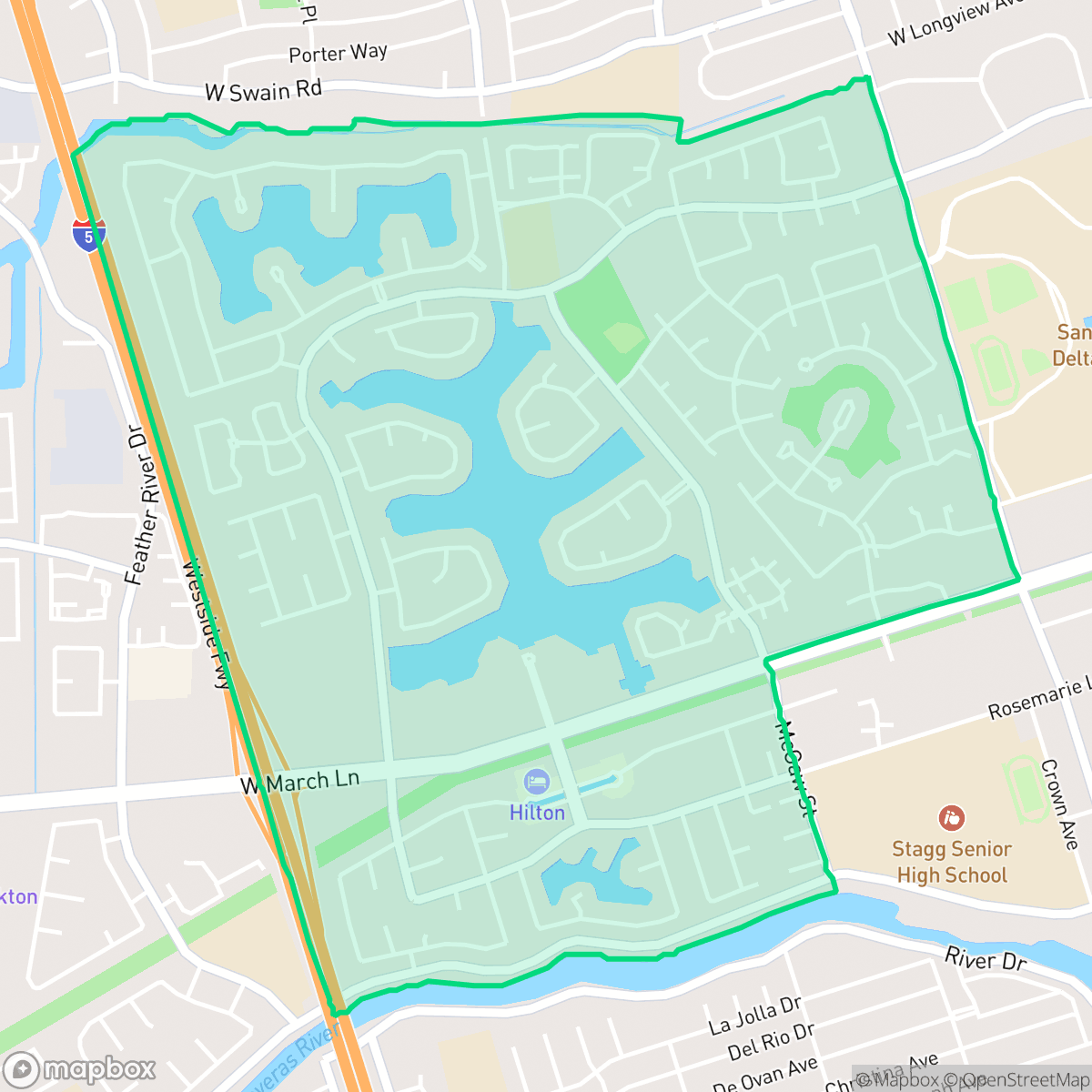
Quail Lakes - Venetian Bridges is a master-planned community in Stockton defined by its signature artificial lakes and accessible pedestrian pathways. The area offers a lively suburban atmosphere with diverse local dining, though residents should expect significant noise levels from nearby road traffic.
Key Highlights
About Quail Lakes - Venetian Bridges
Developed primarily in the 1970s, the master-planned Quail Lakes - Venetian Bridges neighborhood in Stockton, California, is defined by its artificial waterways, including Quail Lake and Lake Venezia. The Quail Lakes portion was developed by Fritz Grupe of The Grupe Company, who integrated man-made lakes and waterfront residences into the design. The neighboring Venetian Bridges section was developed by Eckhardt Schmitz. A major cultural landmark in the neighborhood is the Stockton Civic Theatre, which moved to Venetian Bridges in 1981 following a land donation by Schmitz, who constructed the 300-seat facility at cost. Another prominent local institution is the Quail Lakes Baptist Church, which established its campus in the fledgling development in 1980 under the leadership of longtime pastor Fred Jantz.
The neighborhood stands out for its well-manicured landscaping and integration of water features, which contribute to a higher visual appeal than much of the surrounding city. Residents benefit from a robust network of sidewalks and greenbelts that connect housing clusters to local retail hubs and recreational spaces. This environment supports a variety of social amenities, ranging from casual cafes and international eateries to established community institutions. The area maintains a strong sense of suburban activity, bolstered by its proximity to essential services and public parks. Prospective residents should weigh the benefits of the neighborhood's walkability and aesthetic quality against its acoustic environment, as road noise is a notable factor for many properties. While the area is largely residential and free from industrial activity, it sits within a complex educational landscape, with school options varying significantly in performance. The community is well-suited for those who prioritize outdoor access and a central location in Stockton, provided they are comfortable with a higher-density suburban setting.
Neighborhood Scores Across 15 Qualities
Housing density is slightly higher than the Stockton average, featuring a mix of closely spaced homes and multi-unit buildings. Many properties maintain a moderate level of separation with private yards and a dense tree canopy providing visual buffers between neighbors.
Extensive sidewalk networks and pedestrian paths provide easy access to local parks and community centers. This area offers a level of pedestrian connectivity that is slightly above the Stockton average.
Manicured landscaping and premium lakefront estates create a visually polished environment that is more aesthetically pleasing than the Stockton average. Many properties feature large homes, private pools, and significant waterfront access according to iHuus data.
Abundant greenbelts, riverside paths, and nearby parklands provide ample space for pet owners. According to iHuus data, these continuous natural corridors offer more walking opportunities than the typical Stockton neighborhood.
Residential density is slightly lower than the Stockton average, featuring a mix of single-family homes and multi-family complexes integrated with nearby open spaces. According to iHuus data, the area provides a structured suburban layout that borders more open, semi-rural landscapes.
Local dining and social hubs provide a noticeable level of activity that is higher than the Stockton average. Residents can find a variety of diverse eateries and community spaces scattered throughout the neighborhood's streets and green spaces.
Frequent noise from nearby freeways and rail lines creates an audible disturbance. According to iHuus data, these acoustic levels are notably higher than the Stockton average.
Air quality levels fluctuate between acceptable and unhealthy at times, which may cause occasional concern for sensitive groups. This level of-air quality is consistent with the average found throughout Stockton.
Industrial activity is virtually nonexistent in this area, offering a cleaner environment than the Stockton average. According to iHuus data, the landscape is comprised of residential, recreational, and light commercial uses without the presence of warehouses or hazardous sites.
Health insurance coverage levels in this area are slightly higher than the Stockton average, according to iHuus data.
Political leanings in this area are primarily liberal, though the concentration is slightly less pronounced than the average seen across Stockton.
Residents live alongside a diverse mix of young adults, families, and seniors. This age distribution is slightly more varied than the typical Stockton profile, according to iHuus data.
Flood risk in this area is difficult to determine because FEMA has not completed a detailed study for this specific location. According to iHuus data, the level of risk is slightly higher than the Stockton average.
Address-Level Insights for Quail Lakes - Venetian Bridges


iHuus Neighborhood Intelligence Insights
Get address-level neighborhood insights for Quail Lakes - Venetian Bridges
- Street-level scores — see how individual blocks compare, not just neighborhood averages
- Micro-zone boundaries — identify quiet pockets, flood boundaries, and walkable clusters before you visit
- 15 dimensions in full — walkability, noise, air quality, school quality, insurance coverage, population age profile, urban/rural index, and more
- Boundary risk alerts — know if your address sits near a block boundary where scores drop, the kind of detail no listing will ever mention
- School insights — individual school ratings and insights, not just district-level data
- Compare before you commit — side-by-side data across neighborhoods, down to block precision
No credit card required
Compare with Any Neighborhood
| Dimension | Quail Lakes - Venetian Bridges | Anderson |
|---|---|---|
| 🚶 Walkabilityavg 8.33 | ||
| 🔊 Acoustic Comfortavg 3.04 | ||
| 🤫 Privacy Indexavg 5.32 | ||
| 🎨 Visual Appealavg 6.38 | ||
| 🐕 Dog Friendlinessavg 6.44 | ||
| 🗺️ Urban-Rural Indexavg 6.82 | ||
| ✨ Neighborhood Vibeavg 4.6 | ||
| 🏥 Health Insurance Coverageavg 6.72 | ||
| 🌿 Air Qualityavg 6 | ||
| 🏭 Industrial Proximityavg 7.71 | ||
| 🌊 Flood Safetyavg 5.9 | ||
| 🗳️ Ideological Leanavg 8.5 | ||
| 👥 Population Age Profileavg 4.59 | ||
| 🔥 Fire Safety | ||
| 🏫 School Quality |
Quail Lakes - Venetian Bridges Rankings
School Districts Serving Quail Lakes - Venetian Bridges
School Insights for Quail Lakes - Venetian Bridges
Below average outcomes; significant attendance and academic challenges.
School Insights
See what's really behind every school rating near Quail Lakes - Venetian Bridges
- Individual school ratings — each school's own score with outcome context, not just a district average
- Enrollment & class size data — student-to-teacher ratio and how it compares to the state average
- Full demographics breakdown — ethnicity and gender composition for every school in the enrollment zone
- Every school in the district — all schools within the enrollment boundary ranked by rating, not just the closest one
- Grade levels & benchmarks — elementary through high school, with below/above state-average flags
No credit card required