Magnolia, Stockton
Updated · 3,672 residents
Magnolia is a highly walkable urban enclave in Stockton defined by its dense grid and diverse mix of local social hubs. While it offers excellent pedestrian connectivity, residents experience significant road noise and limited privacy due to the close proximity of homes.
Key Highlights
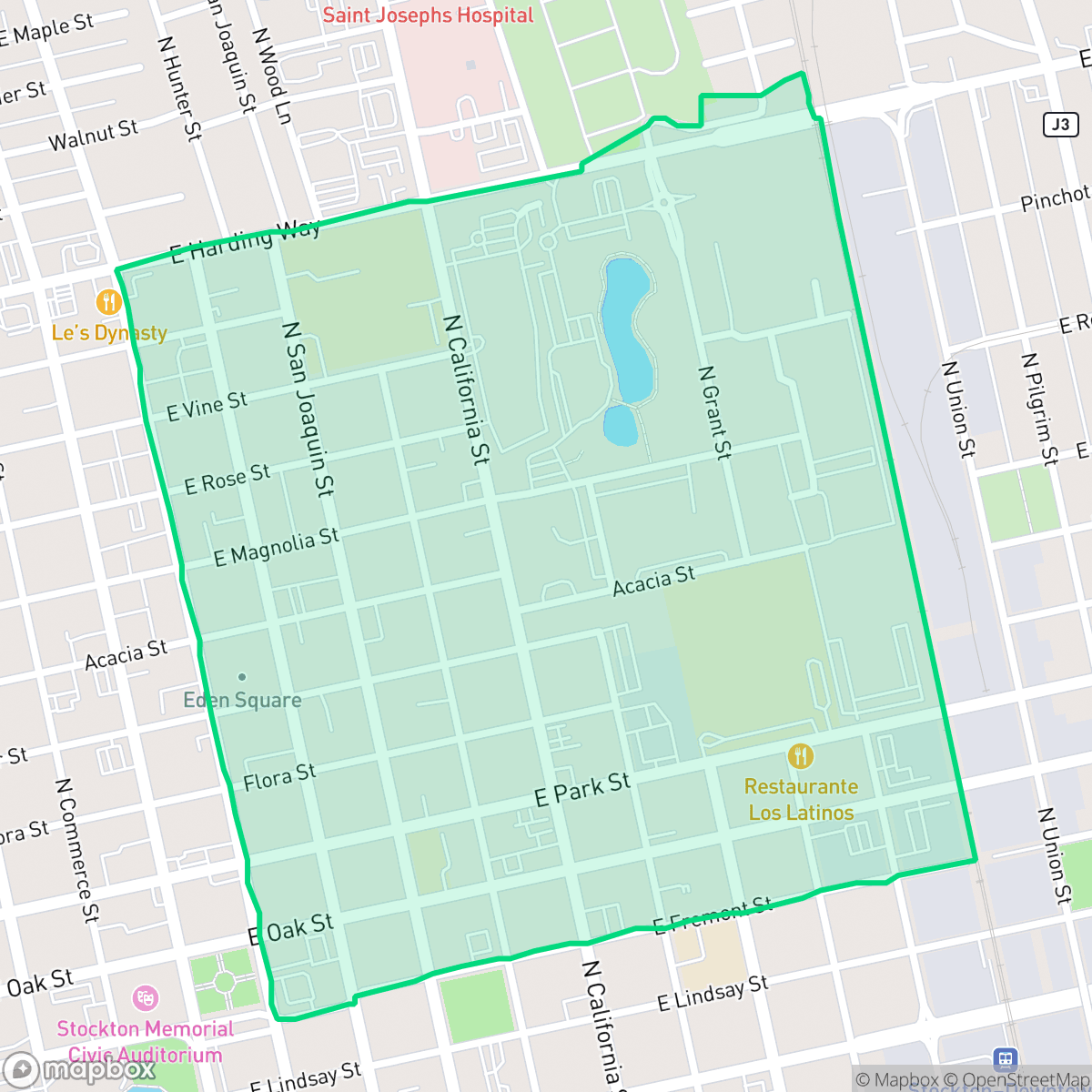
About Magnolia
Located in Midtown Stockton, the Magnolia Historic District is the city's first historic preservation district, established in 1984. Bounded by Harding Way, California Street, Park Street, and El Dorado Street, this neighborhood has been home to a diverse cross-section of residents since the 1860s. Magnolia boasts Stockton’s richest concentration of historic architecture, with more than half of its structures built before 1920. Its tree-lined streets feature an exceptional variety of styles, including Queen Anne, Eastlake, Craftsman, Spanish Revival, and California Bungalow. A prominent local landmark is the Magnolia Mansion, a grand Georgian Neoclassical Revival structure built around 1900 to serve as the residence for the superintendent of the nearby Stockton State Hospital. The neighborhood's historic character is further preserved by its original 19th-century cut-stone paving blocks embedded in the local curbs and gutters.
The neighborhood functions as a dense, mixed-use environment where residential life blends with active commercial corridors. Residents benefit from a highly walkable layout, featuring consistent sidewalks and a grid system that connects local dining and community institutions. The area maintains a lively atmosphere, supported by various social hubs and local businesses that contribute to its daily activity. According to iHuus data, the community is well-integrated into the city fabric, providing easy access to daily necessities for those who prefer to travel on foot.
Prospective residents should consider the trade-offs of living in this established urban setting. The area faces challenges regarding acoustic comfort due to road traffic and proximity to industrial sites, including a nearby EPA Superfund location. Housing is characterized by high density with minimal yard space, and the local school district currently faces significant academic and governance hurdles. This neighborhood is best suited for those prioritizing walkability and proximity to city amenities over quietude or expansive private outdoor space.
Neighborhood Scores Across 15 Qualities
Residential structures are closely situated with minimal private yard space or buffers between neighbors. This level of density is slightly higher than the Stockton average, according to iHuus data.
Sidewalks and clear pedestrian crossings are widely available throughout the neighborhood, providing a level of connectivity that is slightly higher than the Stockton average. This comprehensive grid system links residential streets to local waterfront areas and nearby stadiums.
Residential structures consist primarily of high-density, standard tract housing with small yards and uniform rooflines. This neighborhood offers less visual variety and fewer luxury amenities than the Stockton average, according to iHuus data.
Access to pet-friendly spaces is below the Stockton average, as the area features mostly private fenced yards and narrow sidewalks. Nearby waterfront parks and central green spaces offer some alternatives for walking pets, according to iHuus data.
Residential layouts feature a blend of single-family homes and larger commercial blocks, presenting a slightly more urban feel than the surrounding city average. According to iHuus data, the area maintains a transition between low-density housing and developed street grids.
A mix of suburban streets and commercial pockets provides a higher level of activity than the Stockton average. Residents have access to a diverse range of dining options and local social hubs nestled among green spaces and light industrial areas.
Frequent noise from nearby railroad lines and major freeway corridors characterizes the area. According to iHuus data, acoustic levels are slightly higher than the Stockton average.
Air quality levels in Magnolia fluctuate between acceptable and unhealthy, mirroring the typical conditions found across Stockton. Sensitive individuals may encounter occasional periods of concern according to iHuus data.
Residential areas exist alongside large commercial warehouses and paved lots, resulting in more industrial activity and truck traffic than the Stockton average. According to iHuus data, some parts of the neighborhood are near an EPA Superfund site, which may present potential environmental concerns regarding soil or groundwater.
Health insurance access is significantly lower here than the Stockton average. Residents may face greater challenges accessing employer-sponsored or private medical benefits according to iHuus data.
Voting patterns and census indicators show a predominantly liberal leaning that is more pronounced than the Stockton average, according to iHuus data.
A balanced demographic of young adults, families, and seniors resides here. This age distribution is roughly in line with the broader Stockton area, according to iHuus data.
Properties in this area are located within a designated floodplain, which is a higher risk level than most of Stockton. According to iHuus data, residents should anticipate the potential requirement for flood insurance.
Address-Level Insights for Magnolia


iHuus Neighborhood Intelligence Insights
Get address-level neighborhood insights for Magnolia
- Street-level scores — see how individual blocks compare, not just neighborhood averages
- Micro-zone boundaries — identify quiet pockets, flood boundaries, and walkable clusters before you visit
- 15 dimensions in full — walkability, noise, air quality, school quality, insurance coverage, population age profile, urban/rural index, and more
- Boundary risk alerts — know if your address sits near a block boundary where scores drop, the kind of detail no listing will ever mention
- School insights — individual school ratings and insights, not just district-level data
- Compare before you commit — side-by-side data across neighborhoods, down to block precision
No credit card required
Compare with Any Neighborhood
| Dimension | Magnolia | Anderson |
|---|---|---|
| 🚶 Walkabilityavg 8.33 | ||
| 🔊 Acoustic Comfortavg 3.04 | ||
| 🤫 Privacy Indexavg 5.32 | ||
| 🎨 Visual Appealavg 6.38 | ||
| 🐕 Dog Friendlinessavg 6.44 | ||
| 🗺️ Urban-Rural Indexavg 6.82 | ||
| ✨ Neighborhood Vibeavg 4.6 | ||
| 🏥 Health Insurance Coverageavg 6.72 | ||
| 🌿 Air Qualityavg 6 | ||
| 🏭 Industrial Proximityavg 7.71 | ||
| 🌊 Flood Safetyavg 5.9 | ||
| 🗳️ Ideological Leanavg 8.5 | ||
| 👥 Population Age Profileavg 4.59 | ||
| 🔥 Fire Safety | ||
| 🏫 School Quality |
Magnolia Rankings
School Districts Serving Magnolia
School Insights for Magnolia
Below average outcomes; significant attendance and academic challenges.
School Insights
See what's really behind every school rating near Magnolia
- Individual school ratings — each school's own score with outcome context, not just a district average
- Enrollment & class size data — student-to-teacher ratio and how it compares to the state average
- Full demographics breakdown — ethnicity and gender composition for every school in the enrollment zone
- Every school in the district — all schools within the enrollment boundary ranked by rating, not just the closest one
- Grade levels & benchmarks — elementary through high school, with below/above state-average flags
No credit card required