Lincoln Village West, Stockton
Updated · 9,329 residents
Lincoln Village West is a distinct Stockton neighborhood defined by its extensive waterfront access and maritime character. It offers a highly walkable, well-manicured suburban environment that remains free from industrial hazards.
Key Highlights
About Lincoln Village West
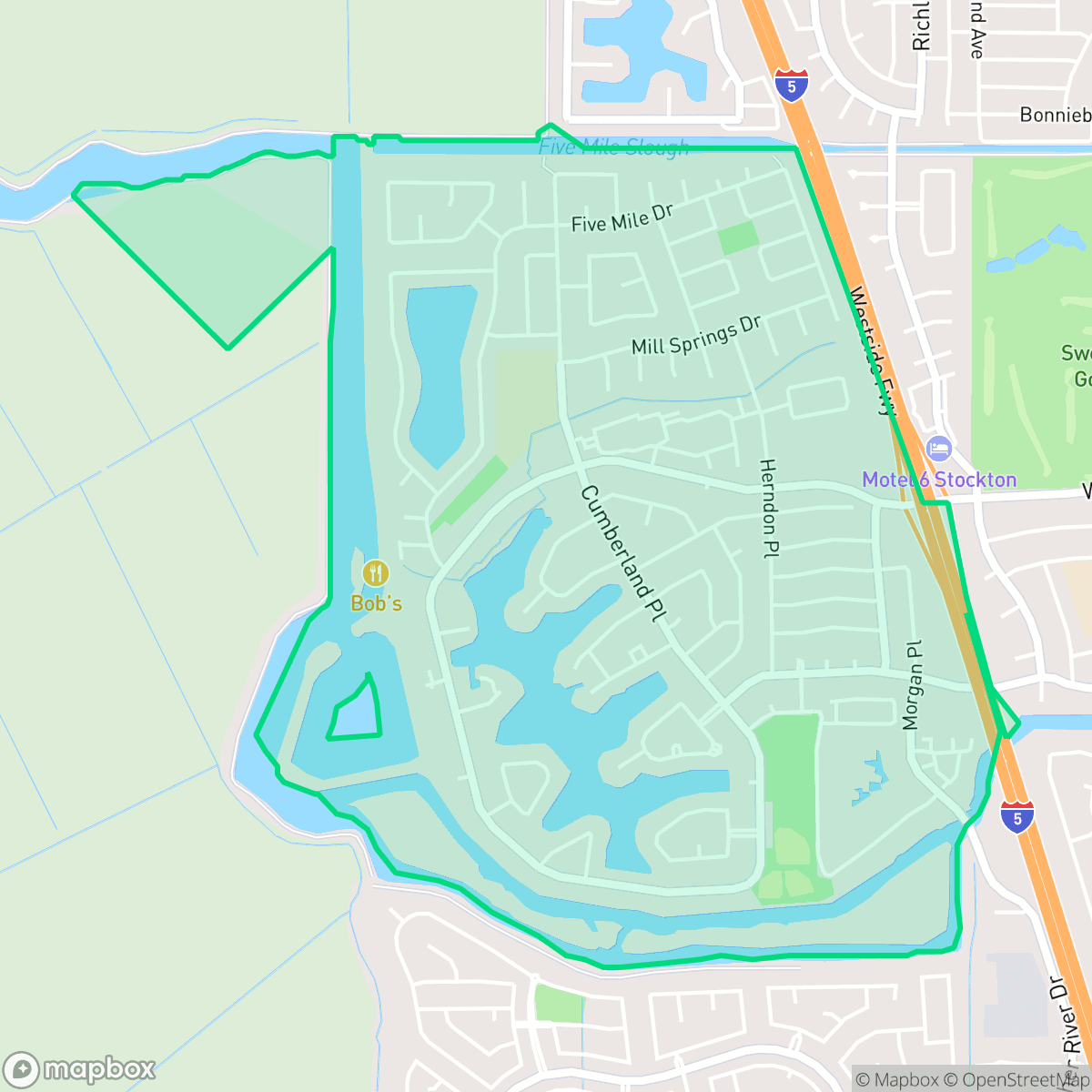
Developed starting in 1966 by the local building firm LILVAL (predecessor to the prominent Grupe Company), Lincoln Village West was envisioned as Stockton's first master-planned community with a direct link to the California Delta waterways. Built on former farmland west of what would become Interstate 5, the 600-acre neighborhood was designed as a self-contained "island peninsula" featuring custom homes, modern apartments, and a 57-acre man-made lake. To provide residents with local shopping, the developers built the Village Square Shopping Center (now the Marina Shopping Center) in the 1970s. Today, the neighborhood's distinct maritime character remains defined by its extensive waterways, the Village West Marina, and the Village West Yacht Club.
The area is characterized by its quiet, suburban layout and consistent visual appeal, featuring large homes and private backyard pools. Residents benefit from a high degree of walkability, with continuous sidewalks and pedestrian paths that wind around the local lakes and green belts. The neighborhood maintains a residential focus, providing a clean environment without the presence of industrial facilities or warehouses. While the atmosphere is generally peaceful, the proximity to major roadways results in a moderate level of ambient traffic noise for some residents.
Neighborhood Scores Across 15 Qualities
Residential plots offer moderate density with consistent buffers between homes; this level of separation is slightly higher than the Stockton average. Most properties feature private, fenced yards and standard suburban spacing according to iHuus data.
Continuous sidewalks and well-defined pedestrian crossings make navigating the neighborhood on foot very easy. According to iHuus data, the sidewalk network and connectivity are notably superior to the Stockton average.
Large homes, private pools, and well-maintained landscaping characterize this area, providing a visual quality that is notably higher than the Stockton average. Premium lakefront estates and spacious properties contribute to an affluent aesthetic throughout the neighborhood.
Abundant greenbelts, golf courses, and waterfront paths provide significant space for pets. According to iHuus data, these connected open spaces offer much better access to walking areas than the Stockton average.
Open land and scattered greenery provide a slightly more rural atmosphere than the typical Stockton landscape. According to iHuus data, the area features a blend of low-density housing and managed natural spaces.
Suburban streets and green spaces characterize this area, offering a tranquil atmosphere with limited local commercial activity. According to iHuus data, the level of neighborhood liveliness sits slightly below the Stockton average.
Steady traffic sounds from nearby busy streets are present; however, acoustic comfort levels remain higher than the Stockton average according to iHuus data.
Air quality in this area fluctuates between acceptable and unhealthy levels. Residents and sensitive groups should expect occasional periods of concern that are consistent with the broader Stockton average.
Industrial activity and heavy warehouses are absent from this area, making it significantly more residential than the Stockton average. Residents can expect a landscape composed of housing, recreation, and retail without the presence of industrial hazards or large-scale manufacturing facilities.
Health insurance accessibility is notably higher than the Stockton average. According to iHuus data, a significant majority of residents in this area are covered by health plans.
Political leanings in this area are more moderate compared to the more strongly liberal leanings found across the rest of Stockton.
Residents live alongside a balanced mix of young adults, families, and older populations. This demographic distribution is largely in line with the typical age profile found throughout Stockton.
Flood risk is higher than the Stockton average because parts of the area sit within a 500-year floodplain, meaning some residual risk remains during extreme weather events.
Address-Level Insights for Lincoln Village West


iHuus Neighborhood Intelligence Insights
Get address-level neighborhood insights for Lincoln Village West
- Street-level scores — see how individual blocks compare, not just neighborhood averages
- Micro-zone boundaries — identify quiet pockets, flood boundaries, and walkable clusters before you visit
- 15 dimensions in full — walkability, noise, air quality, school quality, insurance coverage, population age profile, urban/rural index, and more
- Boundary risk alerts — know if your address sits near a block boundary where scores drop, the kind of detail no listing will ever mention
- School insights — individual school ratings and insights, not just district-level data
- Compare before you commit — side-by-side data across neighborhoods, down to block precision
No credit card required
Compare with Any Neighborhood
| Dimension | Lincoln Village West | Anderson |
|---|---|---|
| 🚶 Walkabilityavg 8.33 | ||
| 🔊 Acoustic Comfortavg 3.04 | ||
| 🤫 Privacy Indexavg 5.32 | ||
| 🎨 Visual Appealavg 6.38 | ||
| 🐕 Dog Friendlinessavg 6.44 | ||
| 🗺️ Urban-Rural Indexavg 6.82 | ||
| ✨ Neighborhood Vibeavg 4.6 | ||
| 🏥 Health Insurance Coverageavg 6.72 | ||
| 🌿 Air Qualityavg 6 | ||
| 🏭 Industrial Proximityavg 7.71 | ||
| 🌊 Flood Safetyavg 5.9 | ||
| 🗳️ Ideological Leanavg 8.5 | ||
| 👥 Population Age Profileavg 4.59 | ||
| 🔥 Fire Safety | ||
| 🏫 School Quality |
Lincoln Village West Rankings
School Districts Serving Lincoln Village West
School Insights for Lincoln Village West
Below average outcomes; significant attendance and academic challenges.
School Insights
See what's really behind every school rating near Lincoln Village West
- Individual school ratings — each school's own score with outcome context, not just a district average
- Enrollment & class size data — student-to-teacher ratio and how it compares to the state average
- Full demographics breakdown — ethnicity and gender composition for every school in the enrollment zone
- Every school in the district — all schools within the enrollment boundary ranked by rating, not just the closest one
- Grade levels & benchmarks — elementary through high school, with below/above state-average flags
No credit card required