Gleason Park, Stockton
Updated · 7,943 residents
Gleason Park is a dense, industrial-suburban neighborhood defined by its tight grid of historic cottages and proximity to active railway and warehouse zones. While the area offers a unique cultural history, residents experience significant noise from nearby traffic and limited privacy due to the close proximity of homes.
Key Highlights
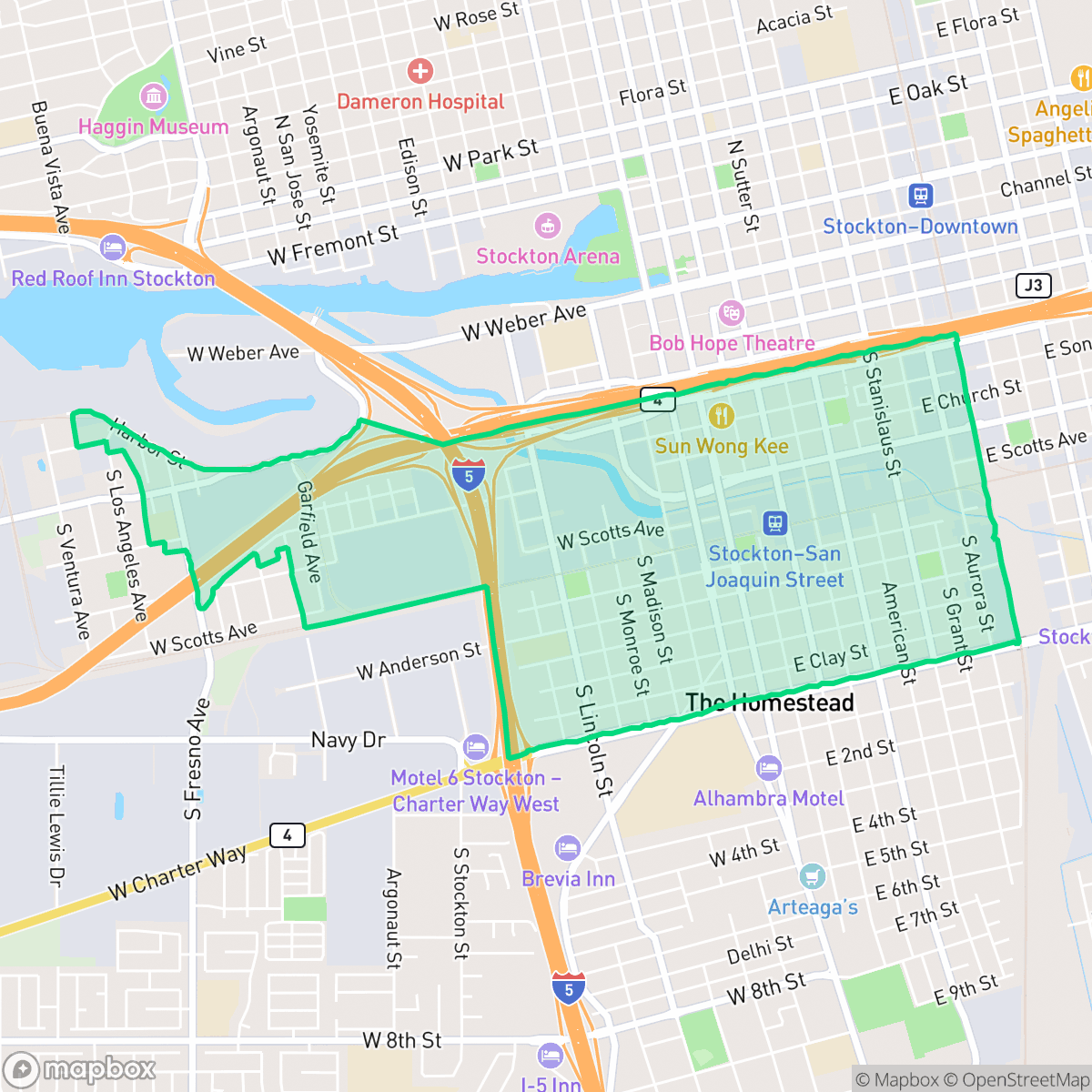
About Gleason Park
Named after Edna Gleason, Stockton’s first female city council member, the Gleason Park neighborhood developed south of downtown starting in the 1860s. Initially a working-class enclave for employees of the nearby Holt Manufacturing Company, the area is architecturally defined by modest wood-frame Queen Anne cottages built between the 1890s and World War I, often constructed in identical rows along streets like South American Street. Due to discriminatory local housing practices, Gleason Park became a historic hub for Stockton’s Asian communities, notably encompassing the "Little Manila" district around El Dorado and Lafayette Streets, alongside Japanese and Chinese businesses. The neighborhood’s fabric was significantly altered in the 1970s by the construction of the Crosstown Freeway (Highway 4), which physically severed Gleason Park from the downtown business district.
The current landscape is shaped by a mix of residential blocks and heavy industrial infrastructure. The area features a dense, low-rise grid where small, older homes sit close to one another, reflecting its origins as a worker enclave. Local landmarks like the Chansisamakidham Buddhist Temple and the Greater Faith Missionary Baptist Church provide focal points within the community, which remains lively despite the constant presence of freight traffic and warehouse operations.
Prospective residents should consider the trade-offs of living in this industrial-adjacent environment, which includes elevated noise levels from road and rail transit. The neighborhood presents challenges regarding environmental factors, including proximity to industrial sites and limited access to green space. With a school district that faces ongoing governance and academic hurdles, the area is best suited for those prioritizing proximity to employment hubs over quiet, suburban amenities.
Neighborhood Scores Across 15 Qualities
Residential structures feature varied spacing, though houses are often closely packed with minimal side-yard gaps. This level of density is slightly higher than the Stockton average, particularly near industrial edges.
Quiet residential streets allow for walking, but the lack of sidewalks on many roads makes navigation less accessible than the Stockton average. According to iHuus data, proximity to heavy industrial traffic and rail lines can also impact pedestrian safety.
Standard tract housing and high density define the area, which features simpler architectural geometries and fewer amenities than the Stockton average. According to iHuus data, the landscape includes small lots and some unpaved land near industrial edges.
Greenery and public park access are sparse throughout the area. Most vegetation is confined to private backyards, leaving few grassy verges or accessible public spaces for walking dogs compared to the Stockton average.
Residential blocks are closely integrated with large-scale warehouses and major transport infrastructure. This area presents a more industrial character than the typical Stockton neighborhood due to the presence of significant logistics centers and utility zones.
A mix of warehouse corridors and suburban streets creates a steady but subdued rhythm, sitting largely in line with the city average for activity. While various local dining options and essential services are available, much of the area remains car-dependent and quiet due to the prevalence of industrial landscape and highway proximity.
Frequent noise from nearby railroad tracks and heavy freeway traffic is a notable feature of this area. According to iHuus data, acoustic comfort in Gleason Park is lower than the Stockton average.
Air quality in this area fluctuates between acceptable and unhealthy levels, matching the general air quality found across Stockton. Sensitive groups may experience occasional concern on certain days according to iHuus data.
Heavy industrial zones, large-scale warehouses, and active rail yards are notably more prevalent here than in the rest of Stockton. Residents should be aware of proximity to an EPA Superfund site and the increased freight traffic associated with nearby logistics hubs.
Health insurance enrollment among Gleason Park residents is notably lower than the Stockton average, according to iHuus data. This indicates a higher proportion of uninsured individuals living in the area.
Voting patterns and census indicators show a predominantly liberal leaning that is more pronounced than the Stockton average, according to iHuus data.
Residents live alongside a varied mix of young professionals, families, and seniors. This demographic spread is largely consistent with the broader Stockton area.
Significant flood risk exists due to the area's location within a designated floodplain; according to iHuus data, this level of vulnerability is much higher than the Stockton average.
Address-Level Insights for Gleason Park


iHuus Neighborhood Intelligence Insights
Get address-level neighborhood insights for Gleason Park
- Street-level scores — see how individual blocks compare, not just neighborhood averages
- Micro-zone boundaries — identify quiet pockets, flood boundaries, and walkable clusters before you visit
- 15 dimensions in full — walkability, noise, air quality, school quality, insurance coverage, population age profile, urban/rural index, and more
- Boundary risk alerts — know if your address sits near a block boundary where scores drop, the kind of detail no listing will ever mention
- School insights — individual school ratings and insights, not just district-level data
- Compare before you commit — side-by-side data across neighborhoods, down to block precision
No credit card required
Compare with Any Neighborhood
| Dimension | Gleason Park | Anderson |
|---|---|---|
| 🚶 Walkabilityavg 8.33 | ||
| 🔊 Acoustic Comfortavg 3.04 | ||
| 🤫 Privacy Indexavg 5.32 | ||
| 🎨 Visual Appealavg 6.38 | ||
| 🐕 Dog Friendlinessavg 6.44 | ||
| 🗺️ Urban-Rural Indexavg 6.82 | ||
| ✨ Neighborhood Vibeavg 4.6 | ||
| 🏥 Health Insurance Coverageavg 6.72 | ||
| 🌿 Air Qualityavg 6 | ||
| 🏭 Industrial Proximityavg 7.71 | ||
| 🌊 Flood Safetyavg 5.9 | ||
| 🗳️ Ideological Leanavg 8.5 | ||
| 👥 Population Age Profileavg 4.59 | ||
| 🔥 Fire Safety | ||
| 🏫 School Quality |
Gleason Park Rankings
School Districts Serving Gleason Park
School Insights for Gleason Park
Below average outcomes; significant attendance and academic challenges.
School Insights
See what's really behind every school rating near Gleason Park
- Individual school ratings — each school's own score with outcome context, not just a district average
- Enrollment & class size data — student-to-teacher ratio and how it compares to the state average
- Full demographics breakdown — ethnicity and gender composition for every school in the enrollment zone
- Every school in the district — all schools within the enrollment boundary ranked by rating, not just the closest one
- Grade levels & benchmarks — elementary through high school, with below/above state-average flags
No credit card required