Fox Creek, Stockton
Updated · 10,131 residents
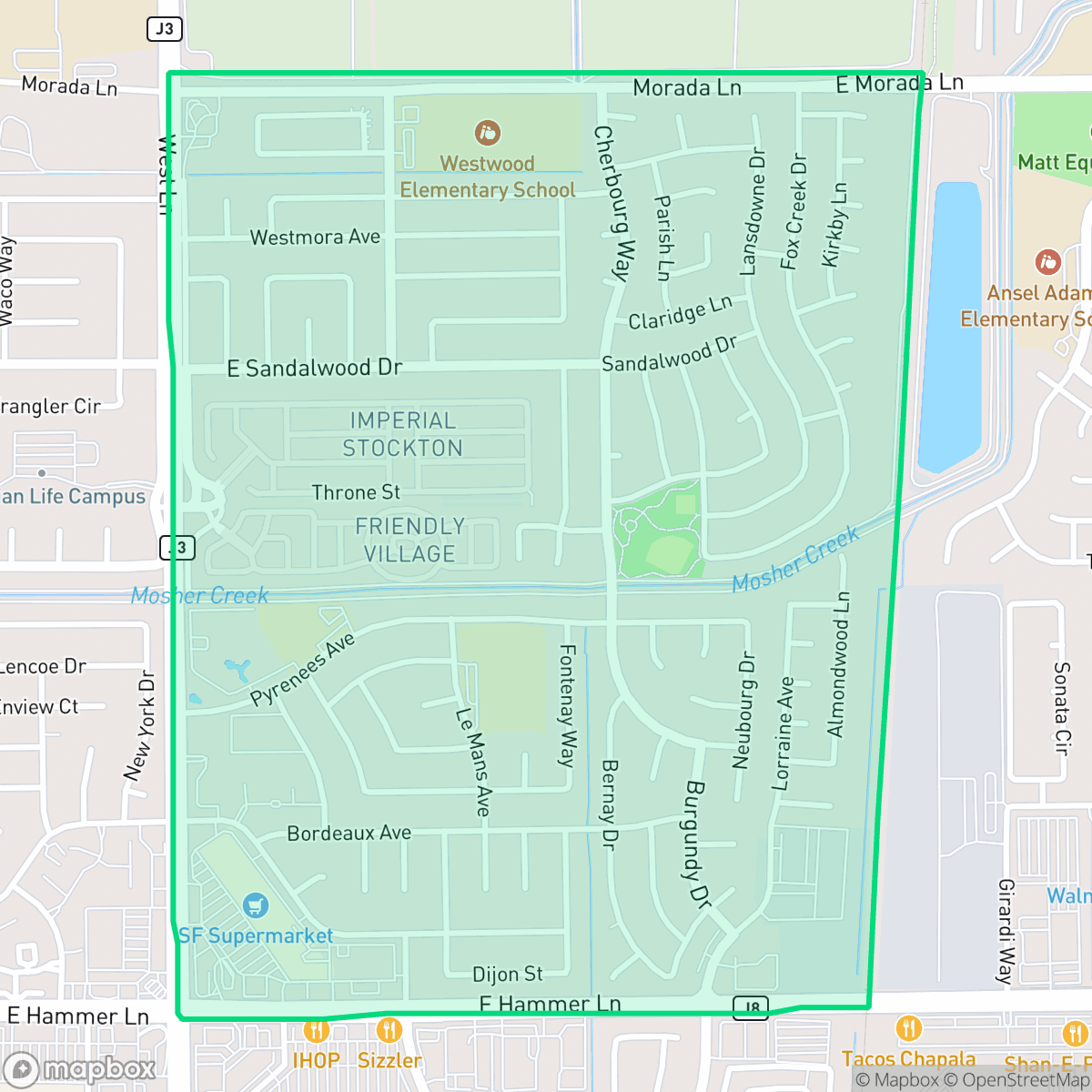
Fox Creek is a suburban neighborhood in Stockton, California, characterized by a grid-based street layout and high walkability. The area features a mix of standard tract housing and high-density residential developments, though residents should be aware of elevated noise levels from nearby road traffic.
Key Highlights
About Fox Creek
Fox Creek is a suburban enclave in Stockton that balances residential density with a structured grid system. The landscape consists primarily of uniform tract housing and mobile home parks, creating a consistent architectural aesthetic throughout the area. Residents benefit from high walkability, with sidewalks present on most residential streets, though the neighborhood is occasionally impacted by noise from arterial roads and nearby rail corridors.
The area is well-suited for those prioritizing pedestrian access to local amenities and schools, such as the nearby Aspire River Oaks Charter. While the neighborhood offers a convenient suburban lifestyle, it presents certain trade-offs, including limited privacy due to the close proximity of homes and higher-than-average noise levels. Prospective residents should also consider the varying performance of local school districts when evaluating the area for long-term living.
Neighborhood Scores Across 15 Qualities
Housing structures are closely spaced with limited buffer between neighbors, which is slightly higher than the Stockton average. According to iHuus data, the area features a mix of suburban lots and high-density layouts where homes are often positioned less than fifteen meters apart.
Continuous sidewalks and dedicated pedestrian paths make navigating residential blocks easy. According to iHuus data, the walkability in this area is notably higher than the Stockton average.
Standard tract housing and multi-family complexes define the area, featuring uniform rooflines and modest yards. This landscape offers slightly less visual variety than the Stockton average.
Continuous parkland and canal-side paths offer ample space for walking dogs away from traffic. According to iHuus data, the availability of public green space and wide trails is roughly in line with the Stockton average.
Residential areas transition into large-scale agricultural fields and open land. This provides a suburban interface that is slightly more semi-rural than the Stockton average.
Suburban streets and green spaces define this area, providing a tranquil environment that is slightly less active than the Stockton average. Most residents will find a low-density setting with limited local businesses reachable without a vehicle.
Audible disturbances from nearby railroad tracks and major freeway traffic are common in this area. According to iHuus data, acoustic comfort levels are slightly higher than the Stockton average, though noise remains a notable presence.
Air quality levels in Fox Creek typically fluctuate between acceptable and unhealthy levels. According to iHuus data, these conditions are consistent with the average seen throughout Stockton.
Residential, educational, and agricultural uses dominate the area, providing a cleaner environment than the Stockton average. While some pockets contain large warehouses or rail corridors that may increase localized noise, most of the neighborhood remains free from heavy industrial activity.
Health insurance enrollment among residents is slightly below the Stockton average, according to iHuus data. Most households in this area maintain active coverage, though access levels are somewhat lower than the broader city area.
Voting patterns and census indicators show a strong liberal leaning, which is slightly more pronounced than the average seen across Stockton.
Residents live alongside a balanced mix of young adults, families, and seniors. This age distribution is consistent with the broader Stockton area according to iHuus data.
Flood risk in this area is notably lower than the Stockton average, although some residual risk remains due to its location within a 500-year floodplain according to iHuus data.
Address-Level Insights for Fox Creek


iHuus Neighborhood Intelligence Insights
Get address-level neighborhood insights for Fox Creek
- Street-level scores — see how individual blocks compare, not just neighborhood averages
- Micro-zone boundaries — identify quiet pockets, flood boundaries, and walkable clusters before you visit
- 15 dimensions in full — walkability, noise, air quality, school quality, insurance coverage, population age profile, urban/rural index, and more
- Boundary risk alerts — know if your address sits near a block boundary where scores drop, the kind of detail no listing will ever mention
- School insights — individual school ratings and insights, not just district-level data
- Compare before you commit — side-by-side data across neighborhoods, down to block precision
No credit card required
Compare with Any Neighborhood
| Dimension | Fox Creek | Anderson |
|---|---|---|
| 🚶 Walkabilityavg 8.33 | ||
| 🔊 Acoustic Comfortavg 3.04 | ||
| 🤫 Privacy Indexavg 5.32 | ||
| 🎨 Visual Appealavg 6.38 | ||
| 🐕 Dog Friendlinessavg 6.44 | ||
| 🗺️ Urban-Rural Indexavg 6.82 | ||
| ✨ Neighborhood Vibeavg 4.6 | ||
| 🏥 Health Insurance Coverageavg 6.72 | ||
| 🌿 Air Qualityavg 6 | ||
| 🏭 Industrial Proximityavg 7.71 | ||
| 🌊 Flood Safetyavg 5.9 | ||
| 🗳️ Ideological Leanavg 8.5 | ||
| 👥 Population Age Profileavg 4.59 | ||
| 🔥 Fire Safety | ||
| 🏫 School Quality |
Fox Creek Rankings
School Districts Serving Fox Creek
School Insights for Fox Creek
Below average outcomes; significant attendance and academic challenges.
School Insights
See what's really behind every school rating near Fox Creek
- Individual school ratings — each school's own score with outcome context, not just a district average
- Enrollment & class size data — student-to-teacher ratio and how it compares to the state average
- Full demographics breakdown — ethnicity and gender composition for every school in the enrollment zone
- Every school in the district — all schools within the enrollment boundary ranked by rating, not just the closest one
- Grade levels & benchmarks — elementary through high school, with below/above state-average flags
No credit card required